The Silent Havel Stringing Bench and the Vanished Tone
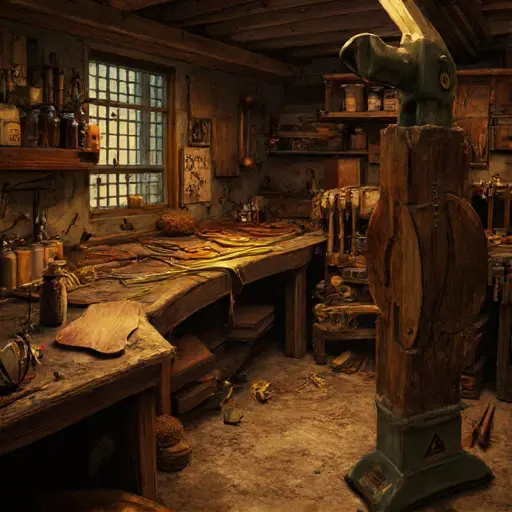
The Stringing Bench in the Attic Workshop stands perfectly still, a violin top lying where a craftsman once coaxed sound from wood. Dust covers the scattered tools lightly, as if granting the room permission to breathe without interruption. A spilled curl of maple dwells near the vise; its soft spiral holds the shape of motion abruptly halted.
More telling is the ghost mark of a missing pegbox mold on the bench’s corner, its outline crisp against the dulled grain. Nothing screams alarm, yet the stillness feels expectant, waiting for hands that never resumed.
The Workmanship of Anton Josef Havel, Luthier
Scattered clues compose an intimate portrait of Anton Josef Havel, born 1873 in Brno, raised in a modest craftsman’s family familiar with the scent of varnish and slow apprenticeships. In the Music Room, Czech sheet music rests atop a harmonium he repaired, its keys dusted but intact. A rack of half-finished ribs leans against a carved stand, their slender arcs betraying his cautious precision. He preferred Carpathian spruce for resonance, Bohemian maple for grace; both lie in measured piles along the attic wall.
Everywhere, his routine hums quietly: gouges aligned by width beside a whetstone rubbed thin at its center; scrapers arranged on a sewing stool he repurposed for sorting tonewood shims. In the Small Parlour, a violin he once restored sits on a settee, fine cracks mended with nearly invisible seams. These rooms recall a patient, almost devotional temperament—one that listened longer than it spoke.

Strain Threaded Through His Craft
Hints of difficulty emerge across the furnished corridors. In the Upper Hall Closet, a cracked mold for a viola scroll lies askew in its crate, its fracture new and sharply angled. A supplier’s invoice, folded twice, lists back-ordered woods and dramatically increased prices. A faint ring of spilled alcohol-based varnish stains the floor beneath a shawl he once used to filter dust. These details whisper of shrinking income, or claims of faulty resonance from an important patron—accusations that might haunt a man whose profession depends on trust as much as acoustics.
In the Guest Chamber, a travel case stands open, lined with felt and fitted for instruments, but no violin inside. Only shavings rest against the padding—too fine, too numerous, scattered as if shaken loose during abrupt handling. A small notebook on the washstand (kept closed by house rules) lies beneath a warped ruler, its placement hesitant, as though he hoped to return and reassess the day’s misjudgment.
A Pegbox Mark Left Unexplained
Back in the Attic Workshop, the missing pegbox mold becomes the quiet center of all doubts. Its former spot on the stringing bench shows a pale rectangle, surrounded by darker impressions where tools once rested in predictable patterns. A rasp lies across that space now, displaced in a way that contradicts Anton’s meticulous habits. On the far end of the bench, a soundpost setter drifts near a plate of unpolished spruce, the distance between them oddly suggestive of a gesture interrupted mid-thought.

One last detail hides beneath a folded polishing cloth: a violin back plate, beautifully figured, but with a subtle twist along its grain—an imperfection too slight for most to notice, yet devastating to a luthier who prized clean resonance. His final pencil marks waver near its center seam, suggesting hesitation, frustration, or perhaps a realization he could not reconcile.
No message accompanies these remnants, no definitive clue to what pulled Anton from his patient craft. The house offers only quiet echoes of intention left unresolved.
It remains abandoned still.
