The Silent Festival House in the Bright Valley
In a wide forest valley lit by a pale white overcast sky, an abandoned Victorian festival house rests in perfect stillness. The light is bright but sunless—an even, soft illumination that flattens harsh shadows and reveals every detail of the enormous structure with calm clarity. Surrounded by lush green forest and scattered flowering shrubs, the building feels less like a ruin and more like a paused celebration, preserved exactly as it was left.
The house is vast, built for gatherings rather than solitude. Its scale becomes clear immediately: multiple wings stretch outward in deliberate symmetry, each one designed to welcome movement, crowds, and shared experience.
Instead of a single entrance, the structure offers four grand porches facing different directions, as if inviting guests from every edge of the valley.
Each entrance is its own visual identity. One is framed in deep sapphire blue and white woodwork, another in faded coral red and cream, another in soft golden-yellow and ivory. These color-coded thresholds create a subtle ritual of arrival—walking around the building feels like passing through different moods of the same long-forgotten celebration.
The architecture expands outward in layers of Victorian exuberance. Towers, conservatories, glass galleries, and covered walkways radiate from a massive central hall. Though clearly built over generations, every addition respects the original palette and rhythm, resulting in a unified but richly varied composition. The building never feels patched together; instead, it feels continuously imagined.
Steep slate roofs run across the structure in complex intersections, their dark surfaces softened by time. Along the ridgelines, decorative trim alternates between blue, red, and gold accents, now weathered into muted tones. Small towers punctuate the skyline, each capped with oxidized copper domes that have shifted into turquoise and sea-green hues.
Tall stained-glass windows line the upper floors, their panes still intact and glowing faintly with jewel-like color. Even under the overcast sky, these windows cast soft reflections of ruby red, amber yellow, cobalt blue, and emerald green onto nearby walls and floors, as if the house still remembers the light it was designed to celebrate.
Inside the festival house, space and color dominate. Rooms are vast, built for gatherings rather than privacy, with ceilings that rise high above polished wood floors. Everything is visible through the glass and open corridors, suggesting a continuous flow between interiors and courtyards.
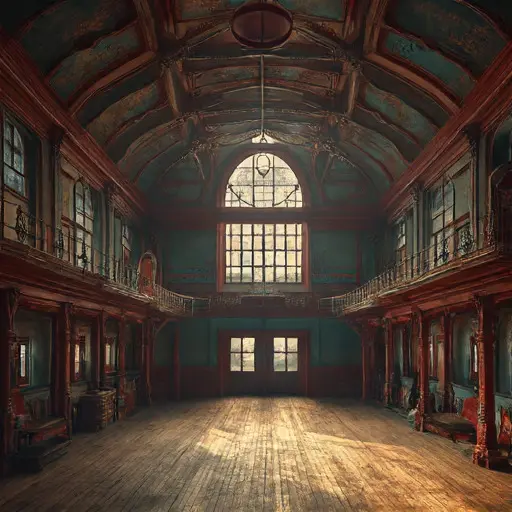
The central hall acts as the emotional core of the structure. It is a monumental open space, surrounded by arches and balconies that allow sightlines across multiple levels. Light filters through stained glass above, scattering gentle color across cream walls, mint-green trims, and faded rose ceiling panels.
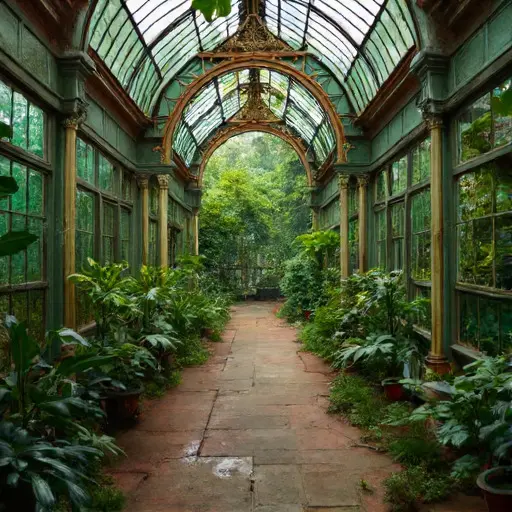
Beyond the central hall, the building branches into themed wings. One wing contains long banquet rooms with rows of wooden tables and pale ivory table settings. Another opens into a glass conservatory where once-lively gatherings likely spilled into garden space. Covered walkways connect everything in a continuous loop of movement and visual rhythm.
The upper levels are especially striking. Long balconies overlook the central hall, while narrow corridors weave between towers and galleries. From above, the entire structure feels like a living diagram of celebration—paths designed for flow, pause, and reunion. Every corner reveals another vantage point, another framed view of the valley and forest beyond.
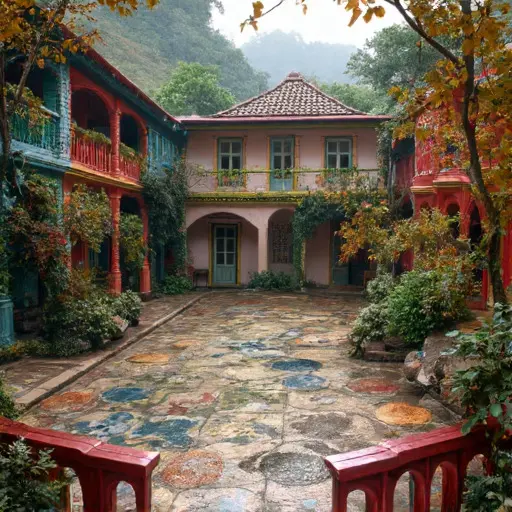
Outside, the grounds continue the same language of celebration. Wide courtyards are paved with intricate stone mosaics forming circles, stars, flowers, and geometric pathways in blue, red, cream, and gold. Painted benches remain positioned as if awaiting guests who simply stepped away for a moment.
The surrounding forest is alive and vibrant, never threatening the architecture. Bright green foliage, clusters of red and yellow flowers, and soft purple and blue ground cover grow naturally around the estate. The house does not resist the forest; instead, it sits comfortably within it, like a memory embedded in nature.
There is no sense of decay here. No collapse, no darkness, no abandonment in the tragic sense. Instead, the festival house feels like a paused experience—an enormous, joyful structure that once hosted countless gatherings and now waits in quiet dignity beneath a soft white sky.
It remains a place where architecture, color, and memory converge into something strangely timeless: a Victorian celebration frozen not in ruin, but in gentle expectation, as if the next arrival is only slightly overdue.