The Silent Darvishi Cloakroom Vestibule Where the Pattern Turned Dim
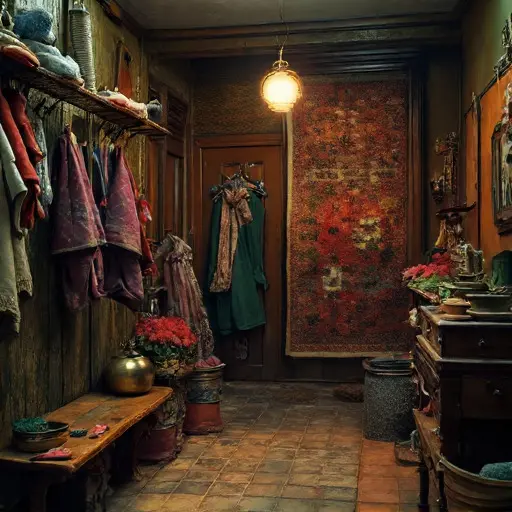
The cloakroom vestibule holds warmth reduced to faint echoes of dye and wool. Shadows settle across the coats and screens, catching the stillness of a task abandoned at the edge of resolution.
A Restorer’s Life Bound to the Pattern’s Pulse
Farid Reza Darvishi, born 1871 in Shiraz, restored modest carpets for passing collectors.
A woven scarf from his sister Laleh cushions his combs and spindles. Farid worked by dawn washing fibers, by afternoon aligning knots, and by night correcting faded borders under calm lamplight. His limited means show in reused dye jars and Persian-script notes tucked beneath muslin wraps.
Quiet Labor Woven Through a Narrow Vestibule
A border motif pinned to the folding screen curves unevenly, redrawn twice. Wool skeins rest near a bowl whose dye has thickened to a sluggish glaze. A comb set shows worn teeth, one bent at its tip. On the bench, a damp cloth carries the ghost of a once-bright medallion. Even the coat hooks lean with the weight of rolled carpets that whisper of tasks paused during a quiet dispute between eye and hand.
Strain Drifted into Fiber and Shadow
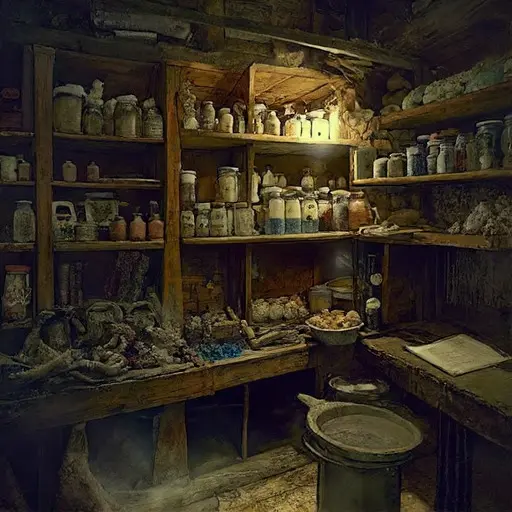
Behind a row of hanging coats lies a returned note: “inconsistent border.” A corner fragment sags on the bench, its knotted edge strained. The stool stands skewed toward the hallway, suggesting Farid rose repeatedly, troubled by focus slipping from fine detail. A dye brush, typically tapered to precision, shows frayed bristles from hurried rinsing. A thread reel lies overturned, unwound in a loose arc.
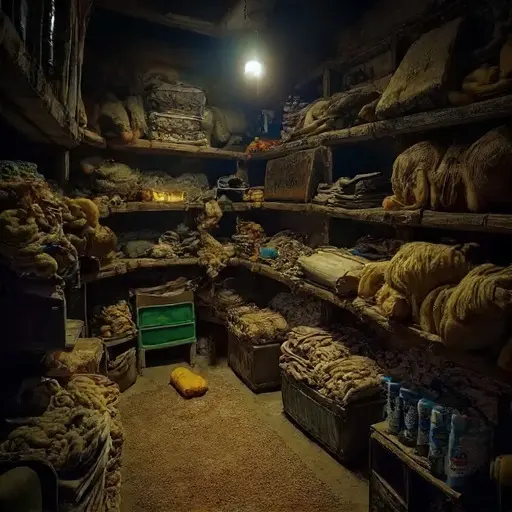
Returning to the cloakroom vestibule, one final sign remains: a flawless knot sample beside the faded fragment—precision and doubt resting quietly together.
The house remains abandoned.
