The Silent Burden of Harrowmere House
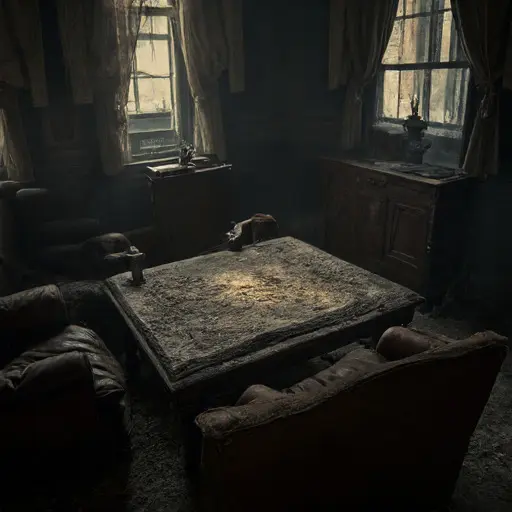
The atmosphere within Harrowmere House was less a cold quiet and more a perpetual suspension of breath. Crossing the threshold into the Reception Hall, one immediately encountered the cold, heavy reality of the forgotten: the air was still, thick with the dry scent of disintegrating fabric and the sharp tang of long-set dust. The grand staircase, with its dark, heavily carved banister, was shrouded in a palpable gloom.
The house was a complete, intact archive of a personal tragedy, its events recorded not in ink, but in the final, untouched arrangement of its furniture and personal possessions.
Eleazer Vance: The Haunted Publisher
The life that defined Harrowmere House was that of Eleazer Vance, a Victorian publisher whose success was built on mass-market serialization—cheap, popular fiction. His temperament was inherently anxious, driven by the belief that his success was purely accidental and could be revoked at any moment. He married Josephine, a talented artist whose vivid spirit offered a brief counterpoint to his neuroses. They had one son, Clement.
Eleazer’s private paranoia is etched into the very architecture of his Personal Office. This room, located in the quietest, darkest part of the house, is dominated by heavy, iron-clad safes built into the walls, far exceeding the security needs of his business. On his large, roll-top desk, beneath a scattering of old printing proofs, lies a small, leather-bound notebook—his Fear Journal. It contains not business plans, but daily, meticulous tallies of his perceived business rivals, market downturns, and imagined financial ruin. His true, private profession was the terrified calculation of failure.
The Conservatory’s Palette of Grief
Josephine Vance found her spirit slowly crushed by Eleazer’s controlling, fearful nature, which demanded her life be as predictable as his spreadsheets. Her sole, defiant space was the Conservatory, a glass and iron structure filled with tropical plants she cared for meticulously.
The turning point of her personal tragedy is revealed here. On her small, cast-iron work table, alongside a scattering of dried, brittle plant clippings, lies her Watercolor Box. The box is open, revealing blocks of dry, cracked pigment and a single, stiff brush. Hidden beneath a layer of stained tracing paper is her final, uncompleted work: a detailed botanical illustration of a poisonous foxglove plant. A small, separate piece of paper is tucked into the box, containing a two-line note from Eleazer, dated 1898, tersely forbidding her from sending Clement, their sickly son, to the seaside for his recovery, citing the unnecessary cost and risk. Clement died in the house that same year.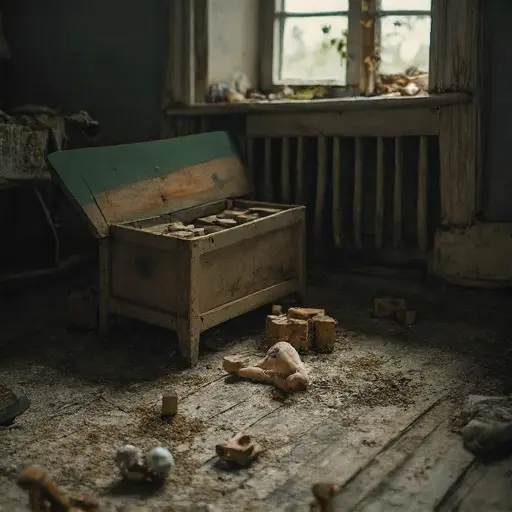
The Proof in the Attic Safe
Josephine, broken by the loss of her son and the realization of her husband’s cold, self-preserving calculation, left the house within a week of Clement’s death. She left behind only a terse note on the Main Hall Table stating, “The house is yours. So is the ruin.”
Eleazer did not pursue her; he could not bear the public scandal. He continued his publishing business for a brief period, but his paranoia escalated into complete mental withdrawal. The final, fatal turning point is concealed in the West Attic, a low, hot space filled with crates of unsold, early edition novels. Hidden behind a heavy stack of discarded canvas backdrops is a small, portable Iron Deed Box. Inside, along with the title to Harrowmere House, is a single, official, sealed envelope. It contains Clement’s Death Certificate and a meticulously folded, handwritten letter from the local physician, confirming that the boy’s life could have been saved with proper, prolonged seaside air treatment. Eleazer had preserved the evidence of his own guilt.
Shortly after sealing the deed box, Eleazer Vance locked every door and window in the house and walked away in 1901, leaving the property to be seized for unpaid taxes. He vanished from the public record. Harrowmere House stands today, utterly full, its luxurious but stifling interiors an archive of a profound, forgotten tragedy, where the publisher’s fear ultimately wrote the final, silent chapter.
