The Secret Compass of Al-Hakim’s Navigation Chamber
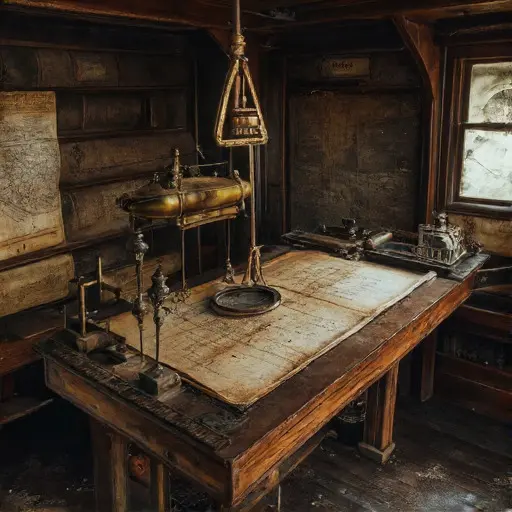
The Navigation Chamber hums with quiet precision. Here, the compass directed every movement: lines drawn, positions calculated, tides and stars noted. Instruments rest mid-use; maps remain unfolded.
The absence of activity fills the room with suspended intention, each object preserving the memory of exacting study interrupted. Even the brass fittings of the instruments hold fingerprints frozen in place, as though time itself paused along with the work.
Cartography in Practice
This chamber belonged to Jamal al-Hakim, cartographer (b. 1874, Alexandria), trained in Ottoman and Mediterranean naval academies. His skill is evident in meticulously plotted coastlines, careful star charts, and finely labeled maps. A small note pinned to a shelf references his son, Faris al-Hakim, reminding him to “update the longitude markers for the Red Sea survey.” Jamal’s temperament was disciplined, methodical, and analytical; ambition lay in creating accurate maritime charts for private patrons and the regional navy, with every calculation intended for precision navigation.
Maps Left Mid-Plot
On the chart table, a partially drawn map shows coastline outlines and compass bearings incomplete. The compass sits nearby, dust settling in its brass casing. Ink-stained dividers and rulers remain in place, evidence of repeated plotting abandoned mid-measurement. Small annotations in Arabic and Greek hint at observations never fully recorded, and open logbooks show tide calculations left half-finished. A faint pencil sketch of waves and currents remains, untranscribed to the chart, frozen in mid-study.
Signs of Decline
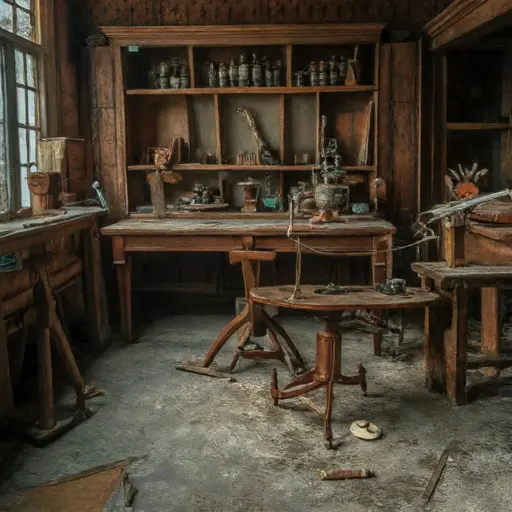
Sketches, charts, and logbooks reveal repeated revisions; positions recalculated and measurements erased. Jamal’s decline was physical: worsening tremors and failing eyesight hindered delicate plotting. Each unfinished compass reading embodies halted intention, meticulous study suspended indefinitely by bodily limitation. Even the small notes in the margins, detailing celestial observations, lie half-written, untouched.
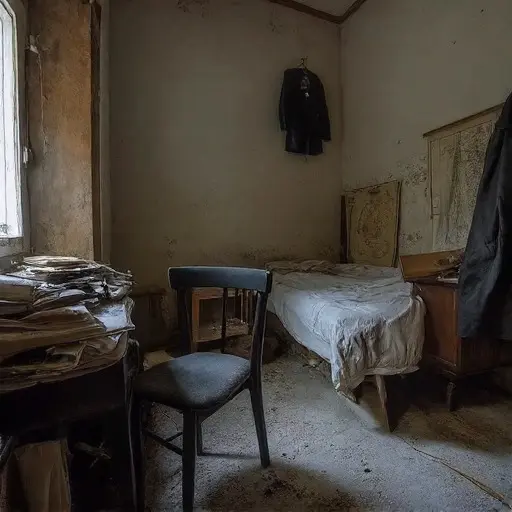
In a drawer beneath the table, Jamal’s final compass remains poised over a half-charted map, ink-stained and idle.
No record explains his disappearance. No apprentice returned to continue his work.
The house remains abandoned, its instruments, charts, and compass a quiet testament to interrupted cartography and unresolved devotion.