The Seabridge House Left Vacant After Headland Erosion Decline
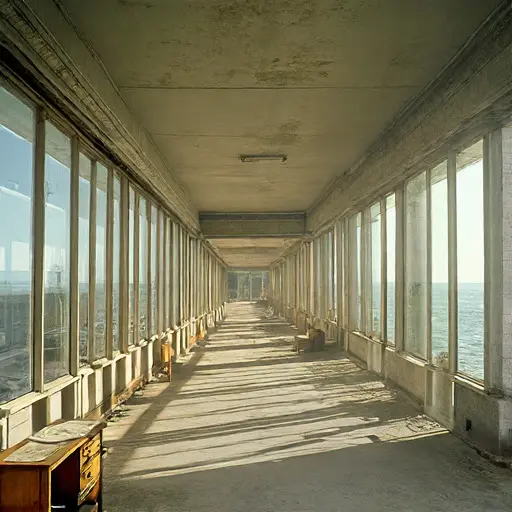
Seabridge House was completed in 1902 on a long, narrow coastal headland where dense woodland abruptly gave way to exposed cliffs and open ocean. Designed by the Halverton family as both residence and coastal observation station, the structure was deliberately aligned parallel to the shoreline, forming a continuous ribbon of architecture anchored against wind, salt spray, and shifting maritime light. Rather than a centralized form, the house extended horizontally, emphasizing movement along the coast rather than inward enclosure.
The exterior was composed of alternating layers of pale limestone and richly glazed terracotta panels. The limestone surfaces appeared weather-softened in tones of ivory, pale shell pink, and cool chalk gray, while terracotta introduced bold but weather-muted bands of cobalt blue, forest green, sun-baked orange, and muted ruby red. These horizontal strata wrapped continuously across the building, subtly shifting at structural transitions and reinforcing the sense of linear progression along the headland.
Inside, the Halverton family organized life around coastal monitoring and maritime observation. Thomas Halverton documented wind patterns and shipping routes, while his wife Eleanor maintained correspondence with harbor authorities and managed household records. The long central spine of the house functioned as both corridor and workspace, connecting a sequence of glass pavilions that served as observation points overlooking different sections of sea and cliff.
Early financial strain
By the late 1920s, coastal shipping coordination became increasingly centralized through larger port authorities, reducing the need for independent headland observation residences. As institutional systems absorbed maritime oversight, the Halverton family’s role diminished. Maintenance of the elongated structure became increasingly difficult due to constant exposure to salt spray and wind-driven erosion. Copper flashings along the roof began oxidizing rapidly into turquoise-green patina, and sections of terracotta paneling lost their vibrancy under persistent weathering.
Gradual decline in the household
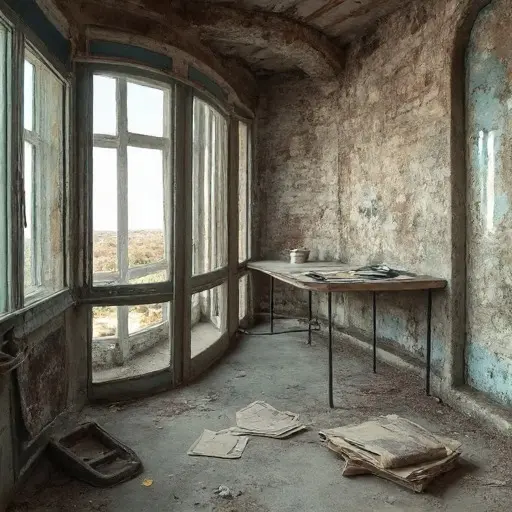
As financial pressure increased, entire glass pavilions were gradually closed off due to structural vulnerability. Wind exposure made maintenance increasingly costly, and sections of the house closest to the cliff edge were abandoned first. Interior circulation became concentrated within the central spine, while outer observation rooms fell into disuse. Salt-laden air continued to infiltrate the structure, accelerating wear on both stone and metal components.
Family members began relocating to inland towns and port cities where administrative maritime roles had become more stable and centralized. By the early 1940s, only partial occupancy remained, primarily for archival storage and occasional inspections.
Final abandonment phase
By 1946, Seabridge House was no longer fully inhabited. Utility services were reduced and eventually discontinued due to persistent maintenance challenges and financial arrears. Without upkeep, wind and salt accelerated deterioration across the entire structure. Glass panels became clouded or fractured, and iron supports weakened under corrosion. The long horizontal spine remained intact but increasingly exposed, with sea mist flowing freely through its length.
The house left empty
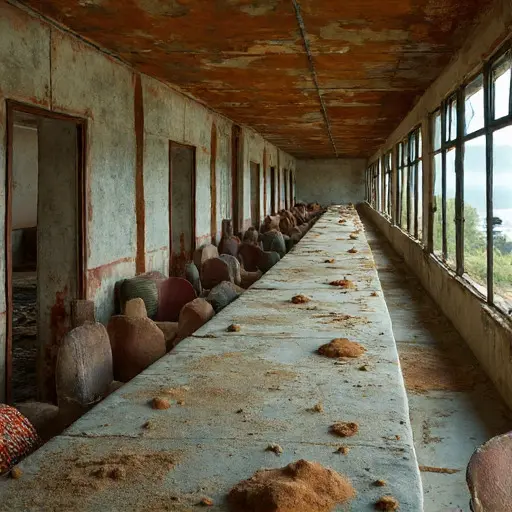
By the late 1940s, no formal ownership or maintenance of Seabridge House remained. Legal responsibility for the estate lapsed as heirs failed to return or assume control. No restoration was undertaken, and no institutional transfer occurred. The house remained stretched along the coastal headland, slowly deteriorating under relentless wind and salt spray, its once-vibrant horizontal bands fading into the shifting tones of sea, stone, and sky.