The Sandstone Estuary House Resting Between Tide and River
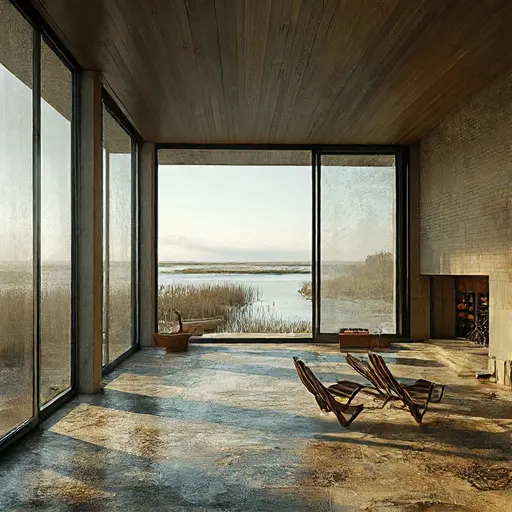
The Sandstone Estuary House stood at the meeting point of freshwater currents and tidal salt channels, where braided waterways cut through smooth mudflats and reflective pools. The structure was small and horizontally grounded, designed not to dominate the landscape but to sit within its shifting geometry. Built from pale sandstone blocks interspersed with narrow vertical inlays of dark slate, the façade carried a quiet striped structure that echoed both geological layering and architectural restraint.
Its composition was asymmetrical but carefully balanced. One wing extended slightly closer to the water, supported by low stone buttresses that disappeared into the soft, unstable bank of the estuary. Opposite this, the house receded into a sheltered courtyard enclosed by partial brick walls, forming a gentle wraparound geometry that embraced the water channels without enclosing them.
Windows were arranged in measured spacing, but each opening varied subtly in proportion. Some were tall and narrow, others wider with softened corners, creating a quiet irregularity that prevented mechanical repetition. Their frames were made of weathered iron, now a muted bronze-gray, and the glass held faint ripples that distorted the estuary beyond—reeds and sky appearing slightly offset, as if the house were observing the world through shifting layers of water.
A modest veranda ran along the water-facing side, supported by short, stout columns resting on stone plinths embedded in the mudflats. The timber had weathered into a silvery drift tone, smooth from salt air and sun exposure. Its railings were simple and functional, shaped by use rather than ornament, reinforcing the house’s practical relationship with its tidal environment.
The roof was a low, continuous slate plane with a shallow pitch, its tiles varying gently from deep graphite to soft green-gray. A single chimney rose toward the inland side of the structure, its brick softened but structurally intact, marked by faint mineral streaks carried by coastal winds over many years.
The surrounding estuary environment remained in constant, quiet motion. Reeds grew in thin, elegant clusters that traced the water channels like brushstrokes across a living surface. Small tidal pools mirrored fragments of sky and architecture, while the mudflats shifted in sheen between silver and copper depending on light and tide. Nothing in the landscape was static, yet nothing felt chaotic.
The interior shaped by tidal light and reflection
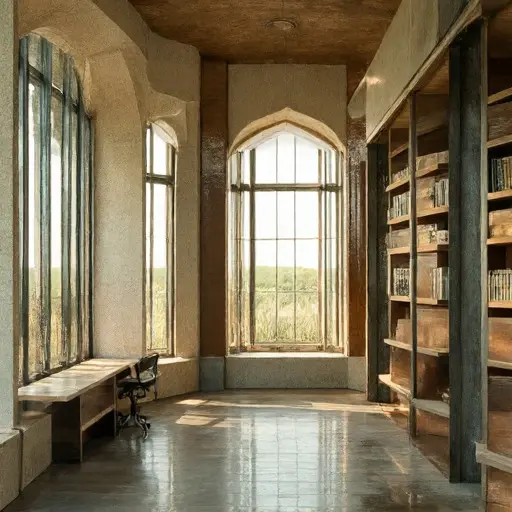
As time passed, the house’s decline was not marked by sudden collapse but by gradual reduction in human presence. Seasonal visits became rare, then intermittent, until the structure was left without consistent occupation. The estuary itself remained unchanged in its slow rhythm of flow and sediment shift, while the house held its position at the edge of this movement.
Despite abandonment, the building retained its structural coherence. The sandstone blocks remained tightly fitted, the slate roof continued to shed water cleanly, and the veranda held firm against tidal influence. Only the absence of daily activity marked its transition into stillness.
Final equilibrium between architecture and tide
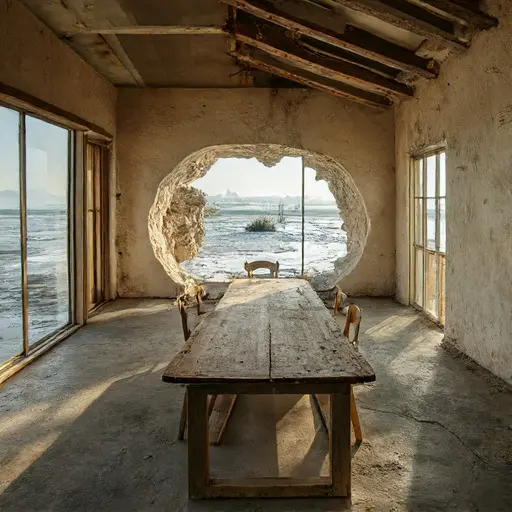
No restoration or return followed the final departure of its inhabitants. The Sandstone Estuary House remains at the edge of shifting water and mud, intact and quietly weathered, continuing to reflect the braided channels in its windows without interruption, renewal, or change.