The Sandstone Bridge House Resting Above a Slow River
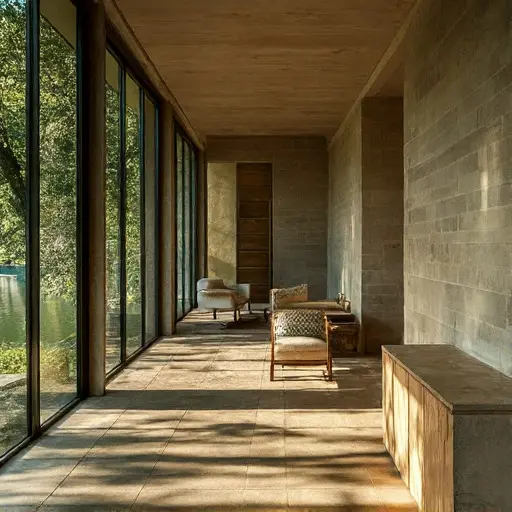
The Sandstone Bridge House stood at the end of a narrow stone bridge that crossed a slow river braided with glassy reflections of sky and foliage. The structure was small in footprint but rose with a quiet confidence in layered tiers, its mass carefully balanced above the water’s reflective surface. Built from warm, pale sandstone interwoven with bands of deep forest-green glazed brick, the house achieved a subdued contrast that shifted gently with light rather than asserting itself through color.
The façade was composed like a restrained architectural stack: a grounded main volume anchored directly to the bridge terminus, a slightly recessed second level that softened the vertical rise, and a subtly curved attic tier that tucked inward beneath the roofline. Rather than relying on decorative excess, the Victorian character emerged through controlled geometry—arched window heads carved into stone, shallow pilasters that emphasized vertical rhythm, and cornices that were integrated into the structure rather than applied as ornament.
Windows were tall and evenly spaced, yet deliberately varied in depth. Some sat flush with the sandstone surface, while others were set deep into shadowed reveals, producing a shifting visual rhythm as one moved along the bridge approach. The frames were darkened bronze, aged into a muted brown-black patina, and the glass held faint distortions that bent reflections of the river into soft, fluid abstraction.
A modest enclosed porch extended toward the bridge itself, constructed from slender iron framing and pale glass panels arranged in a strict geometric grid. It resembled a lantern suspended at the threshold of the house—lightweight in appearance yet structurally precise. Above it, a single balcony wrapped partially around the second floor, its railing composed of simple vertical bars, offering no ornament beyond functional clarity.
The roof was a smooth, continuous slate surface that sloped gently in a unified plane, interrupted only by a low chimney positioned slightly off-center. The slate tiles shifted between cool gray and muted moss green, echoing the tones of the surrounding riverbank and reinforcing the house’s subdued integration with its environment.
The river below moved slowly, braided into multiple narrow channels that reflected sky and foliage in layered, shifting fragments. The stone bridge itself was worn smooth by time but remained structurally sound, its surface forming a quiet, stable threshold between land and water. Reeds along the banks stood in thin, disciplined clusters, as if shaped by the same restraint that defined the architecture.
The interior suspended above water and stone
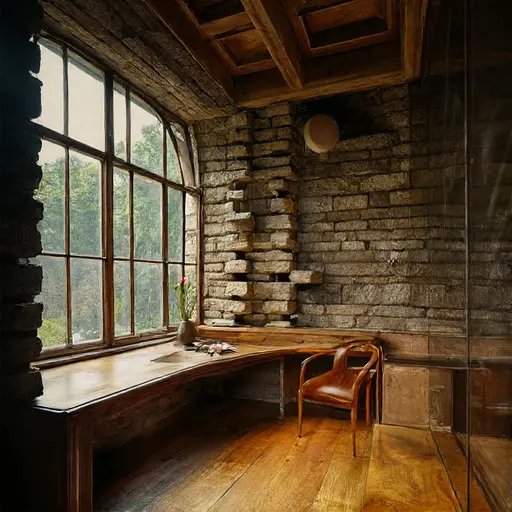
The decline of the Sandstone Bridge House was not abrupt but gradual, marked by diminishing presence rather than structural failure. The original occupants reduced their crossings over the bridge over time, first seasonally, then sporadically, until visits ceased entirely. Maintenance slowed in parallel, yet the building’s disciplined construction preserved its form with remarkable resilience.
The river continued its slow, braided movement beneath the bridge, indifferent to human absence. Light shifted across sandstone and glazed brick without interruption, and the structure remained visually intact, as if awaiting a return that no longer had a defined point in time.
Final stillness between bridge, water, and memory
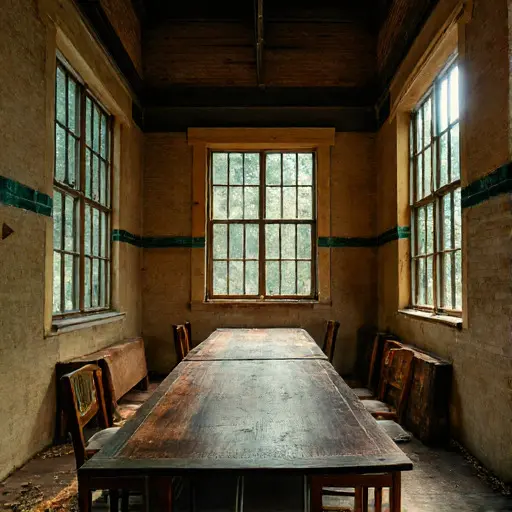
No restoration or reoccupation followed the final departure of its inhabitants. The Sandstone Bridge House remains at the end of the stone bridge, intact and quietly weathered, continuing to reflect the slow river below without interruption, return, or change.