The Rotating Hollow House Resting Between Curved Hills
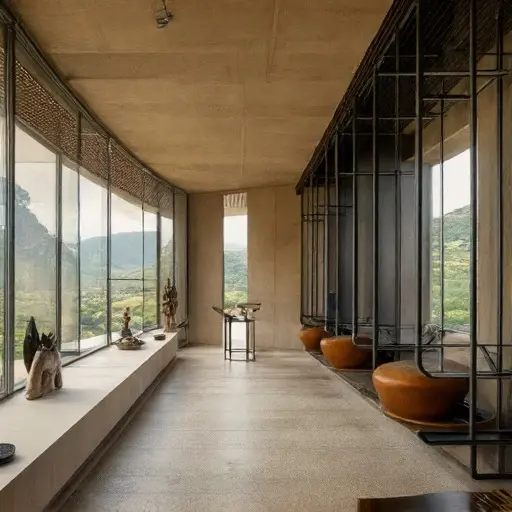
The Rotating Hollow House stood within a quiet natural basin formed by rolling hills that curved around it like slow, softened waves. The landscape created a gentle enclosure open only to the sky, giving the impression that the house existed in a contained yet expansive pocket of land. Built from pale sandstone interwoven with thin vertical ribs of dark volcanic stone, the façade carried a subtle rhythmic texture—more like a carved instrument than a conventional wall.
The structure was defined by a barely perceptible rotational geometry. Each level was offset slightly from the one below, creating a restrained spiral effect when viewed from a distance. This shift was not dramatic or destabilizing; instead, it introduced a quiet sense of motion frozen into architectural form, as if the building had settled into a long, gradual turn and simply stopped there.
Windows were tall, narrow, and deeply recessed into the façade. Their frames were made of aged iron, softened into a matte charcoal tone by time and weather. The glass remained unusually clear but carried a faint waviness that bent reflections of the surrounding hills into layered, watercolor-like distortions. Some windows appeared in pairs, others stood alone, yet all followed a strict vertical logic that preserved the coherence of the overall design.
On one side of the house, a restrained Victorian conservatory extended outward. It was constructed entirely from thin iron ribs and clear glass panels arranged in a precise geometric grid. The structure felt light and skeletal, almost temporary in appearance, as if it could be dismantled without disturbing the main building. Inside, the conservatory held only traces of its former use—empty shelving and faint impressions where potted plants once stood.
The roof formed a continuous slate surface that subtly twisted along its length, echoing the rotational shift of the structure below. The tiles varied in tone from cool gray to muted slate blue, catching daylight in soft gradients rather than sharp highlights. A single chimney rose near the rear corner, slightly angled but structurally intact, its presence reinforcing the quiet asymmetry of the design.
The surrounding hills were covered in fine, uniform grass that flowed in slow directional patterns shaped by wind. Rather than forming clear paths, small stone markers appeared scattered across the terrain at irregular intervals, suggesting forgotten movement or passage without enforcing direction. The landscape felt open yet subtly organized by invisible forces.
The interior shaped by slow architectural rotation
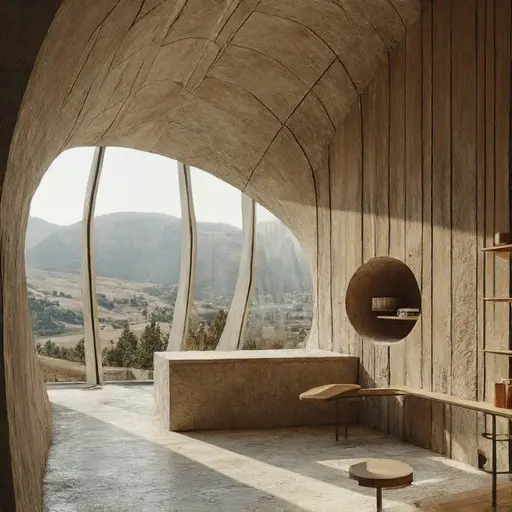
As time progressed, the house experienced decline not through collapse but through gradual absence. Occupancy became intermittent, then rare, until the structure was ultimately left without regular presence. The surrounding hills remained unchanged in their slow, wind-shaped movement, while the house preserved its structural integrity.
Despite abandonment, the building retained a strong sense of coherence. Stonework remained tightly fitted, the roof maintained its continuous form, and the conservatory structure stayed intact, though emptied of life. The rotational geometry of the house remained perceptible even in silence.
Final stillness within a gently turning geometry
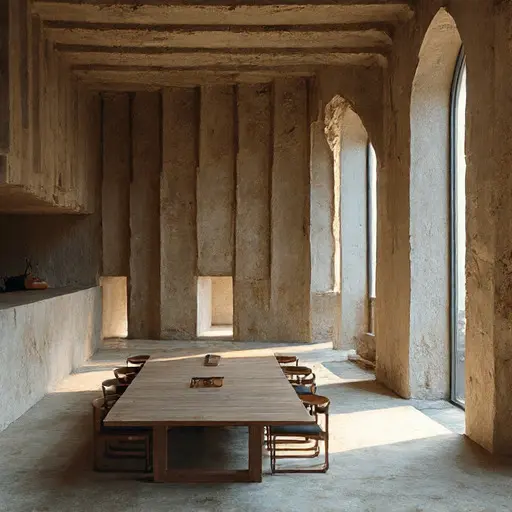
No restoration or return followed the final departure of its inhabitants. The Rotating Hollow House remains within its grassy hollow, intact and quietly weathered, continuing to hold its subtle spiral geometry as the hills move gently around it without interruption, change, or witness.