The Riverbend Segments House
A solitary Victorian residence sits at the edge of a wide river bend within a mixed deciduous forest, where pale birch trunks stand out against dense green undergrowth and the water moves in slow, reflective sheets. The environment is calm and physically grounded, with soft overcast daylight flattening harsh contrast and giving the entire scene a steady, natural realism. Nothing feels stylized or theatrical—only quietly persistent, as if the landscape has settled into long-term stillness.
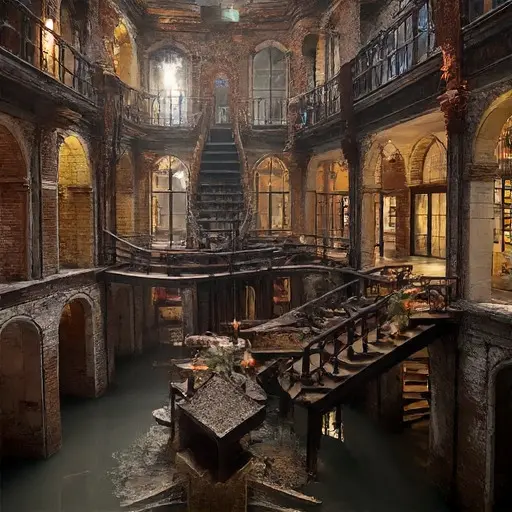
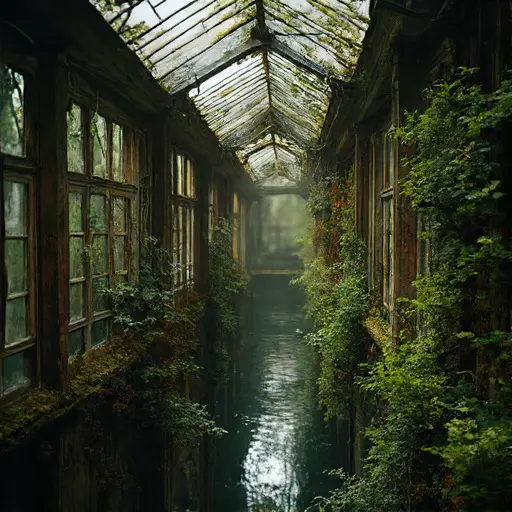
The house is structurally real but architecturally unconventional in its spatial organization. Rather than forming a single unified mass, it is composed of staggered Victorian segments linked together through enclosed glass corridors and elevated timber bridges.
These connections step outward toward the riverbank in measured but non-linear progression, creating a subtle sense of drift across the terrain. Each segment remains individually coherent, but their arrangement introduces a gentle irregular rhythm to the overall silhouette.
Materially, the building remains firmly Victorian in character. Primary walls are built from faded burnt umber brick, softened by age and moisture. These are interspersed with cream stucco panels and dark-stained timber cladding, all weathered into a cohesive but varied surface language. The transitions between materials are clean and intentional, reinforcing the idea of phased construction rather than decorative mixing.
The roof system is complex yet structurally believable. Steep slate gables in deep graphite intersect with curved rooflets made from oxidized green copper, while occasional flat transitional sections function as small, overgrown terraces. Moss collects along joints and seams, and thin saplings have taken root in gutters and roof edges, growing naturally without overwhelming the architecture. The result is a building that feels lightly reclaimed by nature while remaining fundamentally intact.
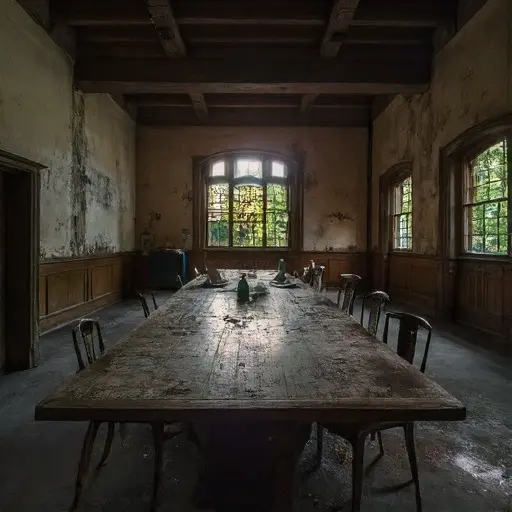
The surrounding yard is broad, uneven, and shaped by both human intention and gradual forest encroachment. A leaning greenhouse of fractured glass stands near the rear, partially filled with climbing vegetation and broken terracotta pots scattered across the soil. Nearby, a long outdoor wooden table remains in place, weathered and softened by rain, surrounded by mismatched chairs that appear abandoned mid-gathering but never cleared away.
A narrow stone dock extends toward the river, where a small rowboat lies overturned—half in shallow water, half on pebble shore—its surface dulled by exposure. Two trees support a diagonal laundry line strung unevenly across the yard, holding muted fabrics in earth tones that shift faintly with the breeze. A rusted iron gate stands open but intact, framing a path that disappears into the forest without obstruction.
The atmosphere is quiet, stable, and evenly lit, with soft light reflecting off water and filtering through trees. The surreal quality exists only in the architectural logic of expansion and connection, while all materials, lighting, and environmental behavior remain grounded, tactile, and entirely believable within a realistic forest riverbend landscape.