The Ridgeway Linear Residence Left Fragmented Across Hillside Fields
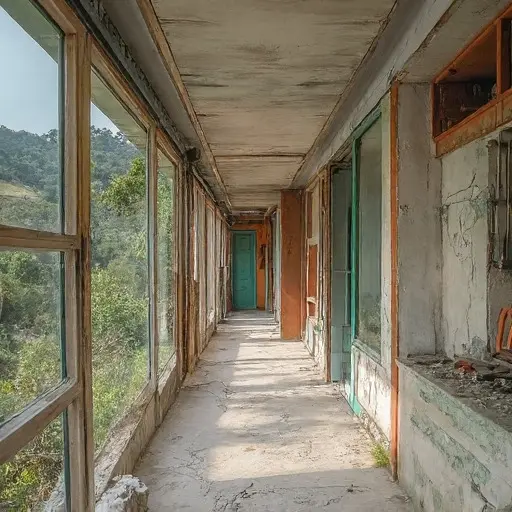
The Ridgeway Linear Residence was constructed in 1972 as part of a rural housing development program intended to test long-form linear architecture adapted to sloped agricultural land The design proposed a continuous stepped residential ribbon that followed the natural incline of the countryside hillside rather than resisting it, allowing habitation to extend along elevation contours in a modular but connected sequence of volumes Each segment was built using weathered white concrete shear walls for primary load resistance, reinforced by an exposed steel exoskeleton that carried tensile forces across displaced structural sections Reclaimed brick infill panels were inserted between frames to provide thermal mass and visual continuity, while elongated glass corridors connected separated living volumes to maintain circulation along the entire length of the structure The residence was originally occupied by multiple small households distributed along its length, each adapting to the subtle elevation changes and elongated spatial arrangement that defined daily movement within the building
Gradual Misalignment and Rural Depopulation
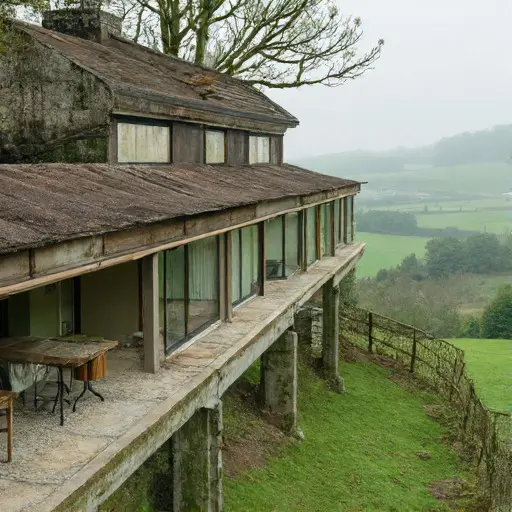
By the late 1980s the Ridgeway Linear Residence began to experience gradual abandonment as rural depopulation reduced long-term occupancy across the entire hillside region Agricultural consolidation led to the migration of residents toward centralized towns, leaving extended linear housing systems increasingly impractical to maintain Maintenance of the continuous structural ribbon required coordinated repair across multiple displaced volumes, as even localized degradation affected load distribution along the steel exoskeleton Over time, sections of the residence were vacated sequentially rather than simultaneously, creating a pattern of partial abandonment in which some modules remained occupied while adjacent ones were left empty The elongated corridors that once facilitated movement between households became underused transitional spaces, and eventually fell into disrepair as glass panels accumulated dust and moisture infiltration worsened visibility By the early 1990s only isolated segments of the structure remained intermittently inhabited, primarily near access roads, while the majority of the residence stood silent but structurally intact across the hillside
Final Abandonment and Rural Stillness
<img src=”https://beyondvisit.
com/wp-content/imagecontent/uploads/abandoned victorian house 12393343.webp” alt=”” />
By 2001 the Ridgeway Linear Residence was officially declared uninhabitable following structural inspections that documented widespread material aging, progressive joint fatigue in the steel exoskeleton, and extensive environmental encroachment along lower hillside sections No demolition was carried out due to the extreme length of the structure and its integration into multiple privately and municipally managed land parcels, making coordinated removal impractical Restoration efforts were deemed economically unfeasible given the scale of required reinforcement across the entire stepped ribbon system Ownership responsibilities were gradually dissolved as rural administration consolidated land management policies, leaving the structure outside active residential planning The residence was left in place as a passive architectural trace embedded into the hillside, slowly weathering under consistent overcast conditions while vegetation reclaimed its base and access routes
The Ridgeway Linear Residence remains stretched across the quiet countryside slope as a silent fragmented ribbon of abandoned habitation Its displaced volumes, exposed steel framework, and elongated glass corridors persist in structural coherence despite complete vacancy No return has ever occurred, and no restoration has been attempted The structure endures as a long, fading architectural line within an ordinary rural landscape, slowly merging with grass, soil, and time under soft diffused daylight