The Ridgefall House Left Empty Above the Ravine
The Ridgefall House stood along a narrow forest ridge overlooking a winding ravine where dense conifers, moss-covered stone, and steep terrain defined the landscape. Built in 1912 as a combined residence and geological observation post, the structure was designed to engage directly with the verticality of the land. Its compact but vertically expressive form followed the ridge line, stepping downward in staggered extensions that mirrored the natural slope beneath it.
The building’s composition emphasized layered material contrast. Pale chalky limestone formed the primary structural mass, while dark brick bands introduced horizontal grounding across the façade. Inset panels of painted metal cladding added reflective variation, shifting between faded steel blue and desaturated bronze depending on light and moisture conditions. Over time, these materials weathered into a subdued but still legible stratified surface.
The roof was a complex asymmetrical arrangement of multi-gables, each ridge aligned with the stepped volumes below. Slate tiles aged unevenly into charcoal black, storm gray-blue, and occasional green patina in shaded sections. A narrow chimney, slightly offset from the central axis, rose above the roofline in darker, more saturated brick.
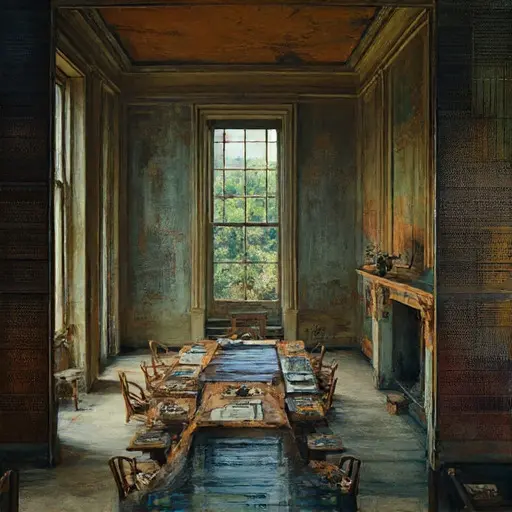
Inside, the house functioned as both family dwelling and field observation site. The central vertical volume contained shared living and analytical spaces, while the staggered side extensions housed sleeping quarters, storage, and mapping rooms. Large windows ensured continuous visual access to the ravine and distant river system below.
Gradual withdrawal from the ridge
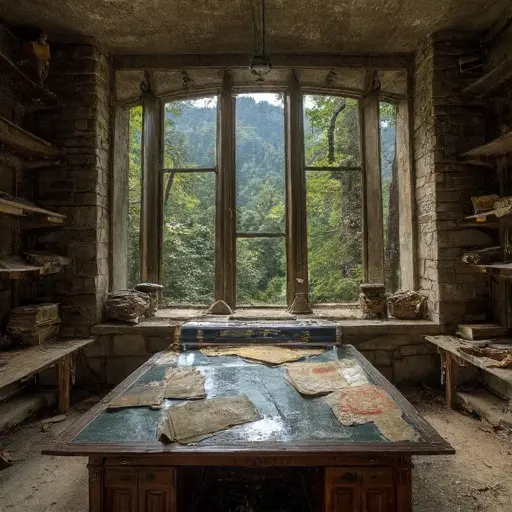
By the late 1930s, the Ridgefall House began to lose permanent occupancy. Geological survey operations in the ravine had been scaled back, and the necessity of maintaining a ridge-based station diminished. Seasonal visits replaced continuous habitation, and sections of the house were gradually closed off.
Exposure to elevation and moisture cycles accelerated material aging. Limestone softened into cooler gray and ivory tones, while brick bands retained structural integrity but dulled in color intensity. Metal cladding developed uneven patinas, reflecting shifting sky conditions and ravine light in muted, unpredictable ways.
The lower stepped extensions were the first to fall out of use, followed by upper ridge-facing rooms. The central volume remained active the longest, but eventually it too was left unoccupied as operations ceased entirely.
Final abandonment above the ravine
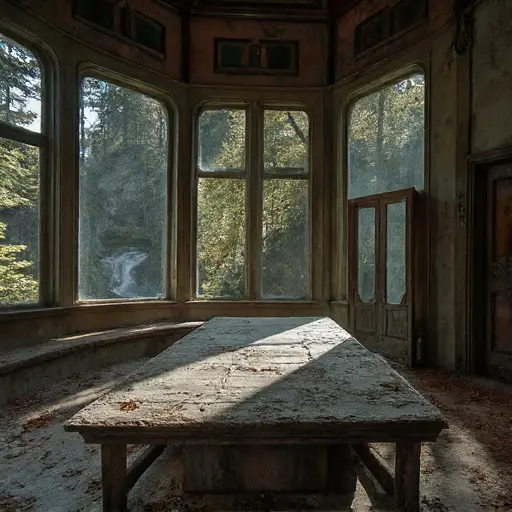
After the final recorded occupation in the early 1940s, the Ridgefall House was left without formal maintenance or restoration. Its ridge-top position ensured continued exposure to wind, moisture, and temperature shifts, gradually shaping both exterior and interior surfaces.
Limestone and brick retained structural clarity, while metal panels continued to oxidize into softer, more muted tones. The stepped architectural profile remained intact, visually echoing the layered terrain of the ravine below. Vegetation slowly advanced along the ridge edges, though the steep slope limited full overgrowth.
Today, the Ridgefall House remains suspended above the ravine, structurally coherent but fully abandoned. Its layered limestone, brick, and metal composition continues to reflect fragmented images of forest, sky, and distant water, holding its place as a quiet Victorian presence shaped by elevation, geology, and time.