The Ribbon House Along the Sunken Basin Edge
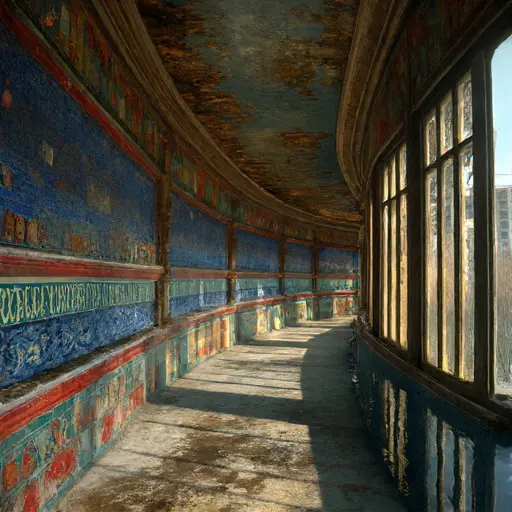
The house was never built to interrupt the basin’s geometry. It followed it, as if the old flood diversion system had dictated not only the path of water but the shape of domestic life itself. Inside, circulation was less about rooms and more about continuity—an uninterrupted ribbon of interior space bending with the curve of the river’s forgotten engineering.
Even in abandonment, that logic remains intact: movement still feels guided, as though the building expects flow rather than occupation.
The materials inside echo the exterior’s chromatic intensity, though softened by distance from weather. Where sunlight enters through the ribbon glazing, it breaks into layered bands of color that slide across walls like slow-moving reflections from water itself.
The submerged viewing hall
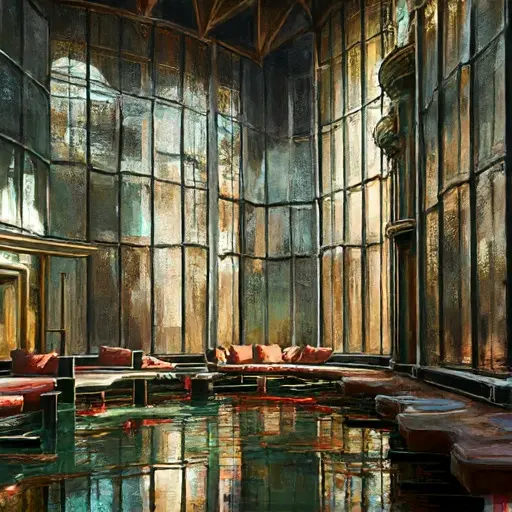
This central hall functioned as both promenade and observation space. Unlike traditional Victorian reception rooms, it was not meant for gathering in fixed positions but for continuous movement along the river’s edge. The architecture encouraged drifting rather than settling—walking, pausing, resuming—mirroring the slow hydraulics of the basin outside.
Over time, this relationship inverted. Instead of the house observing the water system, the water system began to define how the house was perceived: reflections, dampness, and shifting light became the primary architectural presence.
The terraced water threshold
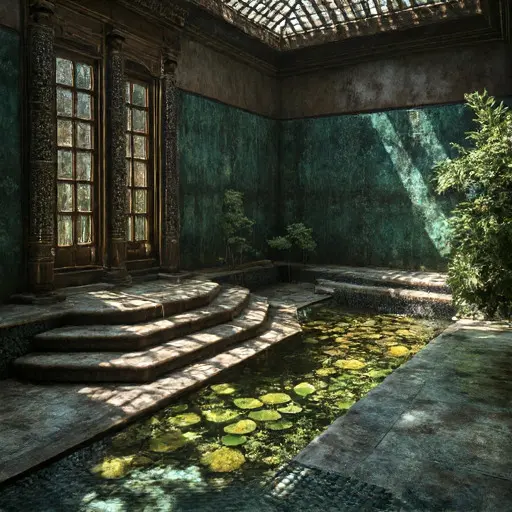
At the lowest level, architecture and landscape merge almost completely. The stepped platforms inside the house mirror the engineered descent outside, erasing any clear boundary between interior flooring and basin infrastructure. This was the most experimental part of the design: a deliberate collapse of separation between domestic space and hydrological system.
Even in abandonment, water remains close but not intrusive. It does not flood the structure—it reflects it. The result is a persistent visual doubling, where every surface has a counterpart in motion below.
The house now stands as a continuous horizontal memory of engineered water logic, preserved in silence. The basin remains still, the reedbeds unchanged in their slow arrangement, and the long ribbon of architecture continues to trace the forgotten path of a river system that once dictated how people lived along its edge.