The Reservoir Garden House Abandoned After Waterworks Closure
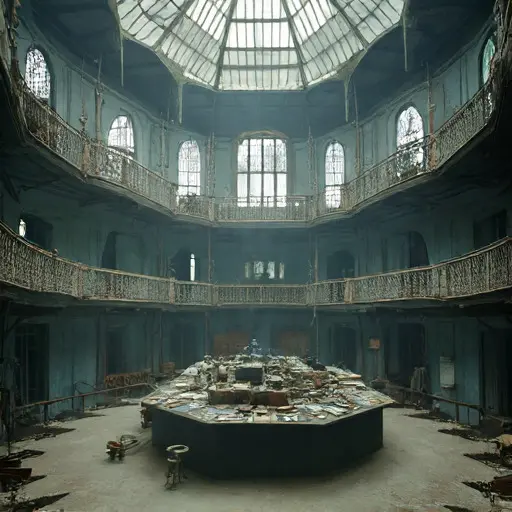
The Reservoir Garden House was constructed in 1897 at the center of a sophisticated rainwater collection landscape designed to supply a distant estate with fresh water. Unlike conventional Victorian residences, the building occupied a circular island within a network of terraced reflecting pools, stone channels, settling basins, and hydraulic structures. The house functioned both as a family residence and as the administrative center of a carefully managed water system.
Architecturally, the building was distinctive from the beginning. Constructed from pale blue-gray limestone and smooth plaster rendered in a faded dusty aqua tone, it possessed an unusually restrained palette. A dominant octagonal central hall formed the core of the design, while smaller wings radiated outward at irregular angles, giving the structure an appearance closer to a scientific institution than a domestic dwelling.
Tall lancet-shaped windows framed in painted iron admitted filtered daylight into the interior. Reflections from surrounding pools shimmered continuously across floors and walls, creating an atmosphere defined by water, light, and quiet engineering precision. Above the hall, an octagonal lantern tower illuminated the center of the house while smaller ventilation cupolas punctuated the zinc-clad roofscape.
For decades, the property remained occupied by the Ashcombe family, whose responsibilities included overseeing the reservoir gardens and hydraulic network. Estate records indicate that the system functioned efficiently through the early twentieth century, supplying water while also serving as a carefully maintained ornamental landscape.
Decline of the water system
The first signs of decline appeared during the late 1920s when modern pumping infrastructure was introduced elsewhere in the region. The distant estate that depended on the reservoir gradually transitioned to newer technologies, reducing the importance of the original waterworks.
As maintenance budgets contracted, repairs to channels, stone bridges, and settling basins were delayed. Water still flowed through portions of the system, but sections were gradually decommissioned. Aquatic vegetation began appearing in neglected basins, and some channels accumulated sediment that was no longer routinely cleared.
The Ashcombe family continued occupying the house, but the economic justification for maintaining the extensive hydraulic landscape weakened each year.
Reduced occupancy and financial strain
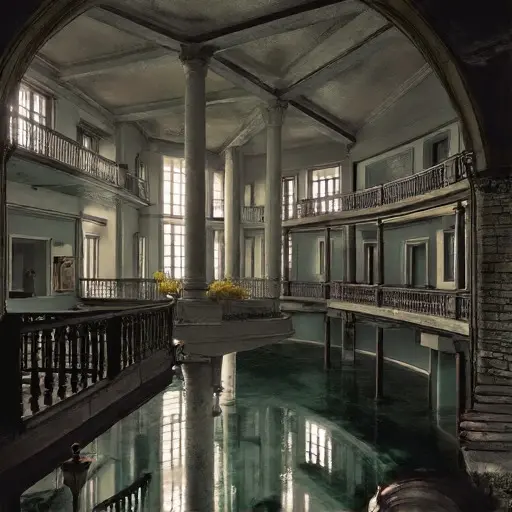
By the 1930s, family members had begun leaving the property. Younger generations sought employment elsewhere, while the costs of maintaining both the house and reservoir gardens continued to rise. Entire wings of the residence were closed to reduce heating expenses.
Maintenance logs reveal growing numbers of unpaid bills related to roof repairs, stonework preservation, and hydraulic infrastructure. The house itself remained structurally sound, but the systems surrounding it deteriorated steadily. Reflecting pools became increasingly overgrown, bridges softened beneath moss, and ornamental channels lost their defined geometry.
Ownership remained within the family, yet no long-term plan emerged for adapting the estate to changing circumstances.
Final abandonment
Following the death of the last permanent resident in 1943, inheritance disputes delayed any decision regarding the future of the property. The reservoir network, already largely obsolete, received no further maintenance. Without active management, vegetation spread rapidly through the waterworks.
The house remained standing at the center of the island, isolated not only by water but by unresolved legal and financial complications.
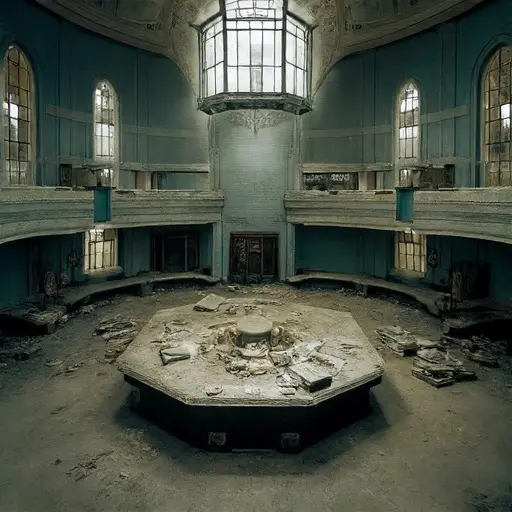
By 1950, the Reservoir Garden House stood completely abandoned. No restoration effort was undertaken, no heirs returned to occupy the residence, and the waterworks that once justified its existence remained obsolete. The reflecting pools, stone channels, and hydraulic structures continue to survive in partial form around the island, slowly reclaimed by vegetation. The house remains vacant at the center of the forgotten reservoir landscape, its future unresolved and its rooms left undisturbed beneath the soft light reflected from abandoned water.