The Ravine-Embedded Victorian House That Settled into Stone and Stream
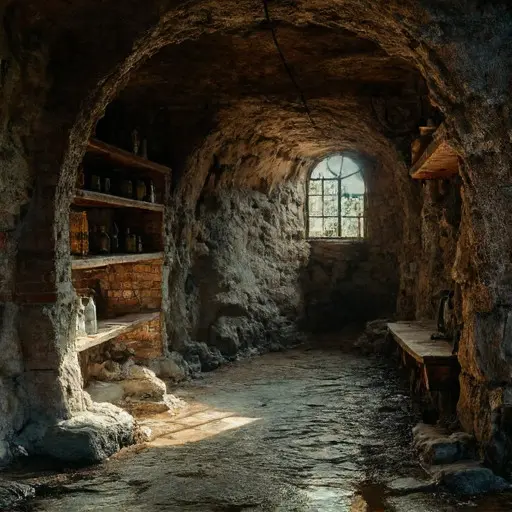
The house begins not at ground level but beneath it, where the ravine has been cut and shaped by water long before the structure existed. In these lower rooms, stone and architecture are nearly indistinguishable. The arched openings carved into the ravine wall still face the slow-moving stream, allowing light and sound to filter in continuously.
Nothing in this space feels abandoned in a sudden sense; instead, it feels left behind gradually, as if the house simply stopped needing these rooms before the world stopped acknowledging them.
The stone walls hold moisture from the ravine, giving the lower level a quiet, cooled permanence. Even without human presence, the architecture feels structurally “used,” as though its purpose was never entirely lost—only paused.
The middle floor aligned with the slope
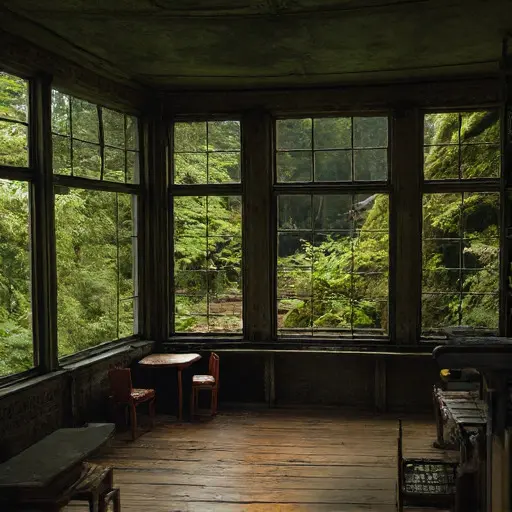
The central living level sits exactly where the ravine becomes most navigable, aligned with the slope rather than opposing it. Here, the house feels most like a home—balanced between enclosure and openness. The windows are evenly spaced, not decorative but practical, each framing a slightly different fragment of the ravine wall opposite.
Inside, the arrangement of furniture remains orderly and restrained. A table stands near the center of the room, oriented toward the stream’s direction, suggesting a life once structured around the landscape rather than away from it. The air carries a faint dampness from the surrounding moss and earth, but the interior remains stable and intact.
No objects appear displaced or hurriedly left behind. Instead, everything suggests a household that simply ceased continuing its routines, leaving structure behind without disruption.
The upper retreat within the hillside
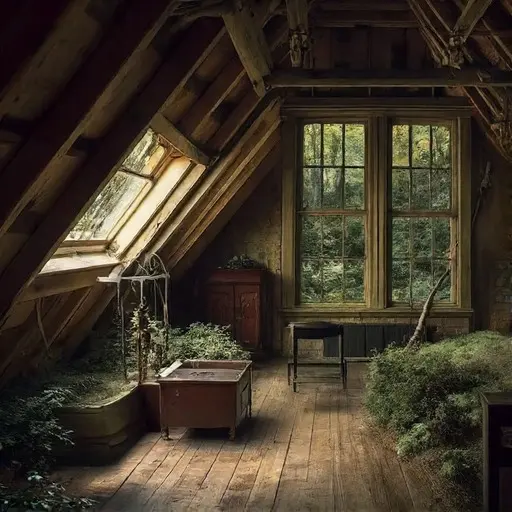
The uppermost floor feels less like a separate level and more like a continuation of the hillside itself. Its dormer windows open directly into the slope, with the roof pressing close enough to suggest the forest is leaning inward rather than the house reaching upward. Light here is more restricted, filtered through layers of earth and vegetation above.
The rooms are small and intimate, shaped by constraint rather than expansion. A bed sits close to the window, aligned not for view but for proximity to daylight. The sense of occupation is faint but persistent, as if the upper floor was once the quietest part of the house and remained so even as everything else faded.
There is no collapse in the structure, no dramatic decay—only a steady integration into the ravine’s rhythm. The stream continues below, the slopes remain unchanged, and the house persists in its embedded position, neither resisting nor advancing.
In this enclosed valley of stone and water, the Victorian house remains exactly where it was built to belong, quietly enduring in the ravine as part of the land’s slow, continuous presence.