The Ravenshollow Manor Left Vacant After Structural Drift
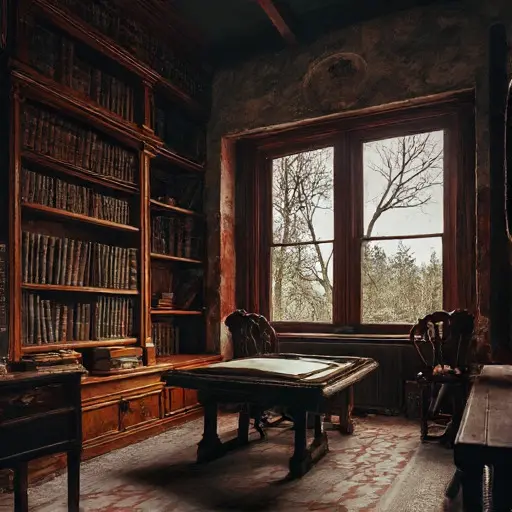
Ravenshollow Manor was constructed in 1896 by the Ellery-Brookes family as a rural retreat intended to combine traditional Victorian craftsmanship with experimental architectural geometry The estate was placed deep within an untouched forest basin where mist and humidity shaped the surrounding terrain as much as the structure itself For its first two decades the manor operated as a stable seasonal residence, occupied intermittently by family members who managed distant industrial investments rather than local land holdings The household remained financially secure at first, supported by urban capital, but maintenance demands gradually increased as the building’s complex design required specialized repairs that could not be sourced locally By the early 1910s subtle structural irregularities had begun to manifest: window spacing varied slightly from one wing to another, and certain corridors appeared longer when measured internally than they did from external observation These inconsistencies were initially dismissed as optical effects caused by uneven terrain and forest density, but they marked the beginning of a slow geometric drift that would later become impossible to ignore
Early Geometric Instability and Household Contraction
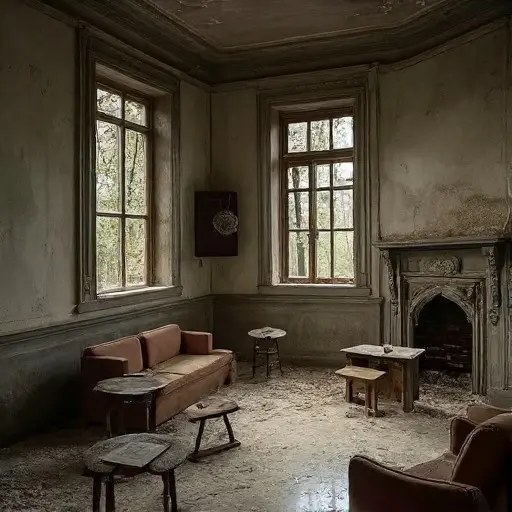
By the mid-1920s the Ellery-Brookes family had begun to withdraw from Ravenshollow Manor as maintenance costs escalated beyond initial projections The forest environment, while serene, accelerated decay through constant moisture exposure, leading to gradual weakening of timber joints and mortar expansion within the brickwork Sections of the manor were closed off one by one as heating entire wings became unsustainable The family’s financial position deteriorated further when overseas investments collapsed during post-war market instability, forcing partial liquidation of assets and a reduction in household staff By 1927 only the central wings remained actively inhabited, while outer extensions were left in a semi-maintained state that blurred the line between occupancy and abandonment Within this period, the manor’s geometric inconsistencies became more pronounced Staircases that appeared straightforward from exterior inspection began connecting to slightly offset interior landings, and doors duplicated along the same walls opened into subtly different room volumes The building still functioned as a coherent residence, but its internal logic was increasingly fragmented across its connected sections
Final Departure and Architectural Abandonment
<img src=”https://beyondvisit.
com/wp-content/imagecontent/uploads/abandoned victorian house 31582440.webp” alt=”” />
By the early 1930s Ravenshollow Manor had entered irreversible decline following the death of the last primary heir, whose estate responsibilities were never formally transferred in time to prevent administrative fragmentation Legal disputes over inheritance and taxation delayed any intervention until the cost of restoration far exceeded practical value County inspectors documented progressive misalignment between structural wings, noting that while no portion of the manor had collapsed outright, the cumulative drift rendered it unsuitable for habitation Entire sections were condemned not for failure but for incompatibility with adjacent geometry, as floors and corridors no longer aligned in consistent spatial relationships Despite this, the building remained physically intact due to its unusually resilient load distribution system, which allowed distorted sections to remain connected without catastrophic failure By 1941 the manor was officially declared abandoned and removed from residential records, with no further attempts made to repurpose or stabilize the structure
Ravenshollow Manor remains standing deep within the forest as an unoccupied architectural relic Its structure continues to exhibit slow geometric drift, with rooms and façades maintaining physical plausibility while subtly diverging in alignment over time No restoration efforts have ever been initiated, and no ownership claims have been revived The manor persists in a silent state of gradual decay, fully abandoned, unresolved, and left to the forest, its interconnected rooms still intact but forever drifting away from a single coherent form