The Ravenshade Radial Manor Left Abandoned After Structural Estate Collapse
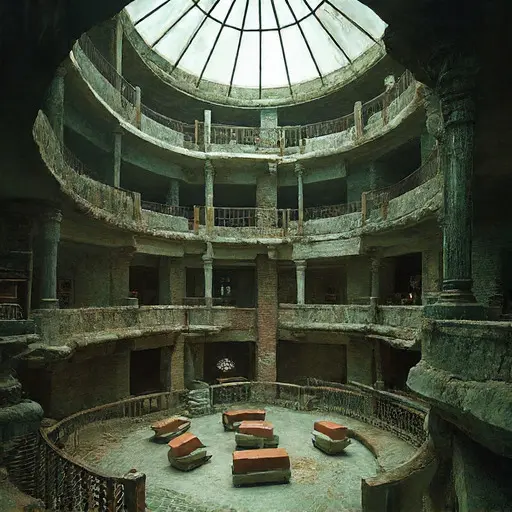
Ravenshade Manor was completed in 1901 as one of the most unconventional Victorian residences ever constructed, designed around a strict radial plan rather than linear or block-based organization. At its core stood a two-story rotunda built from deep green ceramic brick, subtly glossy even under constant weathering. From this central nucleus, six architectural arms extended outward like spokes in a wheel, each terminating in a distinct structural volume and creating a starburst footprint visible even in silhouette.
The manor was commissioned by industrial patron Elias Ravenshade, who believed domestic architecture should function as a distributed system rather than a centralized hierarchy. Each radial wing was assigned a different purpose and aesthetic language, effectively creating six semi-independent environments connected through a shared core. Movement through the house was designed as a cyclical experience, always returning to the central rotunda before branching outward again.
For several decades, the manor operated as a functioning estate with staff assigned to individual wings. The amber stone arm housed formal reception spaces, while the cobalt plaster wing contained administrative offices and recordkeeping rooms. The terracotta and lilac wings served private family quarters, and the glass-brick hybrid corridor housed experimental living spaces and transitional circulation zones. The conservatory arm extended outward as a botanical chamber filled with layered plant arrangements and controlled light diffusion.
Early fragmentation of function
By the late 1920s, the complexity of maintaining six materially distinct wings began to strain the estate’s resources. Each section required specialized maintenance, from terracotta tile preservation to glass-brick structural sealing. As financial conditions deteriorated, the family began isolating individual wings rather than maintaining the manor as a unified whole.
A house divided by radial intent under early decline
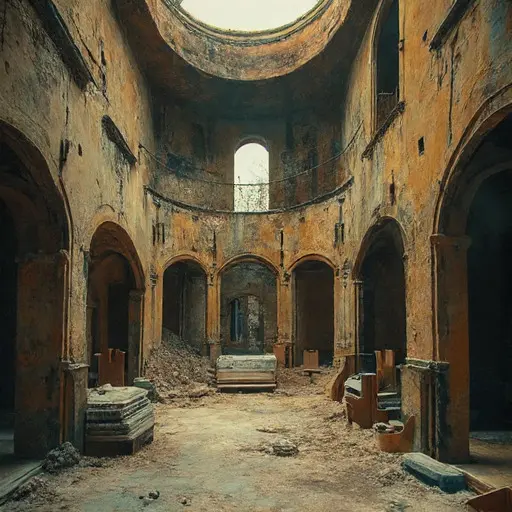
Following the death of the original patron in 1930, ownership of Ravenshade Manor became divided among multiple heirs, each with differing opinions about the estate’s future. Some argued for preservation of the radial structure as an architectural landmark, while others sought to sell individual wings separately to simplify management. Legal disagreements prevented any unified decision, and maintenance gradually slowed across all six arms.
As the 1930s progressed, entire wings were abandoned sequentially. The terracotta and lilac sections were closed first due to structural wear and heating inefficiency. The glass-brick conservatory arm suffered from condensation damage and gradual pane failure. Without coordinated upkeep, circulation through the radial system became increasingly fragmented.
Final abandonment of Ravenshade Manor
By 1942, the remaining occupants vacated the central rotunda, leaving the estate intact but unused. No legal resolution unified the fragmented ownership, and the manor was effectively abandoned as a complete radial structure. The conservatory arm remained partially intact but unmaintained, its plant life fading into indistinct silhouettes behind fogged glass.
The silence of a structure built in spokes
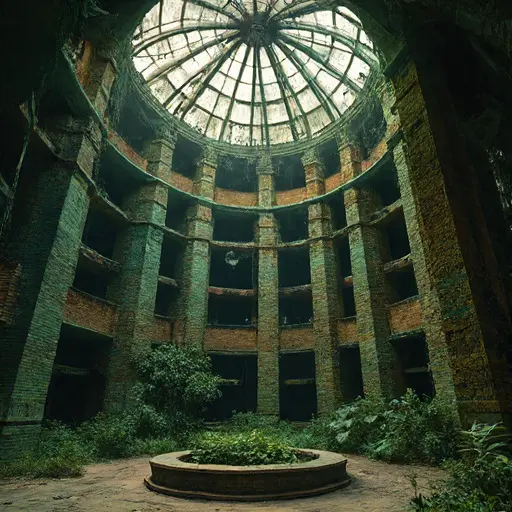
No restoration ever followed the abandonment of Ravenshade Manor. With ownership permanently fragmented and no unified authority to manage its upkeep, the estate slowly deteriorated across all six radial arms. The conservatory arm continued to cloud over, and structural maintenance ceased entirely. Today the manor still stands within its forest clearing, a complete yet abandoned radial organism—no reconstruction undertaken, no resolution reached, and no return of inhabitants recorded, its starburst geometry preserved only by the stillness of time.