The Quiet Stone Hearth Farmhouse on the Hillside
On a gentle forested slope beneath a pale gray overcast sky, an abandoned Victorian hillside farmhouse rests in complete stillness. The light is soft and evenly diffused, removing harsh shadows and revealing every surface with calm clarity. Surrounded by quiet trees and damp earth tones, the house feels less like a ruin and more like a paused way of living—one shaped entirely by daylight, firewood, and simple routine.
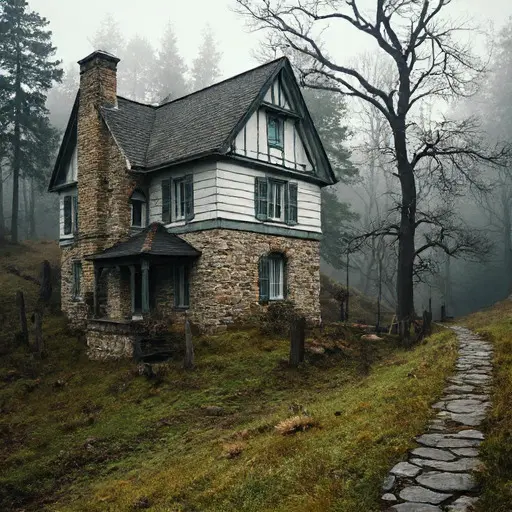
The structure is modest and deeply grounded in its materials. A lower level of pale fieldstone anchors the house into the hillside, while a weathered white timber upper level sits above it with quiet stability.
There is no ornamentation, no decorative excess—only practical form shaped by necessity and environment. Every line of the building feels intentional, measured, and enduring.
Unlike later Victorian homes that embraced gaslight or electricity, this farmhouse exists entirely without modern fittings. There are no wires, no fixtures, no lamps. Illumination comes only from daylight filtering through tall windows and the memory of hearth warmth embedded into the structure itself. This absence of technology gives the home a distinct clarity—life organized around natural cycles rather than artificial illumination.
The building follows the slope in a gentle stepped arrangement. The stone base is partially embedded into the earth, while the timber upper floor aligns cleanly above it. This creates a subtle terraced silhouette that blends naturally into the hillside without drawing attention to itself.
The roof is steep and practical, made of evenly laid dark slate that has weathered into soft charcoal tones. A single brick chimney rises near the center, slightly darkened at its upper edge from long-gone fires. It remains perfectly intact, a quiet reminder of past winters and steady domestic use.
Tall, evenly spaced windows define the exterior rhythm. Their faded white wooden frames are simple and functional, and the glass remains clear though softened by dust and time. Through them, interiors are visible in natural daylight only—no artificial glow, no flicker, no modern intrusion.
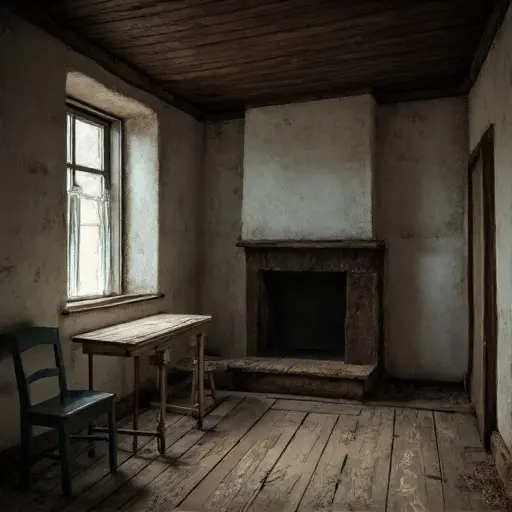
Inside, the farmhouse layout is linear and efficient. Rooms connect in a straightforward sequence: a kitchen with a central hearth, a modest living space, and upper sleeping rooms aligned above. Doorways are evenly placed, reinforcing the sense of functional design rather than decorative planning. Everything is arranged for ease of use, movement, and warmth retention.
Furniture is minimal but sturdy—simple wooden tables, plain chairs, and unadorned shelving. The stone hearth remains the focal point of the living space, built directly into the wall and designed for wood-burning heat. Its presence defines the emotional core of the house: survival, routine, and quiet domestic continuity.
The exterior porch is small and practical, built from timber and stone with no embellishment. It sits directly above a simple stone path that descends the slope in a gentle line. The path is partially softened by grass but remains clearly visible, as if still occasionally used.
The surrounding forest is calm and evenly spaced, with no aggressive encroachment. Trees stand at a respectful distance, allowing the farmhouse to remain visually open to the landscape. Soft green foliage and damp earth tones dominate the environment, reinforcing the quiet rural atmosphere.
There is no decay beyond natural aging. No collapse, no abandonment trauma, no dramatic storytelling. Instead, the house exists as a preserved fragment of pre-electric rural life—a place defined by daylight, fire, and simplicity.
It feels like an exploration-game environment where every space is readable, functional, and honest. A farmhouse shaped by necessity rather than decoration, resting quietly in the hillside forest under a patient gray sky.