The Quiet Ruin of the Elderton-Grove
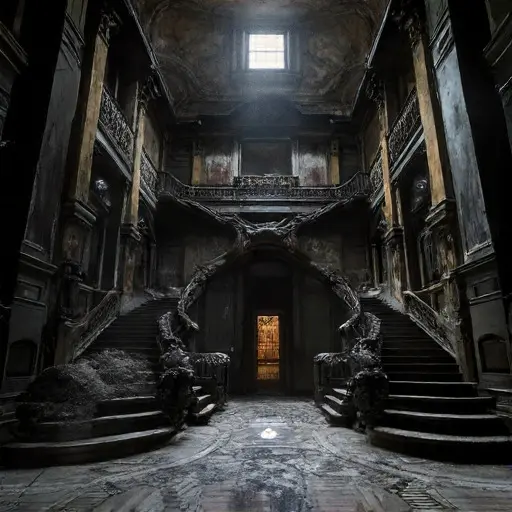
The Elderton-Grove, a blocky, severe Italianate villa of red brick and pale limestone, was completed in 1860, a statement of enduring, old-money wealth. Its broad, overhanging cornices and formal symmetry give it a distinctly somber, unsmiling appearance. To enter the Reception Hall is to be immediately silenced by the overwhelming sense of stasis.
The grand staircase, intended to convey arrival and social importance, is now merely a dusty, monumental barrier. Dust, the primary historical agent here, lies so thick that it absorbs sound, enforcing the profound quiet that has held the house captive for over ninety years, a silence born not of peace, but of utter withdrawal.
The Obsessive Banker, Arthur Elderton
The house was the creation of Arthur Elderton (1815–1890), a figure whose life was wholly dedicated to finance. His profession as a private banker required absolute discretion, meticulous record-keeping, and an unshakeable adherence to tradition. Socially, he was a cold, conservative patriarch whose entire self-worth was tied to his credit and his name.
Arthur married Sarah Vance in 1845, and they had one son, Frederick. Arthur’s personality was obsessive; he distrusted all forms of speculation and despised public display. His daily routine was rigid: he spent his mornings reviewing ledgers in his second-floor Vault-Study, a room he had structurally reinforced with steel beams. His ambition was to establish a family name so synonymous with reliability that it would outlast all temporary market fluctuations. His greatest fear was exposure and the loss of financial control.
The house was built to reflect this. The Reception Hall was intentionally minimalist by Victorian standards, emphasizing sobriety and permanence, not fashion.
The Scandal in the Vault-Study
The tragedy that ultimately caused the Elderton-Grove to be abandoned was a scandal of trust and betrayal executed by the next generation. Frederick, the son, lacked his father’s discipline. While Arthur was alive, Frederick played the role of the dutiful heir, but he secretly accumulated massive debts through high-risk stock speculation, which he masked by manipulating his father’s private accounts.
Arthur died suddenly in 1890, leaving Frederick control of the bank and the estate. For five years, Frederick managed to keep the scheme quiet, but the market turned violently against him. The collapse was inevitable. In 1895, the full extent of the fraudulent transactions was revealed, wiping out decades of client trust and Arthur Elderton’s life savings. Frederick was convicted of embezzlement and sent to prison.
The final, shattering evidence was discovered in the Vault-Study. In a hidden compartment in the reinforced safe, investigators found Arthur Elderton’s original, meticulous ledgers, showing the precise moment Frederick had breached the family trust—the cold, hard data of betrayal preserved in the steel-lined room.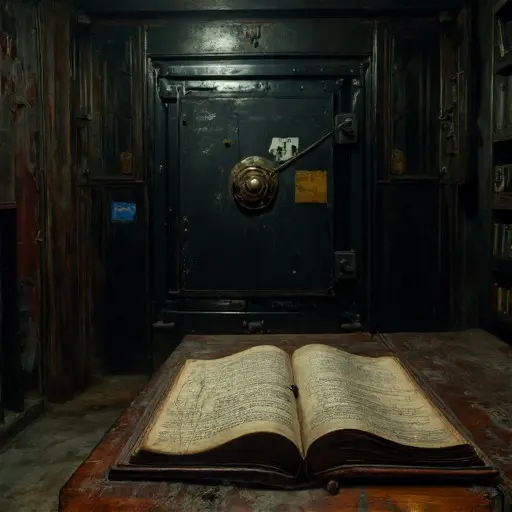
The Unclaimed Keys in the Butler’s Pantry
Sarah Elderton, the widow, was left utterly destitute, her entire social identity erased by the scandal. Her son was imprisoned, her fortune was gone, and her name was a public stain. She had no recourse and nowhere to go.
In a final act of utter despair and rejection, Sarah did not fight the seizure of the assets. She stripped the house only of essentials—clothes, a few photographs—and walked away in 1896, refusing to sell the property herself. She did not want the Elderton name to gain a penny from the ruins. She moved into a small, rented room in a nearby town, ensuring that the property tax bills went unpaid.
In the small, windowless Butler’s Pantry off the dining room, a silent witness remains to the finality of her departure. A small, brass ring containing the entire set of heavy, labeled keys for the estate—from the front door to the linen closet—was deliberately hung on a rusted iron hook behind a stack of empty, dusty wine bottles.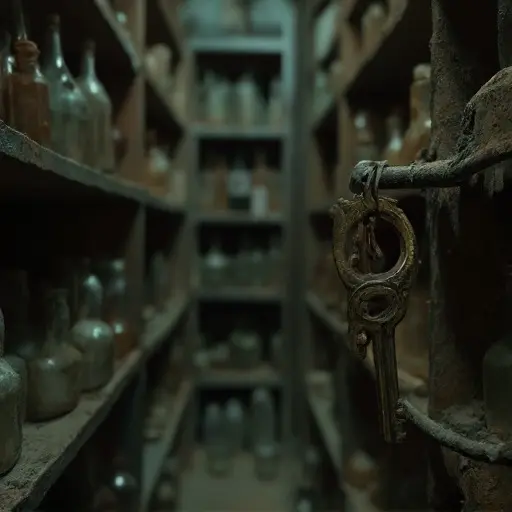
The Elderton-Grove was eventually seized by the state for tax arrears, but the legal complexities of the former bank holdings proved too tangled for a quick sale. The structure was sound, but the atmosphere was toxic, and no buyer emerged for decades. It remains today, its massive, dark façade keeping its long, cold quiet, a physical tomb for the betrayal recorded in a dusty ledger, and the keys to its resurrection left hanging, unclaimed, behind empty wine bottles.
