The Quiet Ruin of Stellamaris Keep
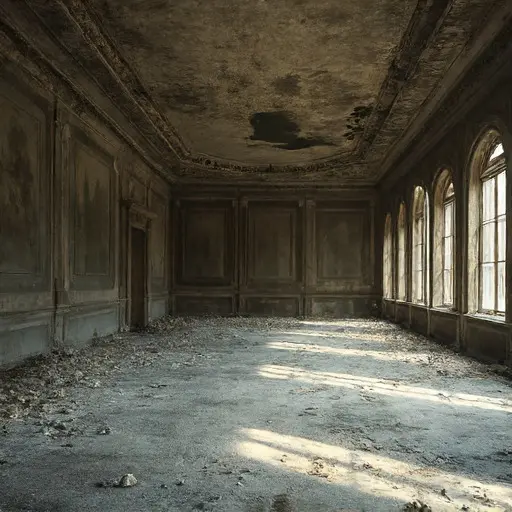
The silence that occupied Stellamaris Keep was not the silence of peace, but the cold, echoing stillness that swallows music. Stepping into the Main Entrance Hall was an exercise in walking through forgotten geometry. The air was cold, tasting of the sea mist that had penetrated the structure for decades, mixing with the dry, fine scent of old paper and pulverized wood.
The entire house, built in 1885, was a monument to the fleeting success of its owner, a life that had been meticulously cataloged and then violently dismissed by fate.
Commodore Alaric Croft: The Sea’s Captive
The mansion was built by Commodore Alaric Croft, a retired naval officer turned immensely successful shipping magnate whose wealth was built on transatlantic trade routes. His temperament was rigid, disciplined, and utterly dependent on predictable order—a characteristic honed by years at sea. His private life, however, was defined by an obsessive fear of the very ocean that made him rich; he suffered from profound aquaphobia following a traumatic shipwreck early in his career. He married Helena, a quiet woman who loved coastal scenery, and they had one daughter, Seraphina.
Alaric’s internal conflict defined the mansion. His Chart Room, located on the top floor overlooking the coast, was the core of his professional life. Here, maps of shipping lanes—now brittle and yellowed—remain pinned to cork boards. Yet, beneath his telescope, hidden in a false bottom of a ship’s writing desk, we find his Private Journal. It contains not business logs, but pages of minute, fearful observations of the tide, the wind speed, and the size of the waves breaking on the rocks—a secret, personal log of his lifelong terror.
The Solace in the Belvedere
Helena Croft spent her life attempting to balance her husband’s rigid anxieties with the life they were supposed to enjoy. Her sole place of refuge and the location of her turning point was the Belvedere, a small, octagonal turret room built into the roofline, offering a panoramic view of the coastline.
The room is sparsely furnished with a small, round table and one delicate iron chair. On the table, beneath a scattering of seagull feathers and grit, lies her Sketchbook. It contains detailed, vibrant pencil and charcoal drawings of the coastal flora and the endless, powerful movements of the sea. Tucked into the final, unused page is a small, carefully folded newspaper clipping, dated 1898. It details a major maritime inquiry into the disastrous loss of one of Alaric’s merchant vessels. The article mentions that a faulty repair, explicitly ordered by Alaric to save time and money, was the likely cause of the sinking. This revelation—that his own fear of loss and control caused the loss of others—was the final turning point that shattered Helena’s loyalty.
The Final Log in the Nursery
Helena left Stellamaris Keep in the spring of 1899, taking their young daughter, Seraphina, with her. She left behind only a short, written note on the Chart Room desk: “I cannot live with the dead.”
Alaric Croft did not contest her departure. He was already emotionally ruined by the revealed truth of his actions and the exposure of his lifelong terror. He retreated into the house, but his final turning point is marked in the Nursery—a room he had always avoided, finding children too unpredictable. The room is still full of toys: a wicker doll carriage, a painted alphabet chart, and a small, wooden rocking horse.
Hidden beneath the small, child-sized Writing Desk is a small, brass-bound logbook, clearly taken from his own office. The final entry, scrawled with a shaking hand, is not a financial calculation but a single, devastating sentence: “The sea claimed them all, but I paid the fare.” The date is October 1900. Alaric Croft was found dead in his study shortly after, having locked himself in and consumed his last, large supply of opium.
Stellamaris Keep was seized by creditors who, unable to easily sell the remote, heavy contents, simply secured the doors and allowed the structure to decay. It stands today, utterly full, its luxurious interiors an intact, forgotten record of a man whose fear of the sea became his final, self-inflicted ruin.
