The Quiet Order of the Neo-Classical Forest Manor
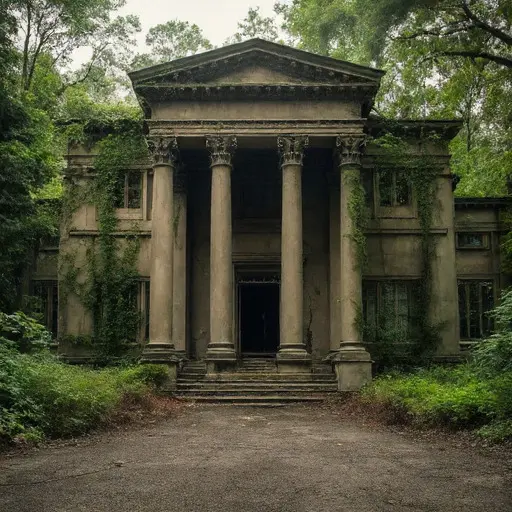
An abandoned Neo-Classical manor sits deep within a dense deciduous forest, its once-imposing symmetry still intact despite years of quiet reclamation by nature. The structure is composed of pale limestone and weathered stucco, its surface softened into muted cream and pale ochre tones that absorb the surrounding forest light rather than reflect it. Even in decay, the building preserves a strict architectural discipline, where every column, cornice, and pediment still aligns with deliberate classical precision.
The façade is defined by a grand colonnade of Corinthian columns supporting a sharply defined triangular pediment. Time has etched subtle erosion into the carved stone, softening edges that were once crisp and ceremonial. Cracked marble steps lead upward to a recessed central portico, where shadow gathers in quiet stillness, emphasizing the depth of the entrance without revealing anything within. The interior remains completely dark, as if the building has withdrawn entirely from visibility.
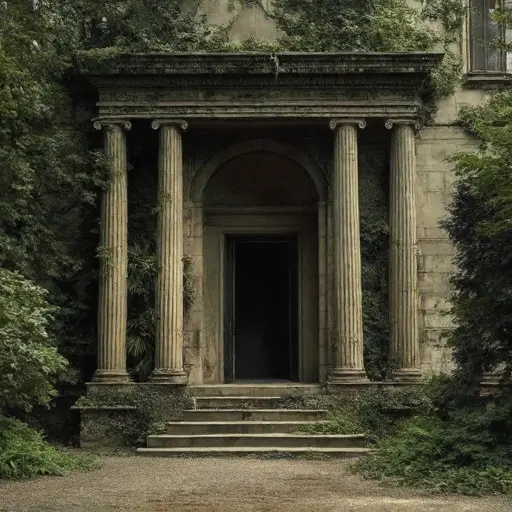
Ivy grows selectively along pilasters and structural seams, following architectural lines rather than overwhelming them, giving the impression that vegetation is respecting the original design. The formal gravel forecourt has begun to dissolve into uneven grass and moss, yet its geometry is still faintly readable beneath the encroaching greenery. Hedges that once defined ceremonial approach paths have expanded into irregular forms, blurring the boundary between designed landscape and wild forest floor.
Behind the manor, dense deciduous trees press inward, forming a natural wall of trunks and layered foliage that frames the estate without obscuring it. The contrast between rigid classical order and organic forest growth defines the entire composition: straight fluted columns against twisting branches, carved stone against irregular bark, architectural stillness against quiet ecological movement.
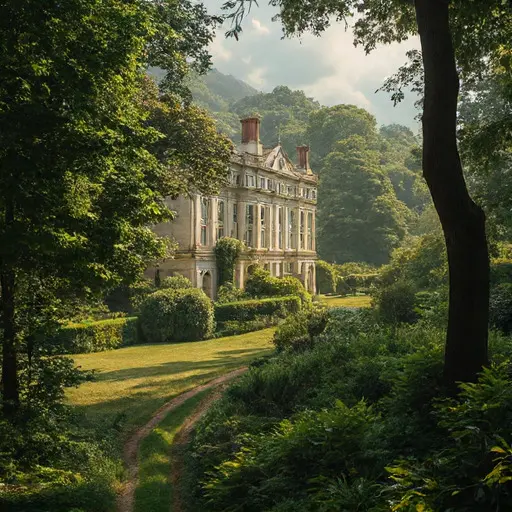
Soft neutral daylight evenly illuminates the scene under a clear, haze-free sky, revealing material texture with clinical clarity. The limestone retains a tactile grain, the stucco shows subtle weathering, and the marble steps reflect faint, diffused highlights. There is no dramatic atmosphere—only calm, persistent daylight emphasizing structure over mood.
The estate feels less like a ruin and more like a paused system of order, where classical architecture and forest ecology exist in parallel states, neither fully dominant, both slowly converging into a single, quiet equilibrium.