The Quiet Measurements of Alderfield Weather Station House
Alderfield Weather Station House stands in a quiet forest clearing beneath a uniform overcast sky, where light falls evenly across every surface without shadow or glare. The surrounding trees maintain a respectful distance, forming a calm perimeter around the structure, as if the clearing itself was intentionally maintained for observation rather than habitation. The atmosphere is still, precise, and quietly functional.
The building is compact and utilitarian in its Victorian design, constructed from pale stone at the base and white-painted timber above. Its proportions are clean and balanced, emphasizing function over ornamentation.
The structure’s most distinctive feature is the raised observation room on the upper floor, which subtly defines the building’s silhouette and purpose from every angle.
This observation room forms a continuous band of tall wraparound windows, creating a panoramic viewing enclosure. The glass remains intact and slightly clouded with age, diffusing the already soft daylight into a muted, uniform glow. The room sits slightly offset from the lower structure, creating a gentle overhang on one side, supported invisibly by internal structural reinforcement that preserves perfect stability.
The lower level is simple and rectangular, with evenly spaced sash windows and a centered entrance. The door remains closed, painted white, and faded evenly by time rather than damage. A short set of stone steps leads up cleanly, their edges worn smooth but structurally sound, reinforcing the sense of careful, functional design.
A narrow exterior staircase runs along one side of the house, connecting ground level directly to the observation room. It is intact and evenly constructed, but its landing aligns with a window rather than a traditional door. This subtle inconsistency suggests a deliberate internal shift in access, as though the structure prioritizes measurement space over conventional circulation.
The roof above the observation level is flat and reinforced, functioning as an open platform bordered by a simple metal railing. The railing runs continuously around the perimeter but shows slight irregular spacing at one corner, a minor construction variation that does not affect its stability. The entire upper silhouette feels engineered for permanence and exposure rather than shelter.
Inside the observation room, visible through the curved glass, is an empty circular workspace designed for systematic monitoring.
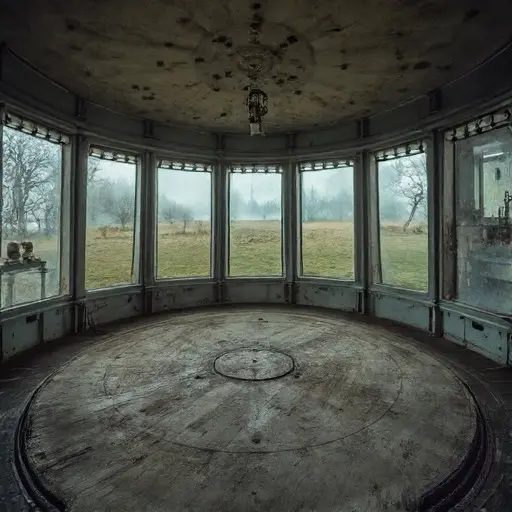
The floor contains faint radial markings that converge toward a central point, suggesting former placement of meteorological instruments. Around the perimeter, evenly spaced mounting brackets remain fixed to the walls, but all equipment has been removed. The room feels operational in structure but dormant in purpose, as though awaiting measurements that will never resume.
Below, the lower interior spaces are small, orderly, and geometrically consistent. Rooms are arranged in simple rectangular divisions, with minimal ornamentation and clean wall surfaces. Light enters through evenly spaced windows, producing a uniform brightness that matches the exterior overcast conditions.
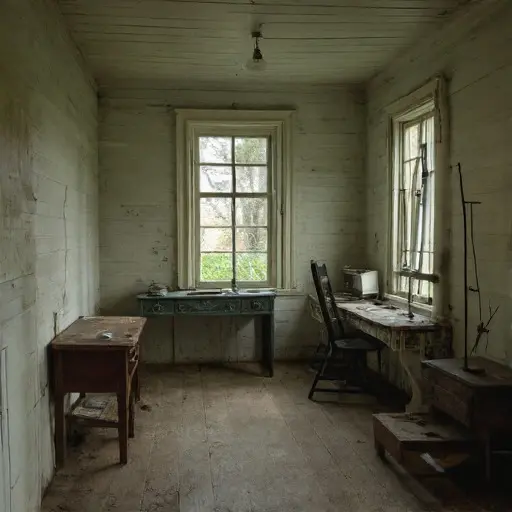
There is no clutter, no signs of disturbance, and no decay beyond mild dust accumulation. Curtains remain static—some drawn fully open, others partially closed—creating subtle variations in light but no disruption to the overall order of the space.
The surrounding forest maintains a consistent boundary, neither encroaching nor retreating. Grass is short and evenly distributed across the clearing, with only minimal vegetation near the foundation stones. The absence of overgrowth reinforces the sense that this place was never fully surrendered, only left behind in a state of paused function.
The entire structure feels like a calibrated instrument in architectural form. Nothing is broken, nothing is missing, and nothing is collapsing. It is simply inactive—preserved in a condition that suggests the next measurement was always imminent, but never arrived.