The Quartzite Manor on the Windswept Heath
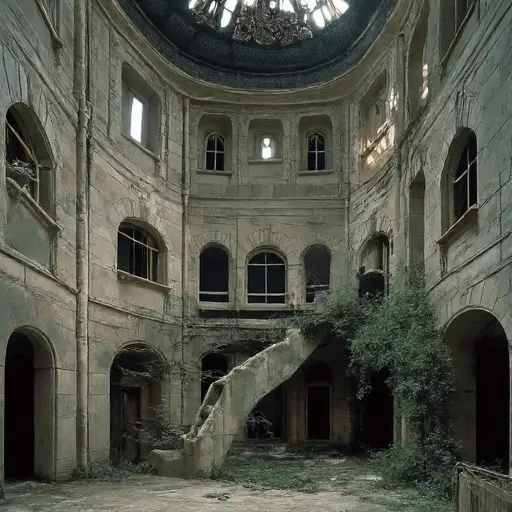
On a windswept coastal heath, a Richardsonian Victorian family house stands in quiet isolation amid purple heather, coarse grasses, and scattered granite outcrops. Constructed from pale blue-grey quartzite blocks with creamy travertine arches, the structure carries the weight and solidity of Romanesque-inspired design while appearing softened by time and coastal weather.
Its immense rounded volumes flow into one another without strict separation, as though the masonry itself has gradually relaxed over generations.
A broad semicircular tower leans subtly outward, while the sweeping veranda curves in a graceful crescent beneath carved stone capitals and stained-glass fanlights dulled by age. The roof, once heavy with authority, is now a weathered skin of oxidized lead marked by moss along its ridges.
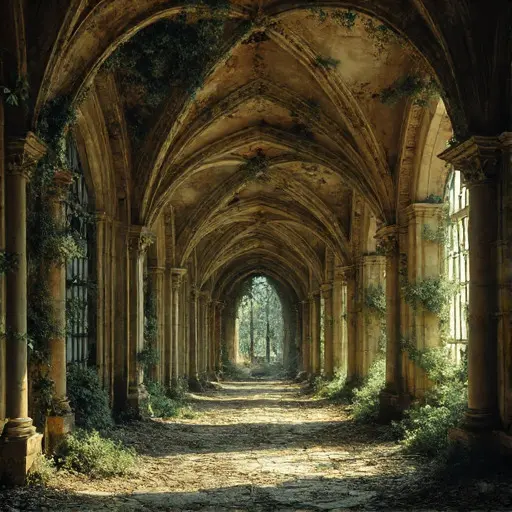
Inside, the manor is entirely unlit. No interior illumination exists anywhere within the structure, leaving every chamber in deep, silent shadow. Soft overcast daylight enters only through deeply recessed windows and fractured fanlights, tracing faint patterns across quartzite and travertine surfaces.
Exterior decay is subtle but persistent. Portions of the balustrade have crumbled away, ivy spreads across the stonework in thick, irregular networks, and moss gathers along the roof ridges where water lingers longest after coastal storms.
At ground level, a rusted baby pram sits abandoned beside a dry, lichen-covered stone fountain. Nearby, a cracked gravel drive winds toward the house before dissolving into the heathland, as if the path itself has slowly surrendered to the landscape.
Seabirds circle overhead in the steady coastal wind, their motion the only dynamic element in an otherwise still composition. The house remains monumental yet softened—an immense stone form gradually yielding to sea air, vegetation, and time.