The Quarry Garden House
Within a sunken garden basin carved from old quarry stone, an abandoned Victorian family house rests in quiet suspension. The land dips gently below the surrounding terrain, forming a naturally sheltered hollow where grass, low shrubs, and scattered wildflowers grow in softened layers. Light filters down from above rather than arriving directly, giving the entire space a calm, evenly lit atmosphere without sharp contrast or shadow.
The house is a two-story Victorian residence built almost entirely from pale sandstone blocks. Time has worn the stone into smooth, muted surfaces, softening edges that were once sharp and newly cut.
One side of the structure is partially integrated into the quarry wall itself, where exposed rock has been carefully retained and incorporated rather than concealed, making the building feel anchored to the geology around it.
Its form is restrained and horizontally composed. A central rectangular mass defines the core, while two shallow lateral extensions follow the gentle curvature of the basin. The result is a composition that feels stable and grounded, as though the house belongs more to the earth than to architectural intention alone.
The roof is a low, continuous pitched structure covered in weathered slate tiles. The tones have shifted over time into a subdued range of gray-blue and softened graphite. Moss gathers along upper seams where moisture lingers, forming irregular natural patterns that subtly echo the contours of the quarry walls. Two short chimney stacks rise from separate points along the roof, hinting at divided hearths within the interior.
Windows are deeply recessed into thick stone walls, each framed by simple lintels without ornamentation. Their tall rectangular proportions align with interior room divisions, creating a measured rhythm across the façade. Some openings sit beneath shallow stone overhangs built directly into the structure, adding a cave-like depth that emphasizes the thickness of the masonry.
A narrow flight of stone steps descends from the upper ground level into the basin, leading toward a simple wooden door set within a rounded stone arch. The door remains intact but weathered, its surface softened into a muted gray-brown with faint traces of older paint absorbed into the grain.
Around the house, the quarry basin has transformed into a quiet, garden-like environment. Grass grows in uneven but gentle patterns across the floor of the hollow, while small flowering plants emerge from crevices in the stone. The surrounding rock walls rise in layered strata, pale and textured, forming a natural enclosure that frames the house without fully enclosing it.
The atmosphere is still and contemplative, shaped by geology as much as architecture. Nothing feels forced or decorative. Instead, the house appears as a quiet continuation of the quarry itself—refined by human hands but ultimately belonging to the stone.
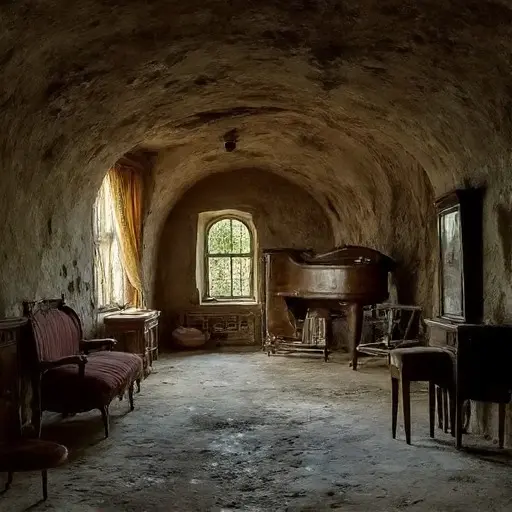
Inside, the main living space is cool and quiet. Thick sandstone walls hold the temperature steady, while light enters through deep-set windows in soft, indirect layers. Furniture remains sparse and functional, arranged with the practicality of long-term family use rather than display.
A central corridor connects rooms along the elongated structure, following the natural horizontal flow of the house. Doorways are simple and unadorned, their proportions dictated by the thickness of the stone rather than decorative intent. The sense of enclosure is strong but not oppressive.
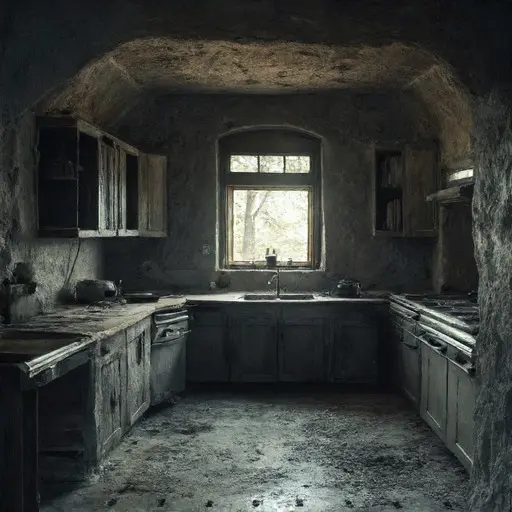
At the rear, a kitchen and service area open toward the quarry wall, where rock becomes part of the interior boundary. Surfaces are worn but intact, shaped by years of daily use rather than neglect. Even in abandonment, the layout remains readable and orderly.
Upstairs, bedrooms sit closer to the light, where the upper edges of the basin allow broader views of sky and stone. Rooms are modest, with simple furnishings and deeply set windows that frame fragments of the quarry landscape. The feeling is not of elevation, but of continued integration into the surrounding earth.
And as daylight filters evenly into the sunken garden and the quarry walls hold their quiet presence, the house remains unchanged—an architectural form shaped by stone, resting in harmony with the basin that cradles it.