The Purple Slate House of Chestnut Hollow
Nestled beneath a canopy of ancient chestnut and beech trees, the abandoned High Victorian Gothic family house stands as a remarkable expression of nineteenth-century craftsmanship, where bold color, textured masonry, and refined ornament combine into a residence that feels both dramatic and deeply welcoming. Though decades have passed since footsteps echoed through its halls, the house retains an unmistakable warmth, its carefully balanced proportions reminding visitors that it was built not as a grand aristocratic estate, but as a prosperous family home meant to celebrate everyday life through exceptional architecture.
Constructed entirely from rugged charcoal-gray volcanic stone, the walls possess a rich, almost velvety texture that contrasts beautifully with vivid bands of warm orange sandstone framing every doorway, window, and structural corner. These lighter stone accents create a rhythmic pattern across the façade, emphasizing the home’s vertical Gothic character while softening the weight of the dark masonry. Time has rounded the sharpest carvings, yet every detail remains remarkably legible beneath the gentle forest light.
Above the stonework rises an intricate arrangement of intersecting roofs clad in glossy royal-purple slate. Even after years of abandonment, the tiles continue to shimmer subtly beneath overcast daylight, shifting between violet, plum, and deep indigo depending on the angle of the light. At one corner, a modest octagonal tower climbs only a single level above the surrounding roofscape before ending beneath a steep copper roof transformed by decades of weather into brilliant turquoise patina. Rather than dominating the residence, the tower serves as an elegant architectural accent, adding personality without overwhelming the intimate scale of the home.
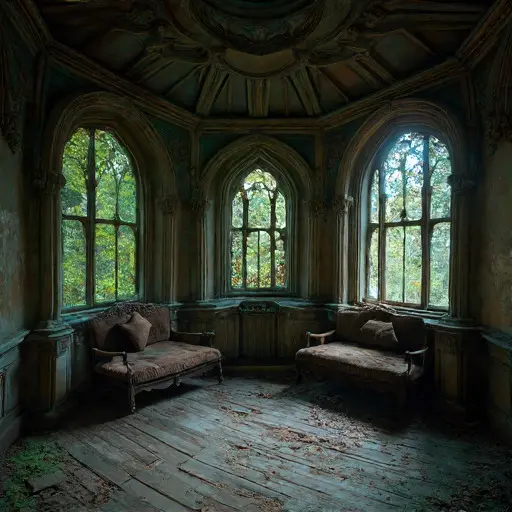
The main façade is anchored by a magnificent two-story canted bay constructed almost entirely from finely carved orange sandstone. Delicate Gothic moldings, clustered columns, and floral capitals surround its tall windows, all now cracked or empty, revealing interiors consumed by complete darkness. Nearby, a pointed entrance arch shelters the front doors beneath a beautifully preserved timber porch painted mustard yellow. Intricate Victorian scrollwork fills every bracket and beam, while fading layers of paint hint at generations of careful maintenance before silence claimed the house.
Heavy emerald-green oak double doors remain firmly in place beneath the arch, their wrought iron hinges still black against the richly painted timber. Fragments of stained glass in ruby, sapphire, and amber survive within decorative panels, their fractured pieces catching only soft daylight while revealing nothing beyond except featureless darkness.
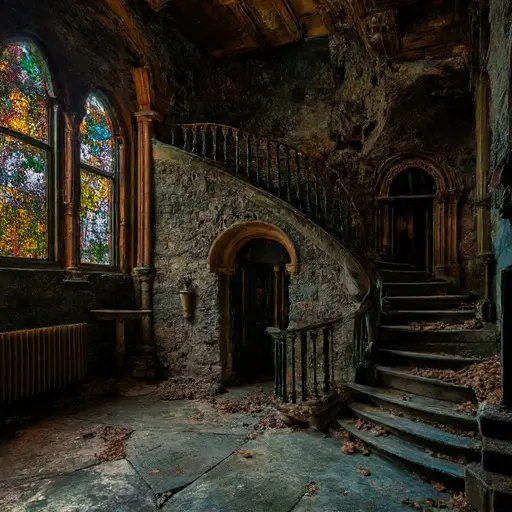
Instead of a traditional wraparound porch, the family once gathered upon a broad elevated stone terrace stretching gracefully across the front of the house. Carved sandstone balustrades border the platform, overlooking gardens that have slowly evolved into a vibrant woodland sanctuary. From its center, an elegant curved staircase descends gently toward the grounds, each weathered sandstone step softened by moss yet remarkably intact after decades of neglect.
Four tall chimneys punctuate the vivid roofline, each carefully constructed from alternating courses of orange sandstone and dark volcanic stone before terminating in elaborate terracotta chimney pots whose sculptural forms still crown the house with unmistakable Victorian refinement. The alternating masonry gives the chimneys an almost striped appearance, reinforcing the home’s unique visual identity.
The gardens remain one of the property’s greatest treasures. Circular flower beds still follow their original Victorian layout, now overflowing with flourishing purple irises, brilliant yellow daisies, scarlet poppies, white hydrangeas, and deep emerald ferns that weave naturally between weathered stone edging. At the center stands a dry octagonal fountain carved from polished black volcanic stone, surrounded by winding gravel paths nearly hidden beneath carpets of colorful wildflowers. Broken sandstone planters lean gracefully among the blooms, while clipped hedges have matured into soft rounded forms that preserve the memory of formal landscaping without appearing neglected.
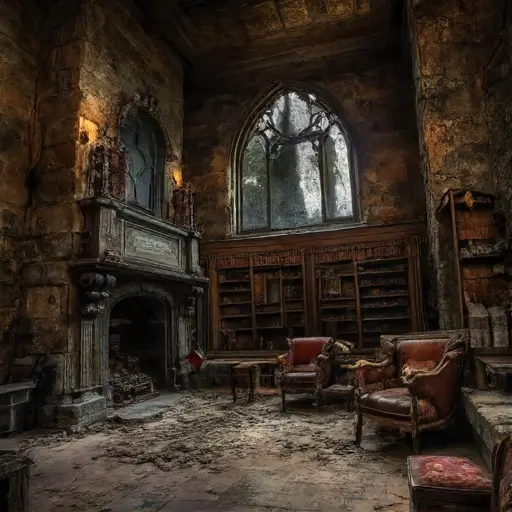
Towering chestnut and beech trees encircle the clearing without crowding it, their broad crowns filtering gentle daylight across the richly colored architecture. Moss-covered boulders, flowering woodland plants, and layers of lush undergrowth frame the residence, creating a composition where nature enhances rather than obscures the building. Every material remains crisp and readable beneath the soft neutral sky—charcoal volcanic stone, warm orange sandstone, royal-purple slate, oxidized copper, aged oak, terracotta, stained glass, and hand-forged iron all contributing to an atmosphere of quiet dignity instead of decay.
Although the house has stood empty for generations, its vibrant palette and extraordinary craftsmanship continue to give it an unmistakable sense of welcome. Rather than becoming intimidating through abandonment, it remains an enduring portrait of Victorian family life expressed through Gothic artistry, patiently preserved beneath the forest canopy where color, architecture, and nature exist in remarkable harmony.