The Prairie Ring Courtyard Residence Left Sinking into Quiet Grasslands
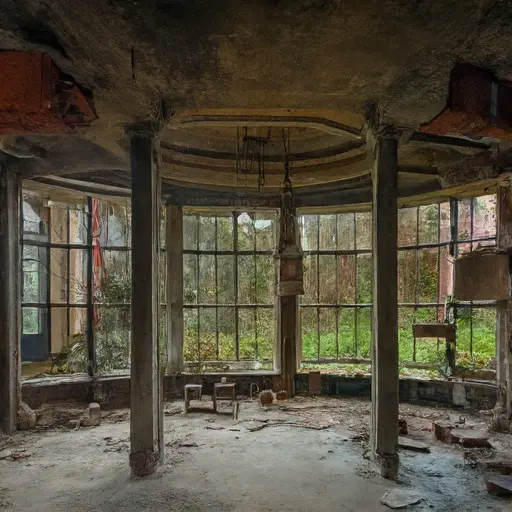
The Prairie Ring Courtyard Residence was constructed in 1956 as part of a mid-century experimental rural housing initiative aimed at integrating communal living structures directly into open prairie environments without disrupting natural sightlines or wind flow patterns The design was based on a continuous circular residential form composed of weathered red brick and cast concrete, reinforced with an internal oxidized steel beam ring that distributed structural loads evenly across the entire footprint Entry points were limited to a few segmented breaks in the ring, while the interior organization followed a radial logic of corridors extending inward toward a shared central courtyard The courtyard itself was designed as an open communal green space, intended to remain semi-natural and lightly maintained rather than fully landscaped, allowing prairie grasses and seasonal wildflowers to coexist with residential use Over time, the structure developed a distinctive identity as a self-contained circular village embedded within the flat landscape, with each household occupying a curved segment along the ring and sharing visual access to the central green space
Gradual Soil Settlement and Residential Decline
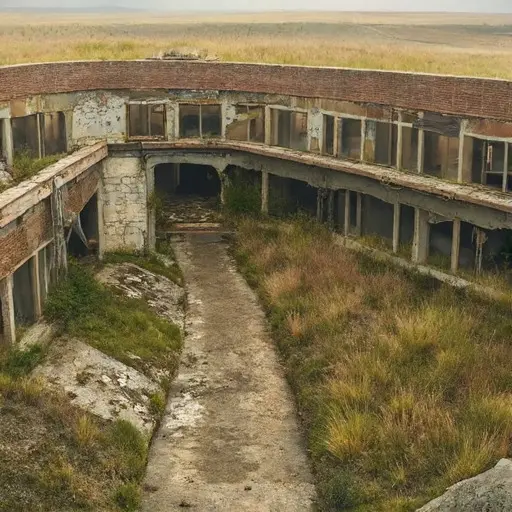
By the late 1970s the Prairie Ring Courtyard Residence began to experience gradual structural and demographic decline as rural population shifts reduced long-term occupancy and municipal support for large-scale experimental housing forms Maintenance of the continuous ring structure required coordinated upkeep across multiple interconnected segments, and as individual units were vacated, repair cycles became increasingly irregular Foundation settlement accelerated in certain sections due to uneven soil compression beneath the circular load distribution system, leading to subtle but cumulative tilting of door frames and minor cracking along brick-concrete junctions The central courtyard, once lightly maintained, began to transition into an unmanaged ecological space as irrigation and landscaping efforts ceased, allowing prairie grasses to grow unchecked into the heart of the structure Despite these changes, the oxidized steel ring support system continued to maintain overall structural coherence, preventing catastrophic collapse even as localized degradation spread through interior surfaces and glazing systems
Final Abandonment and Prairie Reclamation
<img src=”https://beyondvisit.
com/wp-content/imagecontent/uploads/abandoned victorian house 82544405.webp” alt=”” />
By 1994 the Prairie Ring Courtyard Residence was officially declared uninhabitable following structural assessments confirming widespread foundation settlement, advanced corrosion of exposed steel elements, and progressive material fatigue across the continuous ring system No demolition was pursued due to the structural complexity of the circular load-bearing design and its integration into a sensitive prairie ecosystem, and no restoration was undertaken due to the high cost of stabilizing an entire continuous architectural loop Ownership was gradually relinquished as rural land management policies shifted toward ecological preservation, leaving the structure outside active residential and municipal planning frameworks The residence was left in place as a passive architectural remnant within the prairie, with vegetation steadily reclaiming interior spaces and soil movement subtly reshaping its footprint over time
The Prairie Ring Courtyard Residence remains standing in the open grasslands as a silent circular ruin Its continuous red brick and concrete ring persists in structural coherence despite partial sinking and long-term abandonment No return has ever occurred, and no restoration has been attempted The structure endures as a quiet geometric trace embedded in the prairie landscape, slowly dissolving into grass, wind, and time under soft diffused overcast light