The Permanent Glaze of Phosgene-Bake Hall
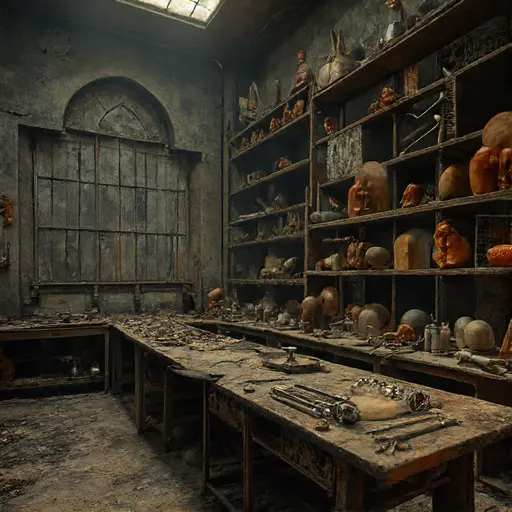
Phosgene-Bake Hall was an architectural testament to sterile preservation: a massive, severe structure of pale gray brick with numerous small, sealed, internal heating chambers. Its name suggested a blend of toxic gas and high-heat stability. The house sat low in a valley, where the air was perpetually still and humid, but the interior felt unnaturally hot and dry. Upon entering the main gallery, which was devoted to the display of anatomical models, the air was immediately thick, warm, and carried a potent, almost dusty scent of purified beeswax, turpentine, and a subtle, sickly-sweet aroma. The floors were covered in heavy, smooth tiles, now slick with dust and residual wax, amplifying every faint sound into an unsettling echo. The silence here was not merely quiet; it was the intense, sterile stillness that follows a chemical reaction, suggesting that all biological activity had been perfectly and permanently halted. This abandoned Victorian house was a giant, sealed oven, designed to achieve and hold a state of absolute, unchangeable biological stasis.
The Anatomist’s Perfect Substitute
Phosgene-Bake Hall was the fortified residence and elaborate laboratory of Dr. Alistair Vance, a brilliant but pathologically obsessive anatomist and wax modeler of the late 19th century. His professional life demanded the meticulous study of human pathology, the creation of flawless, life-like anatomical models for medical training, and the pursuit of absolute, permanent preservation of form. Personally, Dr. Vance was tormented by a crippling fear of biological decay and a profound desire to substitute the fleeting, vulnerable nature of the human body with something immortal, beautiful, and controlled: wax. He saw the Hall as his ultimate kiln: a space where he could finally create a perfect, non-decaying replica of his entire family, ensuring they would never suffer the indignity of illness or decomposition.
The Wax Formulation Chamber
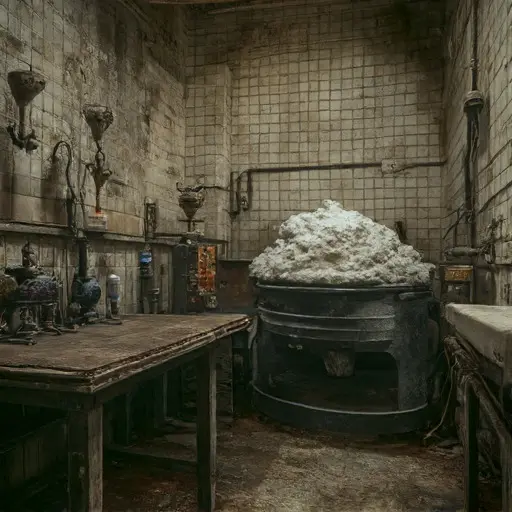
Dr. Vance’s Wax Formulation Chamber was the heart of his art. Here, he mixed his specific compounds—blending beeswax, paraffin, and chemical stabilizers—to create his unique, non-perishable modeling wax. We found his final, detailed Compound Ledger, bound in thick, wax-coated paper. His entries chronicled his escalating desperation to create a wax that perfectly mimicked the look and texture of living human skin. His notes revealed that he had begun to believe the key ingredient was a biological solvent derived from human tissue, which he believed would transfer the essence of life into the model. His final project, detailed meticulously, was the creation of three life-sized wax figures—replicas of himself, his wife Elara, and his son Julian—designed to stand as a perfect, static family portrait.
The Final Display Chamber
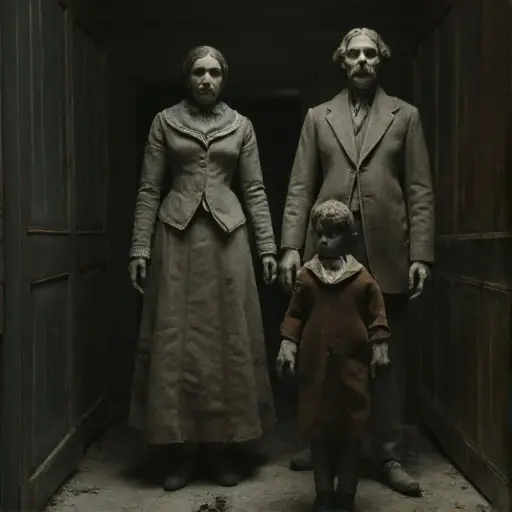
The most chilling discovery was made in the main gallery, where a final, terrifying display was arranged. Standing perfectly still on a raised, velvet-draped dais were the three wax figures. They were flawless, life-like, and unsettlingly serene, dressed in slightly dusty formal attire. Tucked into the inner pocket of the male figure (Dr. Vance’s replica) was a single, small, rolled-up sheet of paper. This was his final note. It revealed the tragic climax: he had finished his replicas, achieved his perfect, non-decaying family. However, during the formulation of the skin-tone wax for the final figure, he was overcome by the chemical vapors, but instead of seeking help, he allowed the process to continue, viewing his death as the ultimate, final sealing and glaze of his creation. His final note read: “The forms are perfect. The life is superfluous. We are now truly beyond the scope of time.” His body was never found. The permanent glaze of Phosgene-Bake Hall is the enduring, cold stillness of the three wax figures, a terrifying testament to an anatomist who substituted the fleeting reality of love with the ultimate, beautiful, and inert artifice, forever preserved within the silent, abandoned Victorian house.}