The Perimeter House of the Quiet Clearing
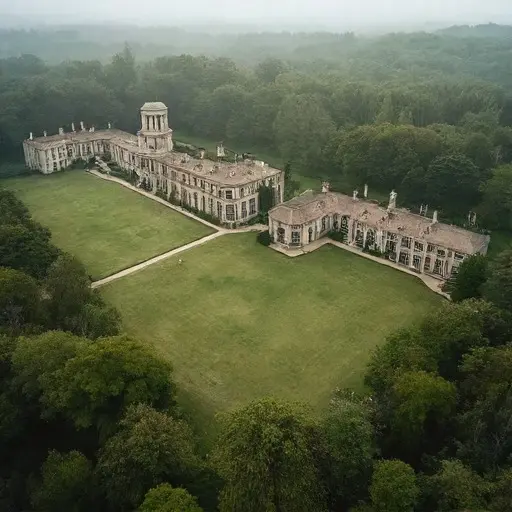
An abandoned Victorian perimeter house sits around a dense forest clearing under soft overcast daylight, where evenly diffused light flattens contrast and renders the entire scene in muted, grounded tones. The structure is fully intact and lightly weathered, built from pale brick with white-painted timber detailing, forming a continuous loop-like residence that encloses an open central field like a carefully drawn architectural boundary.
The house is arranged as a near-rectangular ring, with rooms forming an unbroken circuit around the clearing. Every interior space is oriented inward, while the outer walls present a more solid, restrained façade toward the surrounding forest. This creates a clear duality: openness toward the center and controlled enclosure toward the exterior woodland.
The central field functions as the visual and spatial core of the design. It is a flat expanse of short grass with faint traces of former landscaping still visible beneath natural regrowth. From nearly every window, this inner landscape is visible, reinforcing the sense that the house is built entirely for inward observation and circular domestic life.
A subtle irregularity appears in the ring: one segment of the house gently bulges outward, expanding interior room sizes in that section without breaking the overall geometry. The effect is restrained and believable, like a structural adjustment rather than a flaw.
The roof follows the entire loop as a continuous dark slate band, forming a closed geometric perimeter above the structure. One section dips slightly lower than the rest, creating a soft, almost imperceptible variation in height that runs along part of the circuit.
Inside, the house reveals a continuous sequence of inward-facing rooms connected by corridors that follow the loop. Walking through the interior would create an uninterrupted circular path, eventually returning to the starting point without retracing steps. Rooms are simple and orderly—parlors, studies, and small sitting areas arranged in repetition, each oriented toward the central field.
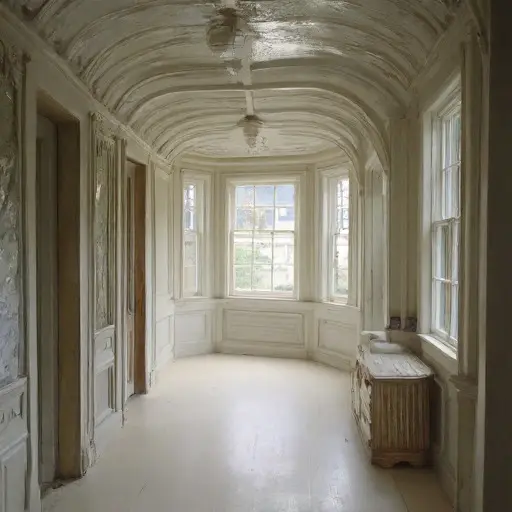
Multiple internal passageways cut across the ring at intervals, offering shortcuts between distant points in the loop. These corridors are aligned and clean but do not perfectly match the rhythm of exterior windows, creating a subtle dissonance between façade repetition and interior circulation.
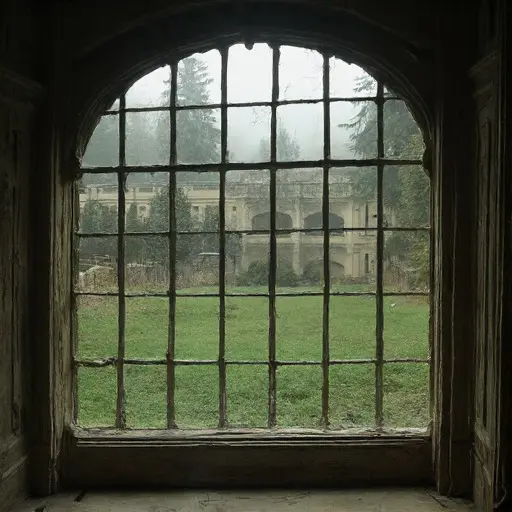
The surrounding forest forms a dense but respectful outer boundary. Trees press close to the exterior walls without breaching them, emphasizing the house’s self-contained geometry. From above, the structure reads as a deliberate architectural loop placed within nature rather than shaped by it.
No decay, no collapse, no surreal distortion. The house remains a quiet, self-contained Victorian residential circuit preserved in stable symmetry under a gray sky, where architecture forms a continuous inward gaze around a single shared clearing.