The Pebbleshore House Resting Between Tide and Stone
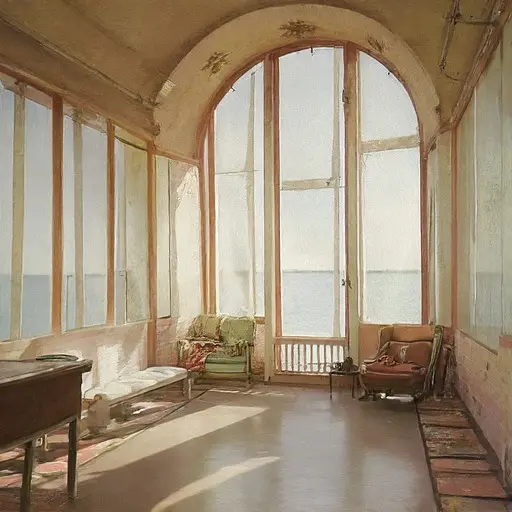
The Pebbleshore House stood at the meeting point of a quiet coastal village lane and a broad pebble shoreline, where rounded stones shifted gently with each retreating wave. Built in 1892 for the Larkspur family, the structure was small and slightly elongated, shaped to follow the shoreline’s subtle curvature rather than impose upon it. Pale pink brick formed the main body of the house, interspersed with bands of glazed white ceramic tiles that caught coastal light like embedded porcelain accents.
The geometry of the house was carefully ordered yet quietly unusual. The main volume was slightly offset from its foundation footprint, creating the impression that the upper floors were gently drifting forward over the lower level. This was not structural failure but a long-settled architectural adaptation, as if the building had gradually adjusted itself to the slope of the land and the persistent pull of the sea.
Tall rectangular windows were arranged in disciplined vertical stacks, but each frame was inset at slightly different depths. This layering produced a façade that shifted visually as one moved along the shoreline, with light and shadow changing the perceived geometry of the structure. The glass remained intact, softly weathered by salt air, producing gentle distortions in which sea and sky merged into silvery gradients.
A shallow front stoop led directly onto a narrow stone walkway formed from flattened river pebbles, worn smooth by wind and tide. The entrance was framed by simple carved limestone pilasters whose edges had softened over time, preserving their form while diminishing their sharpness. Above, a small projecting oriel window extended outward like a quiet architectural lookout, its curved glass reflecting the rhythmic motion of water and sky.
Inside, the Larkspur household maintained a modest coastal routine shaped by fishing schedules, small trade exchanges, and seasonal weather cycles. Henry Larkspur managed local harbor logistics, while his wife Miriam maintained household records and correspondence. The house functioned as both residence and observation point, oriented toward the shoreline as a constant environmental presence.
Early financial strain
By the late 1920s, shifts in local fishing yields and changing trade routes reduced the stability of coastal livelihoods. While the household remained functional, maintenance of the property gradually slowed. The salt air continued its steady influence on materials, subtly softening brick edges and glazing surfaces, though the structure itself remained fundamentally sound.
Gradual decline within the coastal shoreline residence
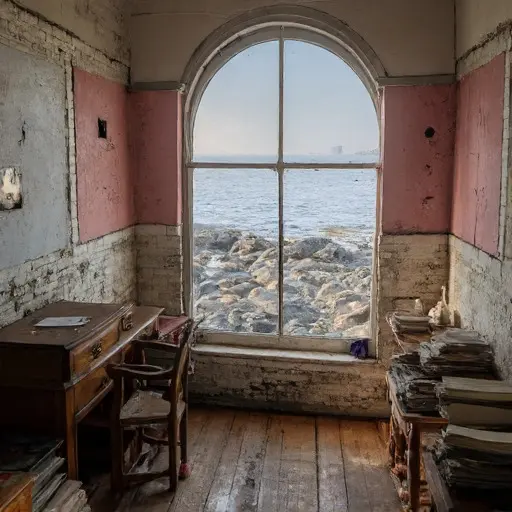
As financial pressure increased, the rhythm of occupation slowed. Certain rooms were closed during colder seasons to reduce heating and maintenance demands, while minor repairs became less frequent. The house remained structurally stable, but its lived cadence softened as daily activity diminished.
Over time, family presence declined. Younger members relocated to inland towns for work, and returns became sporadic. By the early 1940s, the house was occupied only intermittently, used primarily during warmer months and for occasional administrative visits related to coastal trade records.
Final abandonment phase
By 1947, the Pebbleshore House was no longer permanently inhabited. Utility services were gradually discontinued after extended non-use, though the structure remained intact and stable under coastal conditions. The sea continued its steady rhythm beside the house, shaping the shoreline without altering the building’s quiet composure.
The house left beside the enduring tide
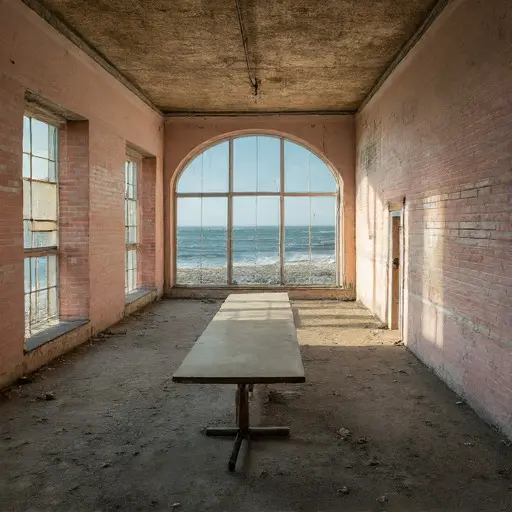
By the late 1940s, no formal ownership disputes or restoration efforts altered the Pebbleshore House. Legal responsibility remained inactive, and no occupants returned. The house stands quietly at the edge of the village lane and shoreline, slowly weathering under coastal light and salt air, holding the memory of lived domestic rhythm without interruption or return.