The Overgrown Symphony of the Art Nouveau Forest Château
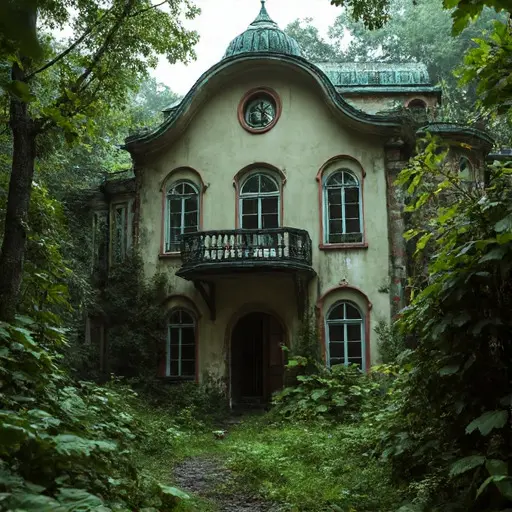
An abandoned Art Nouveau forest château-mansion emerges from the dense woodland as if grown rather than built, its 5-story asymmetrical mass flowing into the landscape through continuous organic curvature. Captured in a low-angle ultra-wide 24mm perspective, the structure emphasizes vertical growth and botanical fluidity rather than rigid architectural order. Pale sand-colored limestone and soft rose stucco form the primary surfaces, their tones gently weathered yet still luminous under diffuse daylight.
Across the façades, blackened wrought iron balconies unfurl like living vegetation—vines, lilies, and curling stems translated into structural ornament. These iron forms wrap around the building in continuous motion, reinforcing the Art Nouveau philosophy of architecture as organic extension. Tall ribbon windows puncture the façade in irregular rhythm, filled with fractured stained glass in amber and teal tones that no longer transmit interior light, only memory.
The copper roofing has oxidized into a deep turquoise-green patina, unifying the upper silhouette with the surrounding forest canopy. Multiple tower forms rise from the structure like carved tree trunks, some containing spiraling stair turrets visible through broken or partially open apertures. The entire mansion reads as a hybrid of botanical organism and aristocratic residence, slowly being reclaimed by surrounding nature.
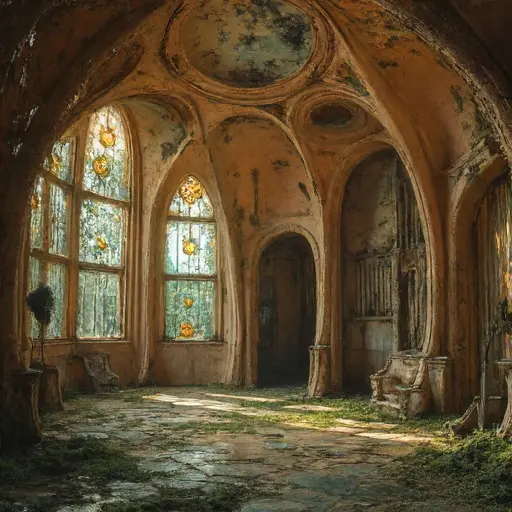
Inside, the château reveals vast flowing interiors defined by curved walls and uninterrupted organic geometry. Structural ribs of blackened iron emerge like botanical veins, supporting vaulted ceilings that appear grown rather than constructed. Tall ribbon windows line the interior, their stained glass fractured into irregular amber and teal fragments that allow only soft, diffuse daylight to enter.
The interior remains entirely unlit, with no artificial illumination surviving. Light filters through broken glass and overgrown openings, casting muted chromatic reflections across pale stucco surfaces. Moss and small plants begin to intrude at floor edges, particularly near breaches in the structure where exterior vegetation has begun reclaiming interior thresholds.
At the entrance, an ornate iron gate stands partially collapsed beneath thick wisteria and tangled ivy. The original stone pathway leading into the estate is submerged under moss and wildflowers, forming a soft green corridor that dissolves formal entry into organic overgrowth. The transition from exterior to interior is gradual, almost indistinct, as vegetation threads through architectural openings.
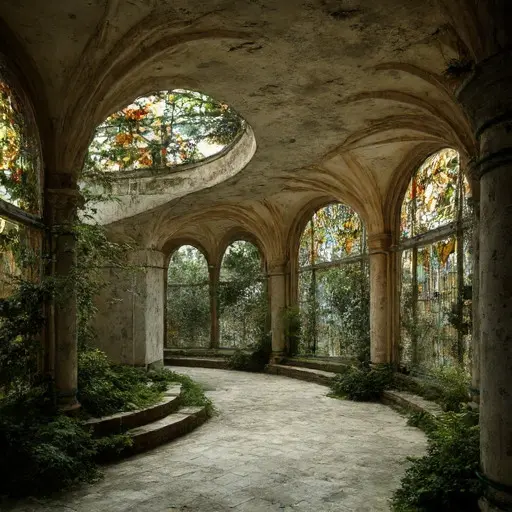
Midground reveals a circular reflecting basin once used as a formal garden centerpiece, now cracked and overrun by reeds and aquatic plants. Ceramic mosaic lining still traces fragments of geometric patterns beneath waterlogged decay, hinting at the estate’s former ornamental precision. Surrounding terraces dissolve into uneven greenery where formal design has been overtaken by natural growth.
Beyond the mansion, dense forest presses directly against the curved architecture. Birch, fir, and chestnut trees rise close to the walls, their vertical forms contrasting with the building’s continuous flowing lines. Branches interlace with balconies and windows, reinforcing the sense that the structure and forest are no longer separate entities but interwoven systems.
Under soft neutral overcast daylight, the entire scene maintains high clarity without dramatic contrast or atmospheric distortion. The palette remains balanced and non-brown dominant—rose stucco, teal copper patina, amber glass highlights, and deep green vegetation forming a cohesive visual rhythm. The result is a cinematic architectural study of aristocratic Art Nouveau decay, where elegance persists through form even as nature quietly completes the composition.