The Overgrown Geometry of the Art Nouveau Forest Manor Complex
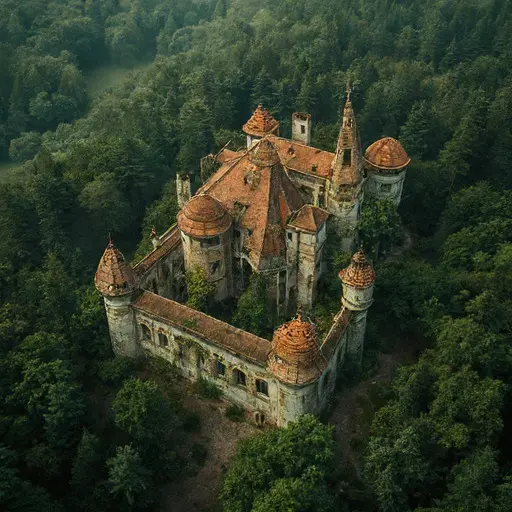
An abandoned Art Nouveau manor complex spreads through a dense conifer forest like a once-cohesive organism now slowly reclaimed by its surroundings. Seen from above, the estate reveals a network of interlocking volumes—brick and terra-cotta structures arranged in flowing, non-linear sequences that resist rigid symmetry. The architecture still carries its original intention of movement and organic continuity, but time and vegetation have softened its edges into a quiet dialogue with the forest.
Elongated rooflines curve across the complex in restrained waves, their surfaces finished in muted olive green tiles and oxidized copper that has aged into deep, subdued patinas. Asymmetrical towers rise at intervals, not as dominant focal points but as rhythmic interruptions in the architectural flow, each one slightly different in height and curvature. The overall effect is less like a single building and more like a continuous architectural landscape woven into the terrain.
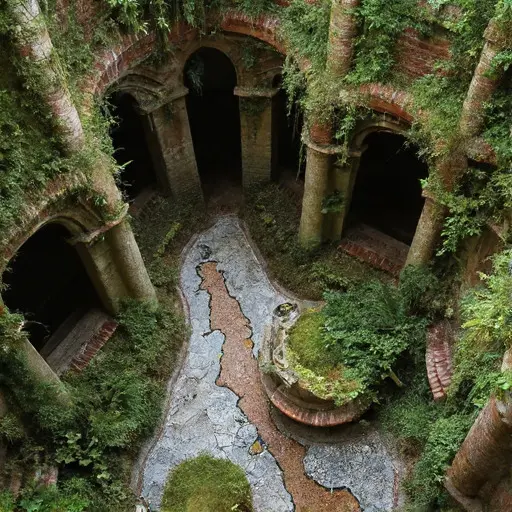
At ground level, the courtyards between the structures have fractured into a patchwork of stone, moss, and fragmented mosaic pathways. Once-formal circulation routes now dissolve into irregular patterns where pine roots push through stone joints and wild grasses occupy former decorative beds. The Art Nouveau language of the estate—once defined by ornamental continuity—now appears partially interrupted, yet still legible beneath the layers of natural intrusion.
Windows and façade details remain expressive despite abandonment. Curved brick arches and elongated openings trace the building’s organic grammar, while decorative ironwork has softened under oxidation, blending into the surrounding palette of greens and earth tones. No interior lights are visible; the buildings are hollow shells of design intent, preserving only structure and silhouette.
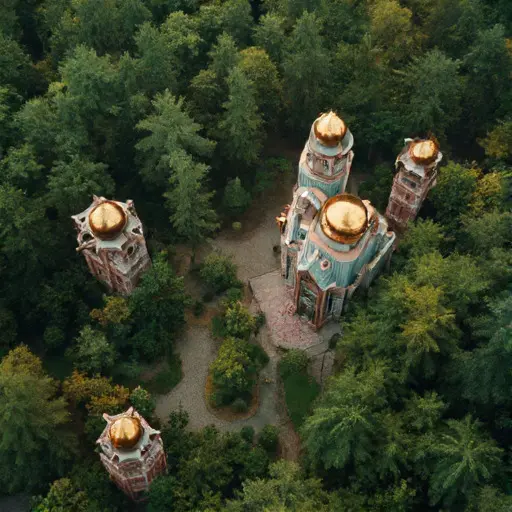
The surrounding conifer forest presses tightly against the estate’s boundaries, its vertical rhythm contrasting with the manor’s flowing horizontals and curves. Tall pine trunks rise in dense repetition, visually echoing the towers while dissolving the distinction between built and natural environments. The boundary between architecture and forest is no longer sharp but interwoven, as roots, moss, and canopy gradually absorb the estate into a shared ecological system.
Soft neutral daylight evenly illuminates the scene, revealing the textures of brick, terra-cotta, oxidized copper, and weathered stone without harsh contrast or atmospheric distortion. The clarity of the air preserves every structural detail, emphasizing material truth over mood or abstraction.
The result is a quiet architectural dissolution—an Art Nouveau complex that still holds its flowing identity, even as nature slowly edits its edges into something indistinguishable from the forest itself.