The Oriel Westerly: A Silent History
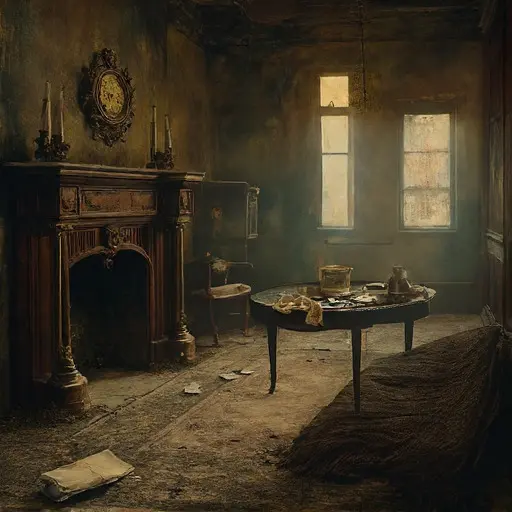
The silence inside the Oriel Westerly does not feel like an absence; it feels like a presence—a dense, palpable recording of the past captured by dust and disuse. Upon stepping past the locked outer doors, the air itself—stale, cool, and smelling distinctly of old paper and damp wool—presses down on the observer. The entrance hall is a somber tapestry of peeling damask wallpaper and sun-bleached wainscoting.
Immediately noticeable is the massive, darkened oak Grand Staircase, its carved newel post worn smooth not by decades of use, but by the hands of one man: Silas Oriel Westerly. Everything here is heavy, detailed, and utterly immobile, a monument to a life that ceased without warning. A brass umbrella stand still holds three walking sticks, and a pair of woman’s velvet slippers rest beneath the bench seat of the hall closet, placed with care, as if the owner only just stepped out for a moment.
Silas Westerly’s Burden of Industry
The architect of the Oriel Westerly’s fate was Silas Oriel Westerly (1838–1904), a second-generation textile mill owner in the nearby city. His profession was the management of immense machinery and the labor of hundreds, instilling in him a personality that was deeply pragmatic, emotionally distant, and relentlessly focused on the continuity of his family name. His social role was the patriarch—a rigid dispenser of means and expectations. Silas and his wife, Beatrice, had one son, Caleb, whom Silas intended to fully integrate into the mill’s operation. Silas’s great fear was the loss of control, a fear that manifested in his obsessive need to categorize and document every aspect of the household and business.
The house was not a home, but a headquarters. The ground floor was dominated by the Library and the Study, spaces where business, not domesticity, was conducted. His daily routine was visible through the physical evidence: in the Study, a worn leather briefcase still rests open on the heavy desk, containing only blank ledgers and a fountain pen dried solid mid-signature. This room changed profoundly when Caleb announced in 1901 his decision to abandon the textile industry for a life in academic mathematics. Silas saw this choice as a betrayal and a threat to the Westerly legacy. He drew a physical and emotional boundary, forbidding Caleb access to the Study and the Second Floor Master Bedroom where his ledgers were kept, effectively cutting his son out of the future of the house.

The Silent Study Ledger
The heart of the Westerly tragedy is contained within the Library in a Silent Study Ledger—the single, final physical artifact that betrays Silas’s collapse. This enormous, canvas-backed volume, usually meticulously maintained, is open to a page dated October 1904. The script, typically neat and authoritarian, devolves into a panicked, illegible scrawl detailing unexpected and devastating losses in cotton futures. The Oriel mills, once the pride of the family, were fundamentally compromised. Silas, facing total and public financial ruin, did not tell anyone.
Evidence in the Conservatory
The most poignant evidence of the aftermath rests in the glass-domed Conservatory. This room, meant for Beatrice’s orchids and ferns, was instead used by Silas in the months before his death as a silent repository for things he could no longer bear to look at. Here, amid the shattered panes of glass and the dried, skeletal remains of tropical plants, rest crates overflowing with the contents of the Master Bedroom: Beatrice’s sewing machine, an incomplete chest of drawers, and, most damningly, a small, polished wooden box containing a stack of unopened letters from Caleb to his father. Silas died of a sudden, quiet pulmonary affliction in November 1904, two weeks after his final, frantic entry in the ledger.
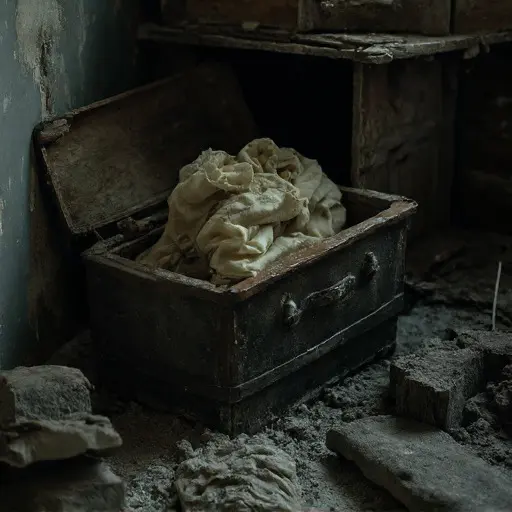
The bank took possession of the house shortly after the funeral, but the complexity of Silas’s tangled estate—combined with Caleb’s total disinterest in managing a bankrupt textile dynasty—meant the receivership never fully materialized. The house was simply secured and left to the slow, corrosive mercy of time. Caleb never returned to the Oriel Westerly, having already grieved the loss of his father and his connection to the house years earlier. The photograph in the final, hidden trunk is of Beatrice, taken on her 21st birthday, tucked inside the clothing she bought for the son her husband had rejected. This final, silent testament of a mother’s hope remains, locked within the walls, while the Oriel Westerly stands, permanently and silently abandoned.
