The Orchard House That Slowly Learned to Lean
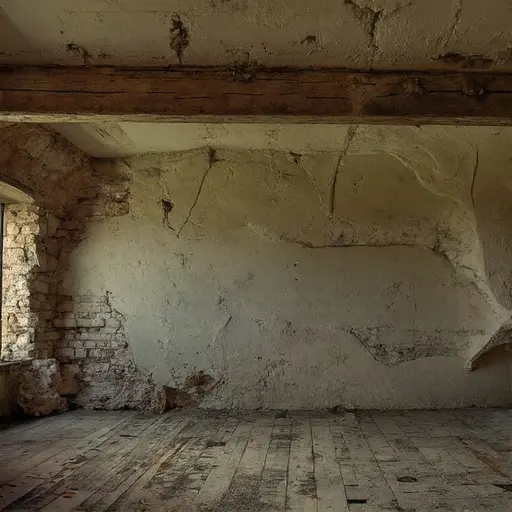
An abandoned family home sits in the middle of a wide orchard plain where rows of aging fruit trees extend in quiet repetition toward the horizon. The trees have long stopped being tended, yet they continue to bear weight season after season, their branches bending under forgotten fruit. The house between them was once ordinary, a rural residence built for stability and symmetry, but time has introduced a slow correction into its geometry—an adaptive deformation that feels more like growth than decay.
The structure remains grounded in familiar countryside architecture: faded cream plaster, weathered oak beams, and a tiled roof softened by years of wind and heat. Yet nothing holds a perfect line anymore. The house has developed a subtle imbalance, as if it has gradually exhaled toward one side and never fully returned. One wing appears slightly expanded outward, while the opposite side compresses inward, producing a gentle asymmetry that feels natural rather than damaged.
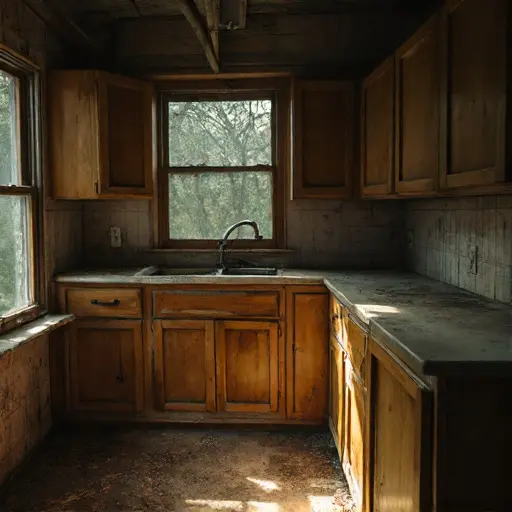
The roof carries the clearest record of this gradual transformation. Its overlapping tile planes no longer align in strict order but instead settle into uneven slopes that rise and dip like softened terrain. Some sections have sunk into shallow basins where orchard debris collects, while others lift gently, catching muted sunlight in warm bands of terracotta and weathered earth tones. It is not a broken roof, but one that has learned to rest unevenly.
Every window in the house is completely dark. There is no interior glow, no flicker of life, only deep matte voids embedded in the warm-toned facade. They reflect the orchard only faintly, as if the glass itself has stopped participating in reflection. Some frames are slightly elongated or subtly skewed, not due to damage but due to long-term structural adjustment, as if the house has been slowly stretching in response to seasonal cycles.
A wide porch wraps around the front and side of the house, no longer maintaining strict rectangular geometry. It curves gently with the land, widening near the main entrance and narrowing toward the orchard-facing edge. Wooden posts lean at varied angles, firmly rooted in soft soil, each one stable despite its individualized tilt. The steps remain intact but irregular, following the subtle settling of the ground beneath them.
Inside, the house is entirely silent and completely unlit. No rooms reveal any detail beyond their thresholds. Each doorway opens into absolute darkness, suggesting that interior space exists only as absence rather than illumination.
Around the house, the orchard continues its slow, patient growth. Apple and pear trees twist in irregular patterns, fallen fruit blends into the soil, and tall grasses reclaim former pathways. The air is warm and still, with soft golden light filtering through branches and settling across the uneven ground. There are no storms, no disturbances—only the quiet persistence of time acting on wood, plaster, and earth.
The house remains abandoned without ambiguity. No return has occurred, no restoration has taken place, and no sign of human presence has reappeared. It stands in the orchard as a slowly corrected structure—neither collapsing nor thriving—quietly reshaped by decades of natural pressure into a stable but subtly warped domestic form.