The Opaline House on the Empty Seaside Promenade
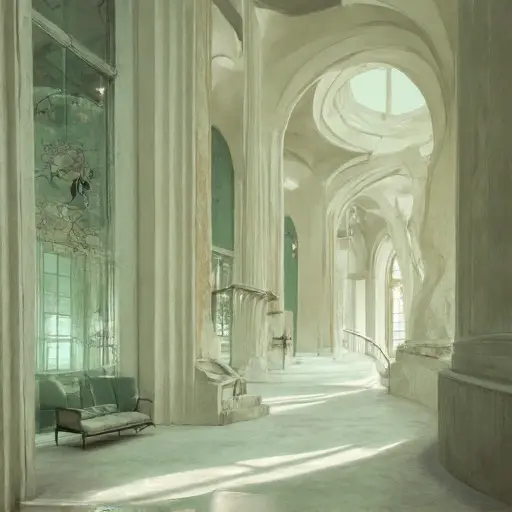
The Opaline House was commissioned at the turn of the 20th century by a private patron fascinated with maritime light and botanical form. Designed as a livable extension of the seaside promenade, the three-story townhouse blended Art Nouveau principles with Victorian structural discipline. Its façade was composed of pale opaline glass panels held within flowing ribs of white marble, creating a continuous sense of movement even in stillness.
The building’s asymmetry was intentional: walls rippled outward like carved waves, and interior rooms were arranged to follow curvature rather than strict geometry. It functioned as a seasonal residence and informal salon for artists, botanists, and visiting engineers who studied coastal light behavior and marine vegetation patterns along the shore.
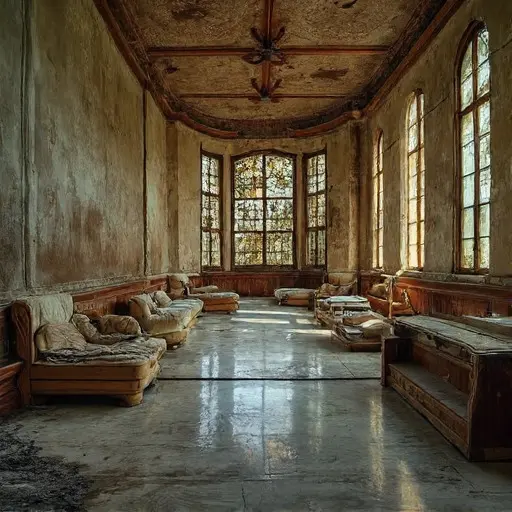
Decline began gradually as coastal erosion altered the promenade’s stability. The once-prominent cultural gatherings diminished, and maintenance of the complex glazing system became increasingly costly. Salt carried by wind began to etch the opaline glass surfaces, reducing their clarity and soft internal glow. The oxidized bronze roof slowly darkened and lost its fluid sheen, while slate sections began to shift under persistent seasonal storms. With the original patron’s death and no appointed successor, the house entered a prolonged legal and financial limbo. Rooms were closed one by one as structural concerns spread through the curved masonry ribs, and eventually the property was vacated entirely as the promenade itself lost civic relevance.
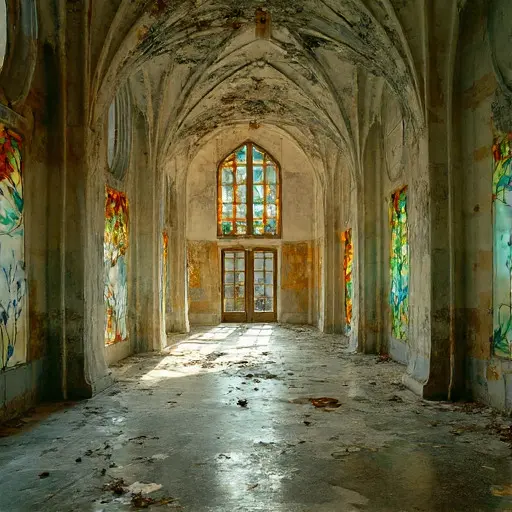
Today, the Art Nouveau–inspired townhouse remains on the quiet seaside promenade, overlooking still water and smooth stone embankments. The rusted iron café chair and cracked mosaic fountain basin remain in place as if waiting for returning guests. Inside, the building continues to preserve its flowing architecture in partial ruin—opaline glass dulled but still luminous in fragments, marble ribs softened by erosion, and botanical motifs fading into abstraction. It stands as a silent coastal relic of an architectural philosophy that once treated light, water, and structure as a single continuous form.