The Opal-Glass House on the Broken Shore
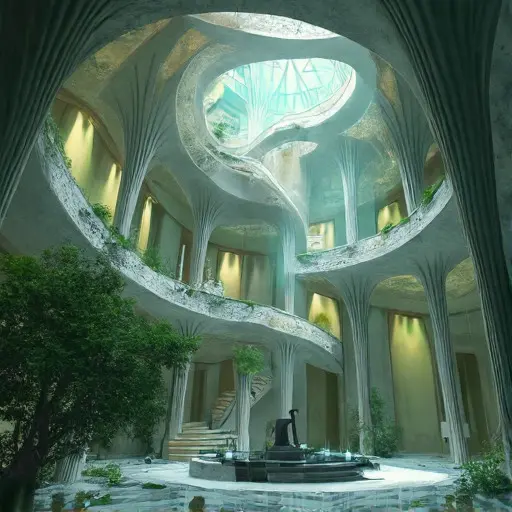
On a desolate basalt shoreline garden where black volcanic stone meets pale lavender sand and low coastal grasses, an Art Nouveau Victorian residence rises as a warped sculptural object rather than a conventional building. The structure is cast in matte ultramarine concrete, interrupted by bands of luminous opal glass embedded within sinuous pale silver structural ribs that sweep across the façade like frozen currents. Every surface suggests motion that has been arrested mid-flow.
The building’s geometry is intentionally unstable. Walls swell outward in convex curves before tapering inward again around a spiraling central bay that tilts slightly off-axis, as though the entire structure has rotated subtly out of alignment with gravity. The effect is not collapse, but controlled distortion—an architectural system designed to feel alive even in stillness.
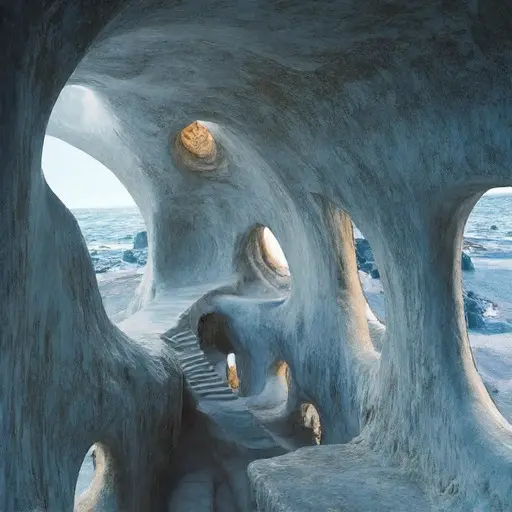
The roof is a layered composition of translucent emerald resin panels and brushed titanium arcs, unevenly staggered and organically folded. Rather than forming a protective cap, it behaves like a second skin stretched across shifting structural rhythms beneath it. Light passes through in muted gradients, but no interior glow exists; the building remains visually inert despite its complex translucency.
All windows are dark, irregular, and unresponsive. Circular voids and elongated teardrop openings puncture the walls at inconsistent intervals, some fractured into mosaic-like gaps where glass has completely failed. There is no sign of internal illumination anywhere in the structure—only the suggestion of depth, sealed and unreadable.
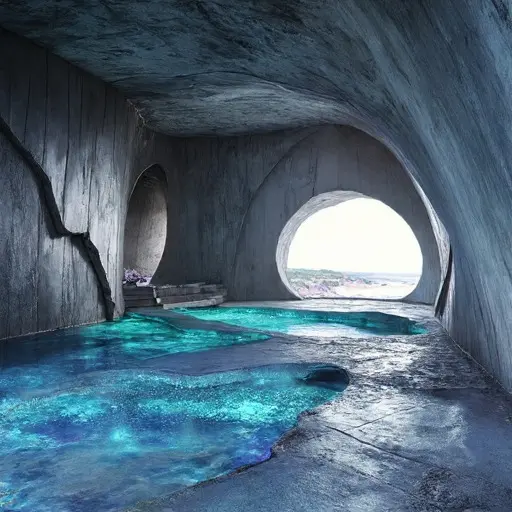
Outside, the abandoned shoreline garden spreads in quiet contrast. Black volcanic stone fragments sit scattered among pale lavender sand and wind-bent coastal grasses. A shattered reflective water basin of cracked mirror-polished stone lies tilted near a collapsed sculptural metal trellis, its geometry twisted and flattened by time. The entire site feels like a dialogue between engineered fluidity and geological stillness, neither fully winning over the other.