The Obsidian Glass Greenhouse Castle
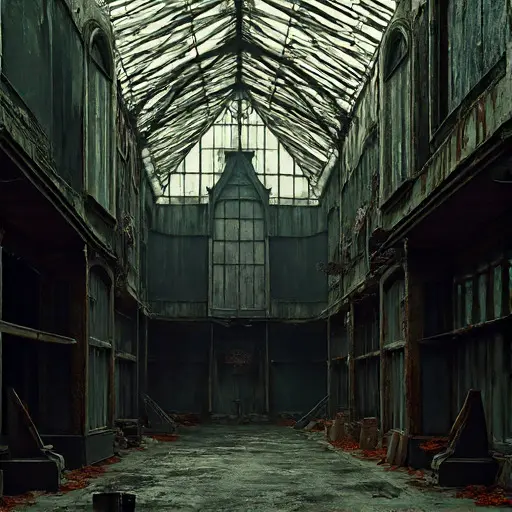
On a vast wind-scoured volcanic plain of obsidian gravel and distant basalt columns, a Castellated Gothic Revival Victorian family house rises like a hybrid between fortress and greenhouse. Built from black obsidian glass panels framed in white porcelain enamel and reinforced with verdigris copper ribs, the structure merges industrial precision with Gothic verticality.
Irregular crenellated towers punctuate the silhouette, their edges softened only by time and atmospheric wear.
At the center, a vast glass nave bows gently outward, its curvature subtly warped as if shaped by persistent wind pressure across decades. The interplay of rigid framing and fluid glass distortion gives the building a controlled instability, as though it might be both greenhouse and cathedral simultaneously.
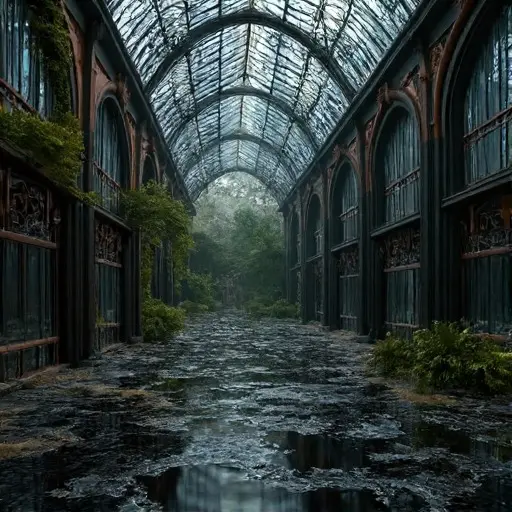
Inside, the structure is entirely unlit. No interior illumination exists anywhere within the building, leaving every corridor, nave, and tower in deep shadow. Only soft overcast daylight filters through obsidian glass panels, producing muted reflections rather than clear transparency.
The surrounding landscape is stark and elemental. A wind-scoured field of volcanic obsidian gravel stretches outward, broken only by towering basalt columns in the distance. The terrain feels ancient, as if the land itself has crystallized into sharp geological forms.
In the yard, remnants of forgotten domestic life remain. A cracked porcelain garden fountain lies fractured among dark stones, its once-smooth surface dulled by volcanic dust. Nearby, a weathered wooden swing set stands half-buried in gravel, its frames slowly being consumed by the black earth.
The house persists as a fragile contradiction—both greenhouse and fortress, transparency and shadow, built against a landscape that refuses softness.