The Obsessive Haunt of Corvid-Latch Hall
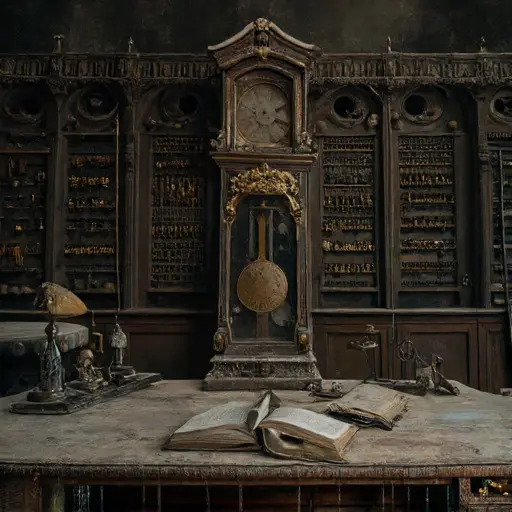
Corvid-Latch Hall was an architectural anomaly, a squat, fortress-like structure of black granite with a single, massive, oddly placed turret. Its name suggested both darkness and a final, permanent closure. The house sat low in a valley, perpetually shrouded in its own shadow. Entering the heavy front door, the air was surprisingly dry and thin, carrying a sharp, clean scent of fine dust and aged wood polish. The floorboards were thick, yet every sound seemed to carry and distort, echoing strangely in the vast, high-ceilinged rooms. The silence was not natural; it was engineered, an absolute quiet that felt deliberately enforced. This abandoned Victorian house was a machine built for one singular, desperate purpose: to defeat time.
The Clocksmith’s Relentless Pursuit
Corvid-Latch Hall was the secluded domain of Silas Pendelton, a brilliant but pathologically obsessive clocksmith and horologist of the late 19th century. His professional life demanded inhuman precision, a mastery of micro-mechanics, and an intimate understanding of temporal measurement. Personally, Silas was tormented by the accelerating march of time and the universal truth of mortality, particularly after the untimely death of his only daughter, Clara, at a young age. He saw his work less as a trade and more as a desperate, lifelong battle against decay. He built the Hall as a climate-controlled sanctuary, convinced that he could engineer a physical space so perfect that time, within its walls, would move slower.
The Chronos Vault
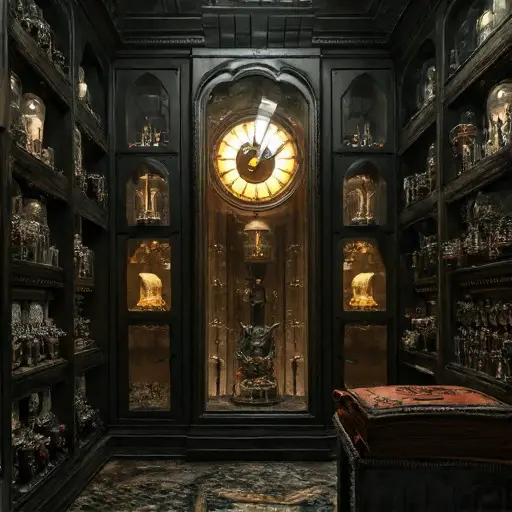
Silas’s Chronos Vault was the heart of his obsession, a sealed, air-locked chamber in the basement. Here, he kept his ultimate project. His final journal, found under the seized master clock, detailed his descent. He documented the failure of his mechanisms, the subtle temperature shifts, and the inevitable entropy that defeated his every effort. His entries devolved into a desperate plea to the universe to stop. He concluded that time was not merely measured by clocks, but experienced by the consciousness, and therefore, to stop time, one must stop the conscious experience. His last entry was a single date, followed by the phrase: “I have found the final stop.”
The Attic’s Frozen Tableau
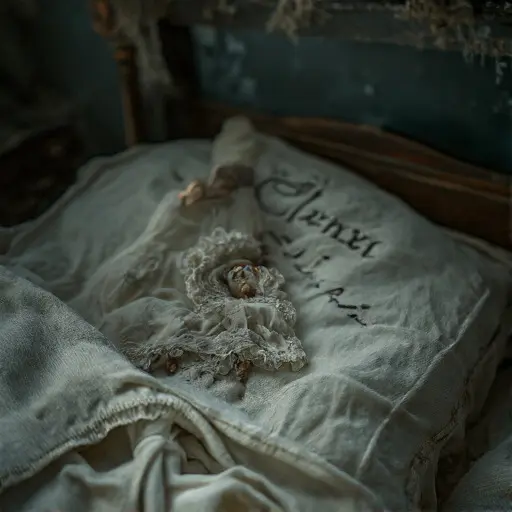
The largest room in the Hall, the unfinished attic, held the final, most unsettling clue. Here, under the towering, dark trusses, we found a collection of old toys and furniture draped in sheets. One sheet, however, covered a child’s small, four-poster bed. When the sheet was carefully pulled back, the scene was preserved perfectly: a pillow embroidered with the name “Clara,” a small, worn porcelain doll resting on the blanket, and, tucked beneath the pillow, a small, silver pocket watch. This watch was unique; it had no hands, only a perfectly smooth face. Silas’s final act, as suggested by his journal, was not to kill himself, but to eliminate his own subjective experience of time. The Hall’s enduring, oppressive silence is the sound of a man who stopped his own clock, leaving the abandoned Victorian house as the permanent, unchanging shrine to his daughter’s memory and his own obsessive failure to defeat mortality.