The Northreach Peninsula House Left Vacant After Lake Stillness Drift
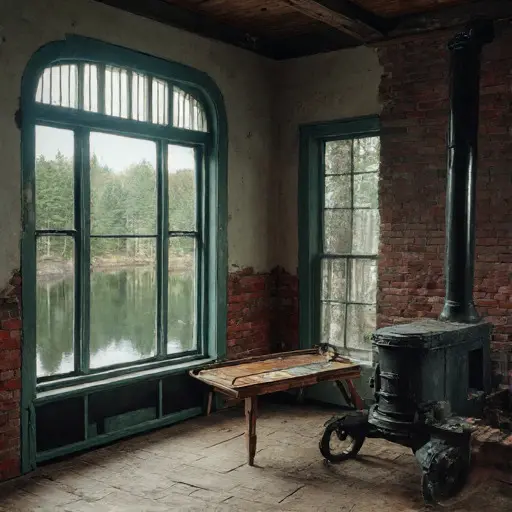
The Northreach Peninsula House was constructed in 1893 by the Ellery family on a narrow peninsula extending into a deep, still lake surrounded by dense conifer forest. The location was chosen for its isolation, direct water access, and the stable yet quiet environment provided by the surrounding pines. Built in a slightly elongated rectangular plan with a gentle angular bend at its center, the structure was designed to follow the curvature of the shoreline rather than impose a rigid geometry upon it.
The house was composed from pale granite blocks mixed with horizontal bands of dark red brick, producing a restrained but layered exterior palette of cool gray, muted rose-brown, and faint slate undertones. Over time, the lower sections of the stone became smooth and water-worn due to persistent lake mist, while upper portions retained more defined edges and texture.
The roof formed a continuous low-pitched structure that subtly shifted direction along the central bend of the building. Covered in weathered slate tiles ranging from deep black to stormy blue-gray with occasional pale green moss growth, the roofline maintained a quiet visual rhythm. Two brick chimneys positioned at opposite ends created a balanced but intentionally asymmetrical silhouette.
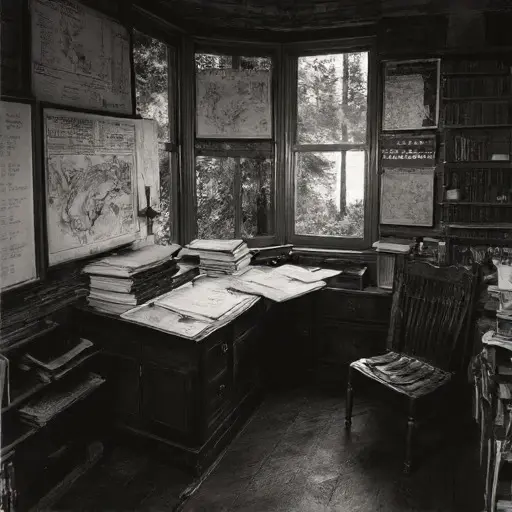
Inside, the Ellery household lived a quiet, self-sufficient life focused on forestry coordination, lake monitoring, and seasonal mapping of shoreline conditions. Henry Ellery managed regional timber and transport agreements, while his wife Edith handled correspondence and household records. The long lake-facing bay window served as a primary observational space, allowing continuous reading of water movement, weather shifts, and forest reflections.
Early financial strain
By the late 1920s, regional forestry and lake transport systems became increasingly centralized, reducing the importance of small independent peninsula households. As administrative control consolidated, the Ellery family saw reduced demand for local monitoring and fewer opportunities for economic participation tied to shoreline management.
Environmental aging became more visible across the structure. Slate roof tiles developed uneven moss patterns in shaded seams, while timber window frames faded into muted teal-gray tones with softened edges. The granite base darkened slightly in moisture-heavy areas, reinforcing the sense of long-term exposure to lake mist and forest humidity.
Gradual decline in the household
As financial pressures increased, maintenance of the peninsula paths and shoreline reinforcement structures was gradually reduced. Pine needles and low shrubs began reclaiming the gravel approach to the house, while moss spread along stone edges near the waterline. The distinction between maintained grounds and natural forest edge slowly dissolved.
Family members eventually relocated to more centralized settlements where forestry and administrative work were concentrated. Their departure marked a significant reduction in occupancy, leaving only minimal oversight of the property. Upper rooms were closed in sequence, and daily activity contracted into a smaller portion of the main structure.
Final abandonment phase
By the early 1940s, the Northreach Peninsula House was no longer fully inhabited. Utility services were discontinued following prolonged financial arrears, and routine maintenance ceased entirely. Lake air and forest humidity entered freely through aging seals in windows and timber joints, gradually altering interior materials and softening structural definition.
Final deterioration
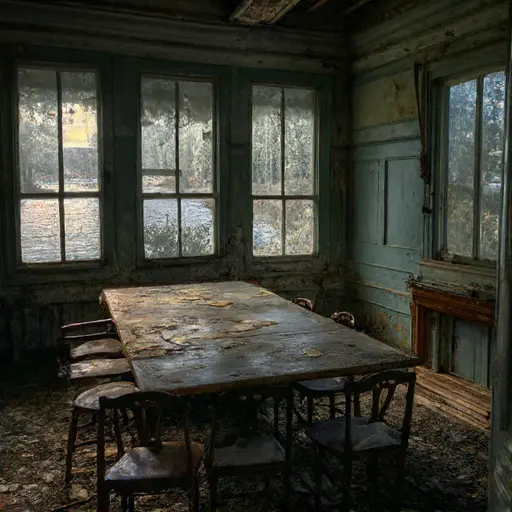
By the mid-1940s, no formal ownership or active maintenance of the Northreach Peninsula House remained. Legal correspondence was repeatedly returned undelivered, and no heirs reestablished residence. The structure persisted on the peninsula in a state of quiet abandonment, slowly weathering under lake mist, forest encroachment, and seasonal atmospheric change. No restoration or reoccupation followed. The house remains empty beside the still water, its elongated form gradually merging into the muted geometry of forest and shoreline.