The Narrow Victorian Townhouse Left in the Quiet Rain Street
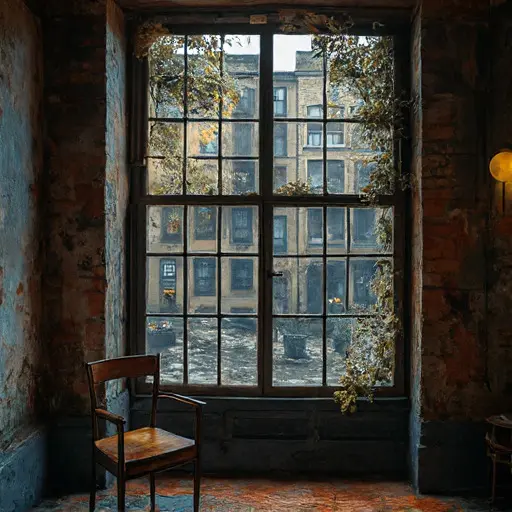
The townhouse was constructed in 1872 during the rapid expansion of the city’s eastern rail and trade district, when narrow plots of land were subdivided to accommodate densely packed Victorian housing. Unlike larger middle-class residences nearby, this structure was built to maximize vertical living within an unusually restricted footprint, resulting in its compressed proportions and strict symmetrical façade. It was originally owned by a clerk employed in the nearby customs office, whose family occupied the building for several decades without major architectural alteration.
The design followed the disciplined urban grammar of the period: three vertical bays, aligned sash windows, and a restrained stone entry arch that emphasized order and permanence. While modest in scale, the craftsmanship of the façade reflected the era’s attention to proportion and material honesty. Brick was locally fired, producing natural tonal variation that remains visible even today, while timber elements were painted in a deep ink-blue chosen for both aesthetic contrast and weather protection against the damp city climate.
Through the late 19th and early 20th centuries, the house remained continuously occupied. Records indicate routine maintenance cycles typical of urban Victorian housing: repainting of timber elements every decade or so, partial roof repairs following seasonal storms, and gradual replacement of iron fixtures as corrosion occurred. These interventions created a layered material history that is still legible in the building’s surface today.
Gradual Urban Decline and Material Aging
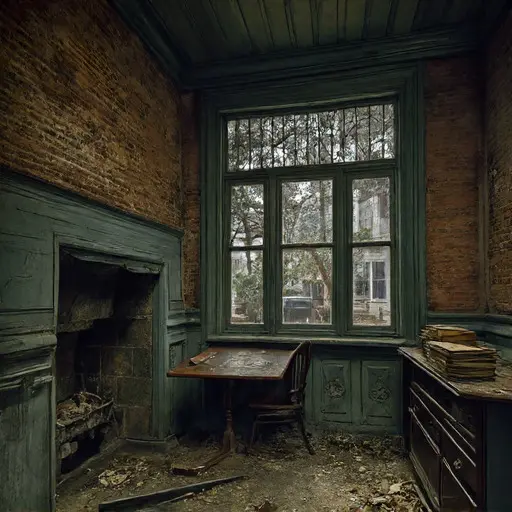
By the 1930s the surrounding district began to experience gradual socioeconomic decline as industrial activity shifted away from the city edge. Smaller residential streets lost commercial vitality, and property maintenance became increasingly inconsistent across the neighborhood. The townhouse remained occupied, but investment in upkeep diminished as owners faced rising costs and reduced income stability.
Exterior paint began to fail unevenly, particularly on lower timber sections exposed to splashback from the cobbled street. Brick joints in certain areas receded as mortar aged, while previous repairs introduced subtle inconsistencies in texture and tone. These variations did not compromise structural integrity but contributed to a visibly stratified surface history.
During this period, the street itself began to change character. Traffic decreased, and footfall diminished. Cobbles remained intact but accumulated moss in joints where drainage slowed. Rainwater pooled in shallow depressions, reflecting façades in fragmented, irregular patterns. Vegetation remained minimal but persistent, with hardy species establishing themselves in cracks and at wall bases.
By the early 1940s, upper-floor occupancy had become intermittent. Curtains remained drawn for extended periods. Interior lighting was rarely observed from the street. Postal records indicate increasing irregularity in correspondence delivery and property tax payments.
Final Vacancy and Preservation Through Absence
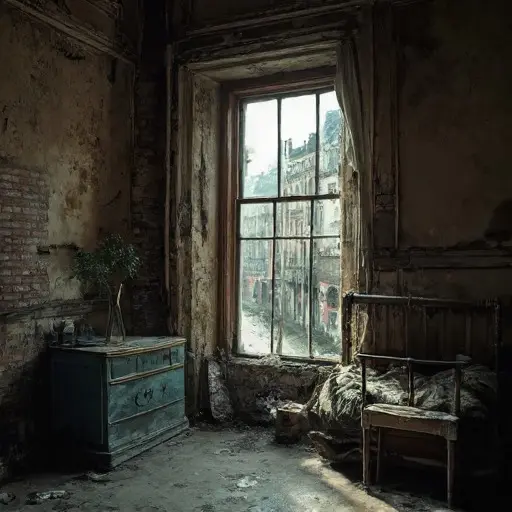
The final recorded occupation of the townhouse ended in 1951 when the last resident relocated following a combination of financial pressure and declining health. No formal redevelopment followed. Ownership passed through unresolved inheritance channels, and the property remained legally intact but effectively unattended.
Unlike heavily decayed structures elsewhere in the district, the townhouse did not collapse into ruin. Its abandonment occurred within a stable environmental envelope: a sheltered street with limited exposure to extreme weather and relatively slow structural degradation rates. As a result, the building retained its architectural clarity even as it ceased to function as a residence.
Over time, the surrounding street transitioned into a quiet residual corridor of the old city. Nearby buildings followed similar trajectories of partial abandonment or low-density occupancy. The urban fabric remained physically present but functionally reduced, creating a space defined more by stillness than activity.
Today the townhouse still stands within its narrow Victorian street, its sun-faded terracotta brick, deep ink-blue timber, and oxidized ironwork recording decades of layered weathering. Windows reflect an empty roadway softened by moss and rain. No restoration has occurred, no new tenancy has been established, and no redevelopment plan has been enacted. The building persists as a precise architectural artifact of urban Victorian life, held in quiet suspension within a street that continues to exist without returning to its former rhythm.