The Muted Memory of Hearth-Echo Court
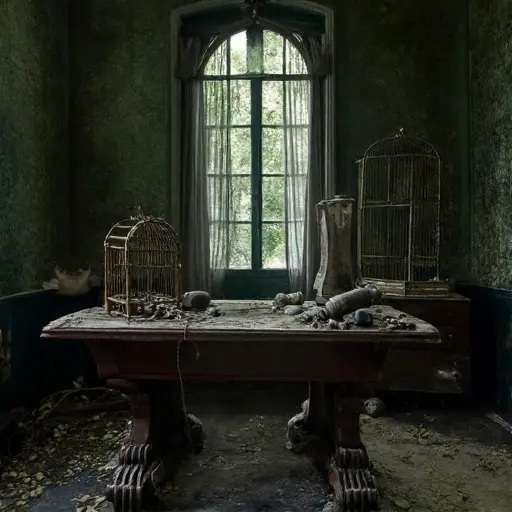
Hearth-Echo Court, a mansion of heavy, asymmetrical stone and numerous gables, stood deep within a quiet, misty valley. The name itself felt like an instruction: a space meant to catch the sound of a fading warmth. The house was built for auditory isolation, its thick walls designed to buffer noise. Upon entering, the atmosphere was immediately heavy and dry, smelling faintly of old books, moth-eaten velvet, and a curious, sharp tang of ozone. The floors were carpeted with the brittle remnants of thick, silent rugs, muting every footstep. The silence here was not restful; it was oppressive, a profound emptiness that seemed to strain to hear something that was no longer there. This abandoned Victorian house was a sensory deprivation chamber, where the only thing preserved was the agonizing absence of sound.
The Linguist’s Final Vocabulary
Hearth-Echo Court was the sanctuary and laboratory of Dr. Julian Albright, a renowned, brilliant, but pathologically anxious linguist and phonetician of the late 19th century. His professional life demanded the precise study of language, articulation, and the subtle mechanics of the human voice. Personally, Dr. Albright was defined by a crippling, escalating fear of silence—a deep terror that his own voice, and all memory of human speech, would eventually fade into an incomprehensible void. He built the Court with specialized acoustic rooms and recording devices, attempting to capture and archive every sound and word uttered within its walls, turning his home into a vast, private dictionary.
The Phonetics Lab
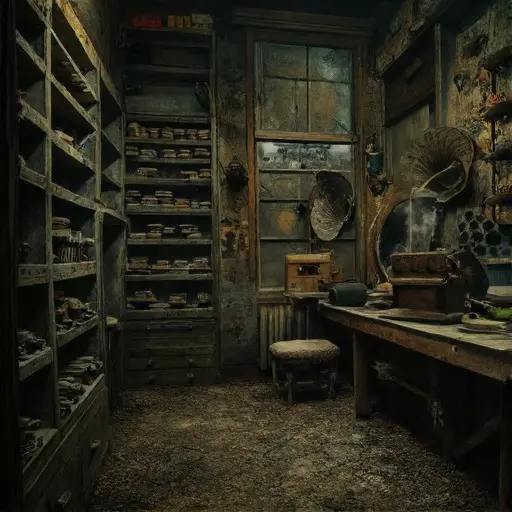
Dr. Albright’s phonetics lab was a bizarre, sound-dampened chamber. Here, the remnants of his recording equipment were scattered among hundreds of wax cylinders, each carefully labeled with a date and a brief, cryptic description—“The Sound of Laughter, 1891,” “A Whisper of Doubt.” His final journal, found rolled inside one of the brass recording horns, detailed his escalating despair. He realized that the very act of capturing sound destroyed the original spontaneity and emotion. He began to focus his research solely on the voices of his wife, Elara, and their young daughter, Lydia, creating an exhaustive sonic archive of their lives. His final entry read: “The word is not the sound. The echo is the lie. Only the memory endures.”
Lydia’s Playroom Archive
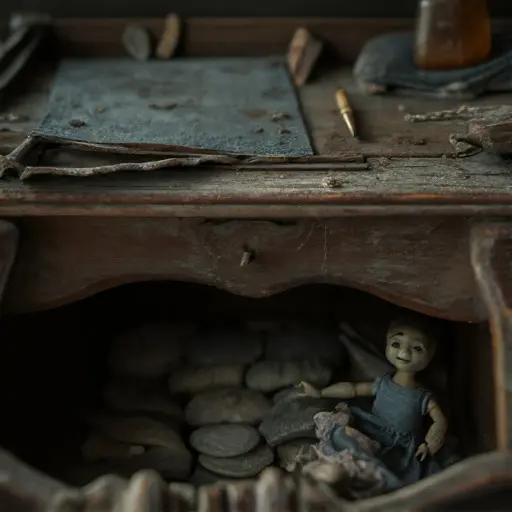
The most poignant and chilling room was the children’s play area, located in a light, high-ceilinged room that had been acoustically treated to capture echoes. Here, amidst abandoned wooden toys and miniature furniture, we found the key to the final silence. Under a small, dust-covered hobbyhorse, there was a series of small, sealed, iron boxes. Each box contained a single, pristine, blank sheet of wax cylinder—untouched, unrecorded. Tucked inside the last box was a final, devastating note from Elara: she and Lydia had left the house months ago, unable to bear Julian’s pathological need to record their every word, turning their lives into an archive. Her note read: “The only way to keep our voices was to take them away from your machine.” Julian Albright was later found in the phonetics lab, having sealed himself in, his voice forever lost to the silence he so feared. The muted memory of Hearth-Echo Court is the oppressive stillness of a house engineered to capture every sound, yet left with the ultimate, tragic emptiness of a final, unrecorded voice within the abandoned Victorian house.