The Montclair Palace Left Vacant After Estate Administration Collapse
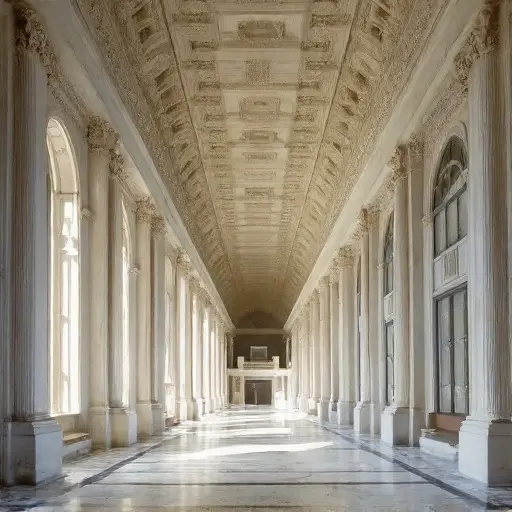
The Montclair Palace was completed in 1882 for the de Lormier family, regional administrators overseeing forest governance, land arbitration, and civic ceremonial functions within the surrounding woodland district. Designed in strict Beaux-Arts tradition, the palace emphasized axial clarity, monumental symmetry, and controlled classical ornamentation. Its pale marble and limestone façade, enriched with carved garlands, laurel wreaths, and refined friezes, was intended to express institutional authority and cultivated order within a natural forest setting.
Inside, the palace operated as both administrative center and ceremonial residence. Henri de Lormier oversaw regional land documentation and arbitration councils, while his wife Claire managed formal receptions and archival correspondence. The building functioned as a hub for structured governance, hosting deliberations, recordkeeping, and seasonal administrative gatherings tied to forest and agricultural oversight. For decades, it remained active under stable institutional frameworks.
Early signs of decline
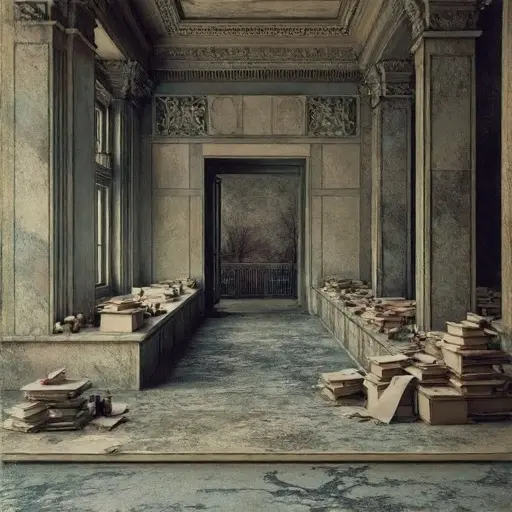
By the early 1930s, shifts in regional governance structures and consolidation of administrative authority reduced the function of independent estates like Montclair Palace. Centralized bureaucratic systems absorbed much of the palace’s former responsibilities, leaving its institutional role diminished. Funding for maintenance and ceremonial operation declined steadily, leading to deferred repairs across both structural and decorative elements.
As administrative activity decreased, large portions of the palace were closed off. Chambers that once hosted councils and formal proceedings fell silent, and documentation processes slowed significantly. The rhythm of governance that once defined the palace became fragmented, with records left incomplete and correspondence delayed indefinitely. Outside, the surrounding forest remained stable and evenly spaced, forming a quiet boundary that contrasted with the building’s internal stagnation.
Final abandonment phase
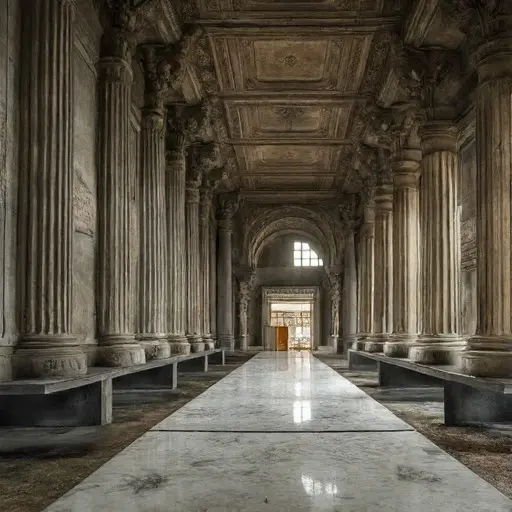
By the late 1940s, Montclair Palace was no longer actively occupied. The de Lormier descendants had relocated to urban administrative centers, and no return to the estate was recorded. Ownership documentation became fragmented through institutional restructuring, and no formal transfer of stewardship was completed. Utility services were discontinued, and the palace was left without maintenance or oversight. The surrounding forest remained calm and evenly spaced, preserving the clearing while allowing subtle natural encroachment at the edges.
The palace persists as an abandoned Beaux-Arts monument, still structurally intact and visually dominant within the forest clearing. No restoration or reoccupation has occurred. It remains a silent architectural relic of institutional authority, gradually softened by time, weathering, and the slow return of nature.