The Mistwood Victorian Manor
An abandoned Victorian family manor sits at the edge of a dense mist-laden woodland where tall beech trees and ancient yews form a heavy, enclosing canopy. The structure is a symmetrical yet subtly elongated stone residence built from pale limestone and soft cream brick, its exterior weathered into layered tones of cool gray, faded ivory, and moss-stained green along the lower masonry. Tall sash windows follow a disciplined rhythm across the façade, their glass still intact but dulled by condensation and age, reflecting the muted forest beyond rather than revealing interior life.
The central entrance is defined by a modest portico supported by carved stone columns and a shallow triangular pediment, leading into a broad hallway that forms the architectural spine of the manor. Two balanced wings extend from this core: one containing formal reception rooms designed for gatherings and social life, and the other housing more private family quarters.
The overall plan is classical Victorian in structure, yet slightly expanded through subtle additions made over decades, giving the building a gentle elongation that feels historical rather than intentional.
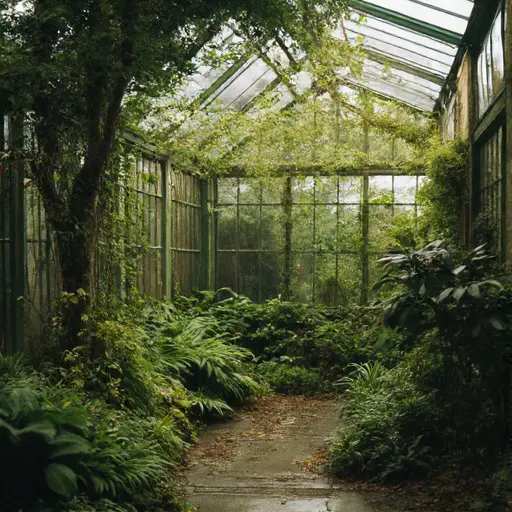
At the rear, a conservatory extends outward in delicate contrast to the heavy stone construction. Wrought iron framing supports large glass panes softened by mineral haze, within which a contained ecosystem has formed. Ferns, ivy, and shade plants grow in quiet abundance, creating a sealed botanical chamber that never fully escaped into the surrounding estate. Nearby, service corridors connect to a detached kitchen wing and a narrow garden passage lined with stone urns now filled with soil, moss, and spontaneous growth.
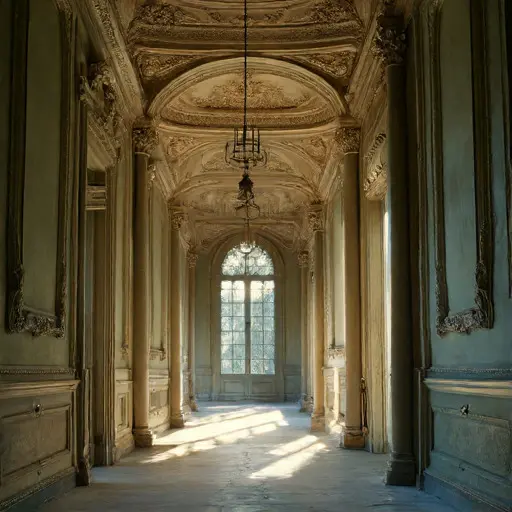
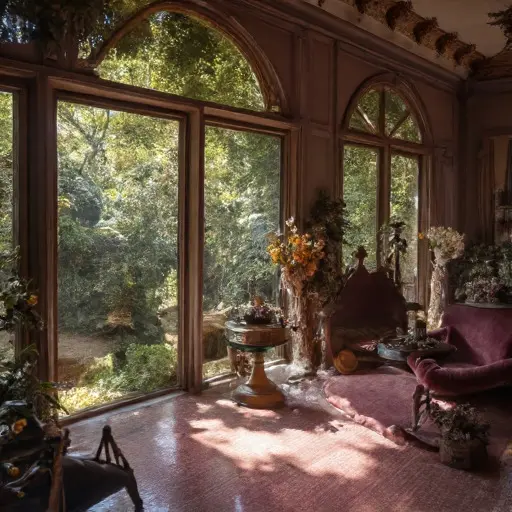
Inside, the manor remains orderly and preserved. High ceilings are decorated with ornate plasterwork, while faded wallpaper in muted sage, dusty rose, and pale cream patterns lines the walls. Long corridors are illuminated by tall windows that filter soft forest light into even, diffuse illumination. Wooden floors show gentle wear rather than structural decay, and furnishings—settees, writing desks, and carved wooden cabinets—remain positioned with quiet permanence, as if awaiting the return of their occupants.
The surrounding grounds have transitioned into a managed wilderness. Former gravel paths are now softened by moss, and ornamental hedges have loosened into irregular green forms. Ivy grows selectively along architectural seams, respecting the manor’s geometry rather than overwhelming it, preserving the sense of intentional design within natural reclamation.
The atmosphere is overcast and tranquil, with diffuse light filtering evenly through dense canopy and glass. The entire scene conveys quiet dignity and architectural continuity—an enduring Victorian family estate slowly absorbed by a stable, patient forest without collapse or violence.