The Mint Green Cottage Beyond the Forgotten Road
At the edge of a quiet woodland neighborhood, beyond a forgotten country road lined with trees and wild growth, stands an abandoned Folk Victorian family house slowly blending into the surrounding forest. Painted in a faded pale mint-green, the three-story residence remains a delicate reminder of a simpler era, where handcrafted details and natural materials created homes with warmth and personality.
The house rests upon a foundation of warm grey fieldstone, its rough texture contrasting beautifully with the softened painted wood above. Years of weather have gently altered the exterior, leaving subtle variations in color, worn edges, and a quiet patina that gives the home a timeless presence rather than a sense of sudden decay.
A weathered cream-colored tin roof stretches across the upper levels, its aged surface showing gentle dips and uneven sections shaped by decades of exposure.
The roofline no longer follows perfect symmetry, instead creating a naturally softened silhouette that feels as though the structure has slowly settled into the landscape around it.
The Folk Victorian character of the house is revealed through its delicate craftsmanship. Intricate gingerbread trim decorates the porch edges, carved wooden posts support the covered entry, and narrow bay windows extend outward with modest elegance. Every detail reflects the handmade quality of a family home built with care.

The façade carries the gentle irregularity of age. The walls bow slightly outward in places, the windows are spaced with subtle differences, and the porch curves around one side of the building rather than following a rigid straight line. These imperfections give the house a natural character, as if it has grown together with the woodland surrounding it.
A small asymmetrical attic dormer rises from the roof, adding another layer of charm to the upper silhouette. Its slightly offset position reinforces the home’s informal Folk Victorian design, creating a structure that feels personal and unique rather than formally planned.
The porch remains one of the most inviting features of the abandoned residence. The curved wooden platform follows the side of the house, with aged railings and faded paint revealing traces of the craftsmanship that once welcomed visitors. Vines and vegetation have begun weaving around sections of the structure, slowly reclaiming the space.
Beyond the porch, the landscape stretches into a quiet woodland setting. Tall birch trees rise above the property, their pale trunks contrasting with the deep greens of moss, ferns, and thick ground cover. Overgrown hedges blur the boundary between the garden and the nearby forest.
A forgotten country road passes nearby, mostly hidden beneath tree branches and seasonal growth. The peaceful isolation of the location adds to the feeling that the house has been waiting silently for years, protected by the surrounding woodland.
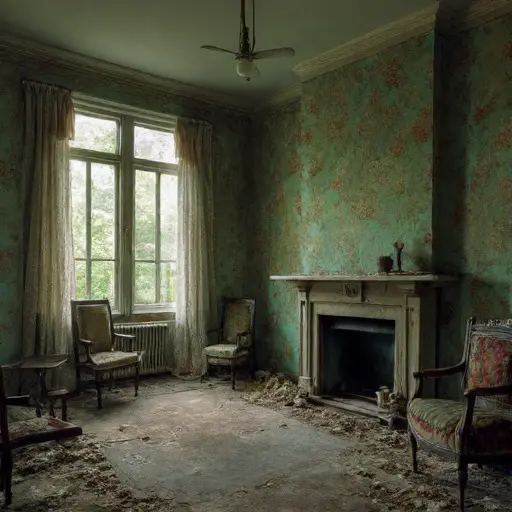
Inside, the residence preserves the atmosphere of a former family home. Wooden floors show years of wear, while decorative trim and handcrafted details remain visible beneath layers of dust and age. The rooms retain a quiet warmth, with faded colors and traditional Victorian proportions creating a sense of preserved history.
The main living spaces feature tall ceilings, narrow bay windows, and carefully carved woodwork. The windows allow soft daylight to filter across abandoned furnishings, revealing textures of aged fabric, worn timber, and faded wallpaper.
The staircase remains a central architectural feature, rising through the three-story interior with simple wooden craftsmanship. The handrails and steps show the marks of generations of use, connecting the lower gathering spaces with the quieter rooms above.
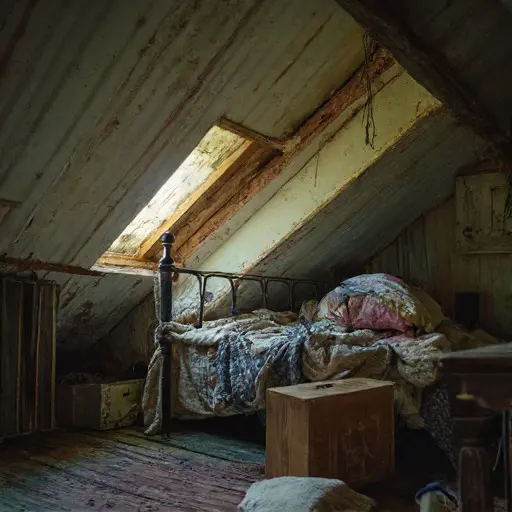
The upper floors contain smaller rooms tucked beneath the aging roofline. The attic spaces feel especially connected to the outdoors, with views of birch branches, forest greenery, and the changing seasons beyond the dormer windows.
Outside, the garden remains filled with small reminders of the home’s former life. A rusted metal garden swing stands beneath an old maple tree, its frame surrounded by grass and fallen leaves. Nearby, a weathered wooden fence stretches along the front garden, its broken gate hanging open toward the overgrown path.
The abandoned Folk Victorian house continues to exist in quiet harmony with its surroundings. The mint-green walls, cream roof, fieldstone foundation, and handcrafted details have weathered together with the forest, creating a portrait of a home slowly becoming part of the woodland landscape.
Though empty, the residence still carries the feeling of family memories, peaceful afternoons, and everyday moments that once filled its rooms. Hidden beyond the forgotten road, it remains a gentle and enduring symbol of Victorian craftsmanship reclaimed by nature.