The Merrowthane House Papers and the Lamplit Desk
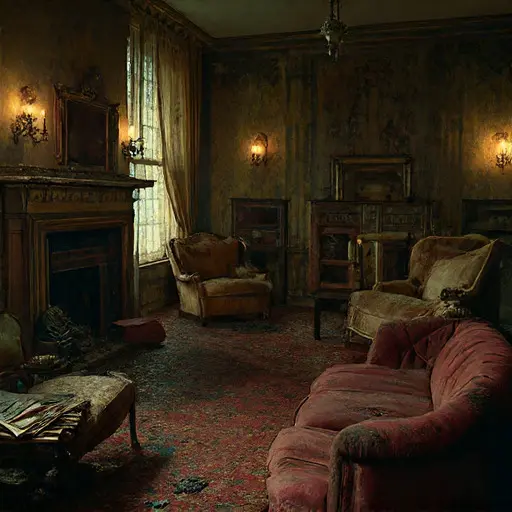
The parlour air is thick, unmoving, touched by the faint acidity of dried ink and the sweetened must of collapsing upholstery. Here, abandonment feels patient, as if the house waited politely for a return that never arrived. Every object remains exactly where last handled, not staged but surrendered to time.
The Measured Life of Charles Edwin Merrowthane
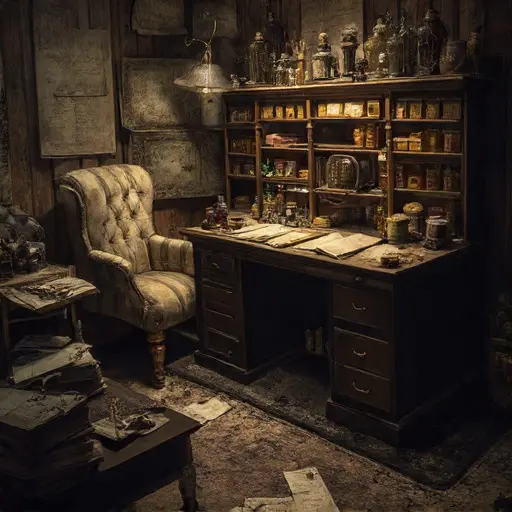
Charles Edwin Merrowthane, clerk for an agricultural trade office, lived here with his wife, Louisa, and their son, Julian. Charles’s profession demanded quiet precision—tallies, crop reports, shipment timetables—and his habits at home reflected this discipline. In the Study, his ledgers sit in organized towers, each marked with neat labels; invoices are pinned in exact rows on a corkboard; and correspondence lies bundled with twine, arranged chronologically in drawers he seldom let others touch.
Louisa maintained the household with gentle, meticulous rhythm. Her sewing, cookbooks, and handwritten household lists linger throughout the rooms. Pressed leaves from the garden she once tended rest between the pages of poetry volumes. Julian’s presence remains in chalk-dusted slates, toy blocks, and a set of practice readers annotated with Louisa’s tidy script.
But Charles’s workload grew heavier after the office consolidated its staff. His handwriting tightened; his ledgers became increasingly blotched where he paused too long. Recurring notations in the margins—corrected sums, repeated calculations—suggest fatigue and mounting worry. When Louisa fell ill, the strain intensified. After her passing, Julian was sent to live with relatives, and Charles’s routines collapsed entirely. He drifted through the house without tending to it, leaving tasks mid-motion: letters unsent, garments half-mended, and rooms unvisited. Eventually, he too left—quietly, without finishing the work he’d meant to resume.
The Hallway of Softened Footsteps
The upstairs corridor narrates the family’s quiet departure. Its runner rug is creased where Charles once paced, diverted by boards loosened with age. A hall table bears gloves, collar pins, and a broken mechanical pencil. Empty picture hooks punctuate the wallpaper, faint outlines marking where portraits were once removed in gradual, hesitant stages.
The Mending That Never Finished
In the Sewing Room, Louisa’s last work remains frozen. A half-hemmed garment rests beneath the presser foot of the treadle machine. A basket holds muslin pieces folded with care, now stiff from settling dust. Pincushions bloom with rusted needles; spools lie toppled in arcs across the table, their threads faded into muted pastels. Here, the absence is quiet, deliberate, and unhurried.
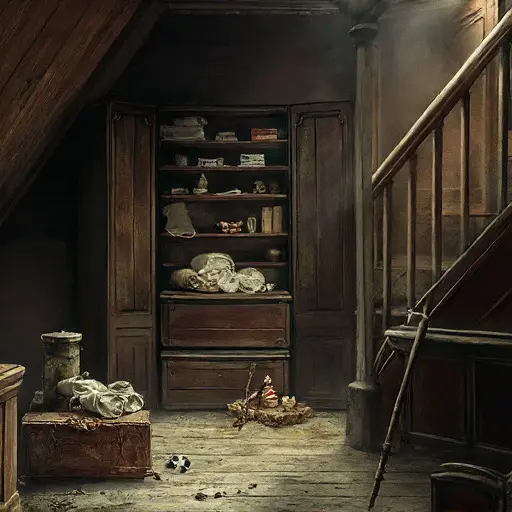
Behind a crate, a note in Charles’s familiar script lists: “papers to finish, accounts to balance, letters to send.” No dates accompany it—only expectation. It remains there still, as Merrowthane House lies untouched, its interior settled into a long and quiet abandonment.
