The Marrowgate Corner House Left Vacant After Trade Route Decline
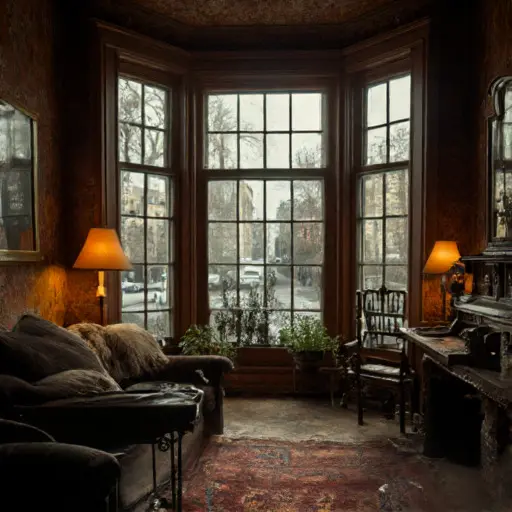
The Marrowgate Corner House was built in 1903 at a crooked intersection where two older trade streets met unevenly in a growing industrial district. Its first residents were the Ellison family—Walter Ellison, a freight clerk, his wife Clara, and their daughter Maud. The house’s slight rotation off the street grid was already present when they moved in, a structural imperfection caused by unstable soil beneath the junction that had never been fully corrected during construction.
Despite its awkward alignment, the house was considered desirable due to its proximity to trade offices and markets. For two decades, the Ellisons maintained a steady household, relying on Walter’s employment in logistics coordination. The interior was modest but well cared for, with each room adapted carefully to the irregular geometry of the structure.
However, the very position that once made the home convenient would later contribute to its isolation as commercial routes shifted away from the district.
EARLY SIGNS OF URBAN AND ECONOMIC DECLINE
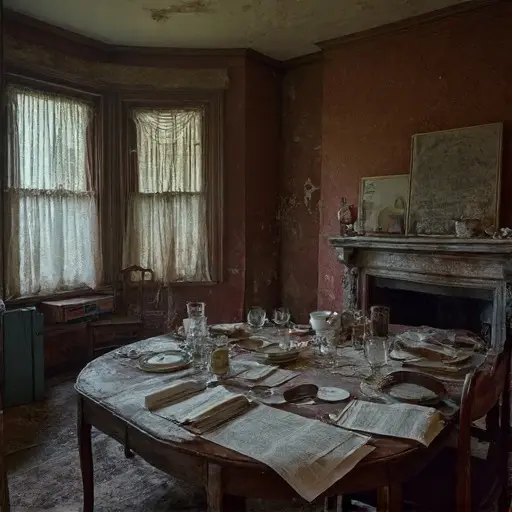
By 1930, the surrounding trade routes that once supported the Ellison household had begun to shift toward larger, more modern thoroughfares. Smaller streets like Marrowgate Junction were gradually bypassed by freight traffic, reducing local commerce and weakening employment stability for residents tied to logistics work.
Walter Ellison’s position was reduced first, then made redundant entirely when his company consolidated operations. Without steady income, the household began to fragment financially. Maintenance of the property became increasingly sporadic, and small structural issues were left unresolved.
The house itself began to reveal the consequences of its uneven foundation. Doors in the upper floors began to stick, and minor cracks spread along the corners where the building’s off-grid orientation created long-term stress points. The fire escape on the side rusted more visibly, its joints darkening under persistent damp air from the intersection below.
Rooms were gradually abandoned within the house, beginning with the lower storage areas and eventually extending into parts of the upper floor.
FINAL OCCUPATION AND COMPLETE VACANCY
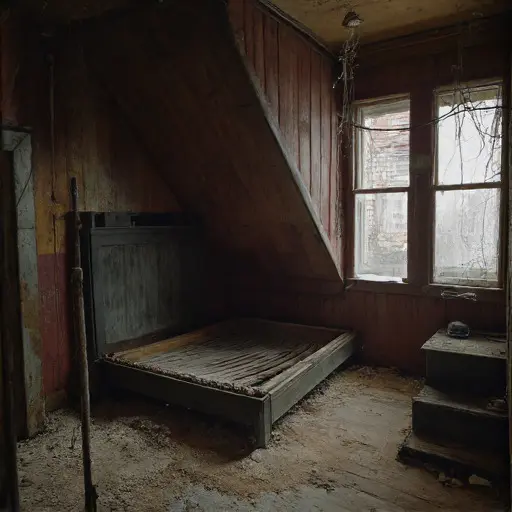
By the early 1940s, the Ellison family had fully dispersed. Walter had passed away after years of unstable employment, Clara relocated to distant relatives following financial hardship, and Maud left the district for wartime industrial work elsewhere. With no remaining household members, the property was left legally unclaimed for a period of time.
The surrounding neighborhood continued to decline as commercial routes shifted permanently away from Marrowgate Junction. Without foot traffic or economic relevance, the house lost both its social and practical context. Municipal records noted its condition but made no effort toward restoration, as the structure remained technically sound despite its aging materials.
By 1947, the Marrowgate Corner House was formally recorded as vacant. No redevelopment followed, and no new tenants were assigned. The building remained in place, its angled geometry unchanged, its interior frozen in gradual deterioration.
The house still stands at the crooked intersection, uncorrected and unoccupied, its rooms empty, its ownership unresolved, and its slow decline continuing without interruption or return.