The Market-Arcade Townhouse Left in a Forgotten Trade Lane
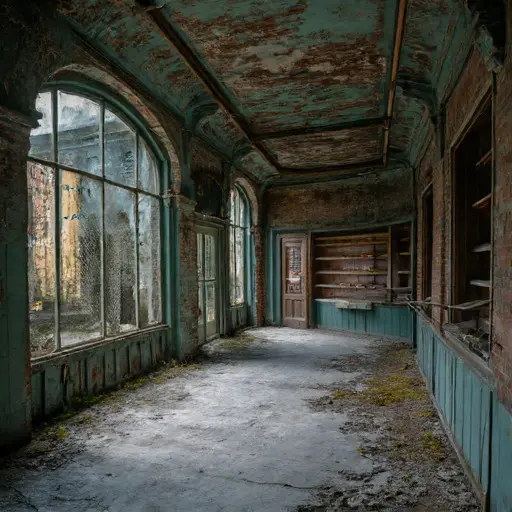
The Market-Arcade Townhouse of East Hollow Lane was constructed in 1887 during the height of municipal market expansion, when urban planning favored tightly integrated commercial-residential buildings within pedestrian trading corridors. Designed for a single merchant family, the structure combined a street-level shopfront with living quarters above, maximizing limited space within the dense Victorian arcade system. Its three-story vertical form was typical of the district, yet its refined material palette and careful ornamentation distinguished it as one of the more desirable properties in the market quarter.
The building’s lower level functioned as a general goods and provisions shop, with arched display windows designed to showcase seasonal merchandise to passing foot traffic. Above, the second floor served as family living quarters, while the attic housed a small workspace used for bookkeeping and textile repair. A narrow rear passage connected the residence to a shared courtyard behind the arcade, allowing discreet movement between neighboring properties without entering the main trade lane.
Commercial Decline and Urban Transition
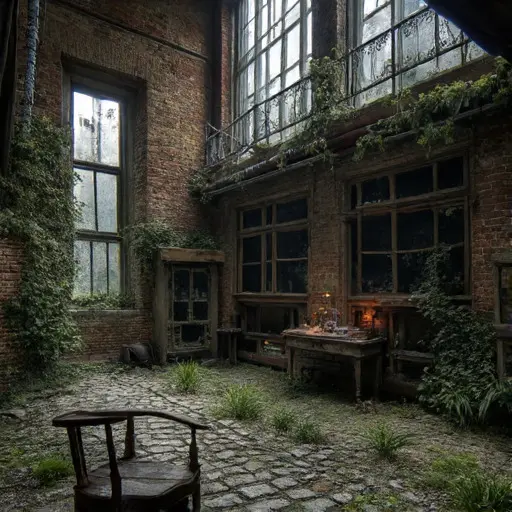
By the early 1930s, the East Hollow market district began to experience steady economic decline as trade routes shifted toward larger centralized commercial centers. Smaller merchant families found it increasingly difficult to sustain foot traffic-dependent businesses, and many storefronts in the arcade either closed or converted into storage-only spaces. The townhouse remained partially occupied for several years after the shop ceased full operations, but retail activity never recovered to its original levels.
Financial records indicate that the ground-floor shop was intermittently leased to short-term vendors before becoming permanently vacant. As income declined, maintenance of the upper residential levels also diminished. Roof repairs were deferred, and minor water ingress from the steep slate roofing began affecting interior plasterwork. The rear courtyard passage, once a practical service route, became overgrown and partially blocked by vegetation spreading from adjacent properties.
Final Abandonment of the Arcade Dwelling
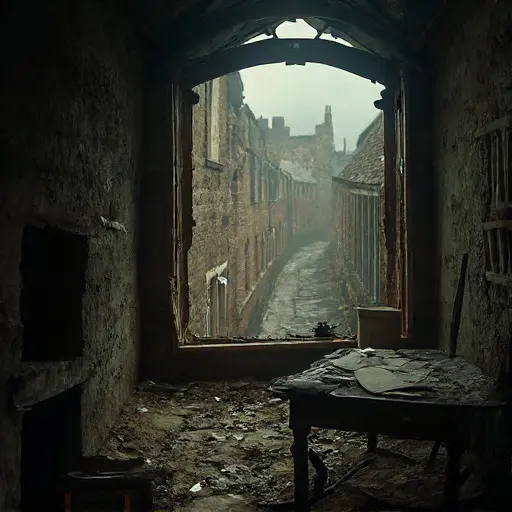
By 1942 the Market-Arcade Townhouse was officially listed as unoccupied following a district-wide inspection of abandoned commercial-residential properties. No subsequent tenant took permanent residence, and the property remained structurally intact but economically obsolete. Ownership passed through several administrative hands without restoration investment, leaving the building in prolonged legal and physical limbo.
In the decades that followed, the surrounding arcade continued to deteriorate. Adjacent shopfronts closed, signage was removed or collapsed, and the once-bustling pedestrian corridor became a quiet passage of stone, moss, and weathered brick. The townhouse itself remained upright, its arched windows and narrow balcony still defining its façade, though increasingly softened by ivy and oxidation.
Today the Market-Arcade Townhouse stands abandoned within the forgotten trade lane. No redevelopment has occurred, no restoration has been initiated, and no occupants have returned. It persists as a vertical fragment of Victorian commerce and domestic life, slowly reclaimed by stillness beneath the muted light of an empty arcade.