The Marble and Oxblood Manor of the Forgotten Garden
At the end of a quiet wooded cul-de-sac, hidden among towering red oaks, silver birches, and ancient cedars, stands an abandoned High Victorian Gothic mansion whose dramatic silhouette rises above the forgotten landscape. Once a grand family residence, the house now rests in complete stillness, surrounded by terraces, gardens, and woodland paths slowly reclaimed by nature.
Constructed as a three-story architectural masterpiece, the manor is built from alternating courses of snow-white marble, rich oxblood brick, honey-colored sandstone, and polished black basalt. These contrasting materials create a richly layered façade where every surface reveals the craftsmanship and ambition of the Victorian era. Above the walls stretches an elaborate roofscape of deep teal glazed slate and oxidized copper spires, forming a complex crown of towers, ridges, and decorative peaks.
The architecture displays the theatrical grandeur of High Victorian Gothic design. Massive clustered chimneys rise above soaring polychrome arches, while carved gargoyle waterspouts watch over stone balconies decorated with intricate masonry details. A huge cylindrical corner tower dominates one side of the structure, balanced by a sweeping semicircular library wing wrapped in tall stained-glass windows that curve gracefully around the garden-facing façade.
More than a century of gradual settling has transformed the original geometry into something uniquely organic. The marble walls gently billow outward, the corner tower leans almost imperceptibly, and the stone balconies sag with elegant softness rather than decay. Roof ridges drift in subtle waves, while the grand veranda extends outward in a broad elliptical arc, flowing around the front garden like a permanent stone embrace.
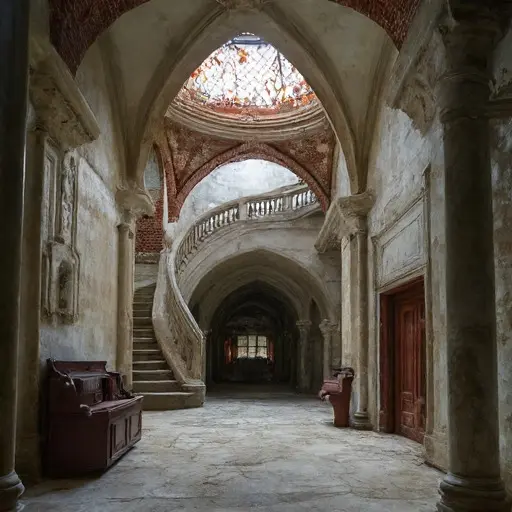
The surrounding estate remains as impressive as the mansion itself. Layered terraces of white limestone descend through the front garden, connected by winding herringbone brick walkways that disappear beneath moss and flowering plants. Overgrown hydrangeas spill across old borders, while foxgloves rise between cracked stones and ivy spreads over retaining walls that slowly vanish into the surrounding forest.
Among the trees stands a faded cream-painted cast-iron gazebo, its delicate framework softened by years of exposure. Once a place for quiet conversations and afternoon gatherings, it now rests beneath the canopy as a forgotten garden monument surrounded by ferns and moss.
Near the center of the grounds, a cracked circular reflecting pool edged with pink granite remains partially filled with rainwater and fallen leaves. Beside it lies a weathered green wooden rocking horse, its faded paint and worn surface suggesting generations of childhood memories now preserved in silence.
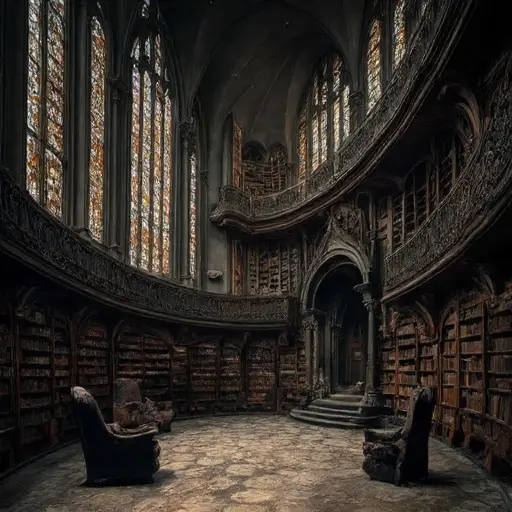
Inside, the manor reveals the same extraordinary attention to detail found throughout the exterior. Grand rooms feature carved wood paneling, elaborate stone fireplaces, patterned floors, and sweeping curved corridors that follow the unusual shape of the building. Every space reflects the wealth and imagination of the family who once inhabited the estate.
The semicircular library remains the heart of the home’s interior design. Its curved walls of stained glass overlook the overgrown terraces, casting faint colored reflections across abandoned bookshelves and worn furniture. Despite decades of neglect, the craftsmanship remains visible in every carved surface and architectural detail.
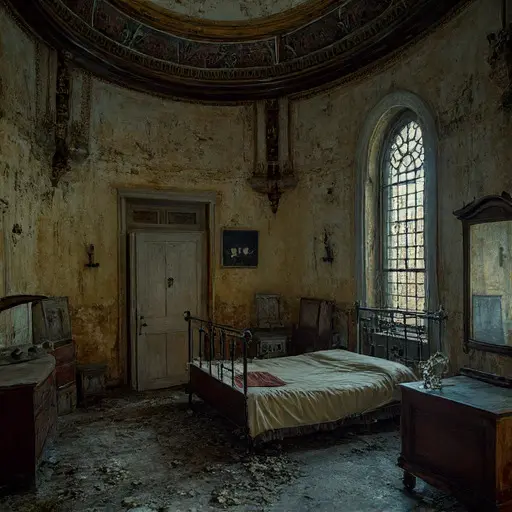
The upper floors preserve the quieter private spaces of the residence. The cylindrical tower rooms follow graceful curved walls, creating intimate chambers filled with aged woodwork, faded fabrics, and architectural details that remain remarkably intact. Dust settles across forgotten furnishings while the surrounding forest continues to press closer to the windows each year.
Today, the Marble and Oxblood Manor stands as a breathtaking relic of Victorian ambition and artistry. Its marble walls, colorful masonry, Gothic towers, stained-glass library, and flowing veranda continue to display a rare beauty shaped not by restoration, but by time itself.
Surrounded by forgotten gardens, ancient trees, and disappearing pathways, the mansion remains a hauntingly elegant reminder of an era when homes were built not only as places to live, but as enduring works of art meant to outlast generations.