The Lost Santoro Drafting Chest and the Line That Slipped
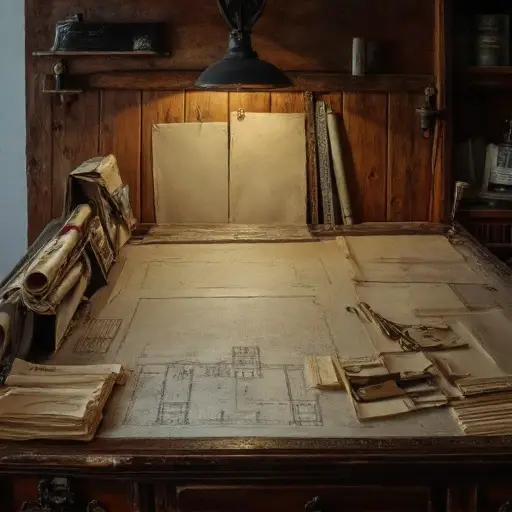
A hush settles over the Architect’s Studio, where every furnishing clings to patient order. The drafting chest’s upper surface holds a nearly complete façade sketch—columns sharp, entablature precise—but a single horizontal guideline stops short, faint as a breath swallowed too soon. A mahl stick leans at an angle that contradicts the room’s otherwise perfect alignment.
Even the compass on the side shelf stands open by a few extra millimeters, as if a once-certain hand hesitated on its final sweep. The space smells faintly of ink, vellum, and cooled metal.
The Measured Craft of Alessandro Vittorio Santoro, Architect
The room’s arrangement reveals Alessandro Vittorio Santoro, born 1873 in Florence, raised in academies that prized proportion and clarity. In the Pattern Alcove, Italian drafting labels and scale markers nest in small wooden drawers. A marble straightedge from Tuscany rests beside parchment tinted with ochre washes, remnants of elaborate façade studies. His temperament appears in these disciplined arrays: calm, methodical, quietly ambitious but never ostentatious.
He likely spent mornings refining elevations, afternoons drafting structural notes, evenings touching details with sable brushes. In the Side Parlor, several framed sketches depict Florentine arches, terracotta roofs, and coffered ceilings—each rendered with confident linework, suggesting a steady career shaped by precision’s comfort. A tea set with painted Tuscan motifs sits unused; dust gathers along the handles, as though he postponed rest too often.
Quiet Fractures Where His Confidence Faltered
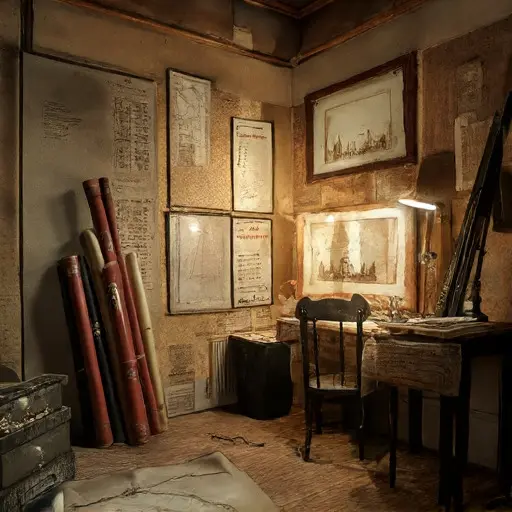
Subtle distress threads itself through adjoining rooms. In the Upper Resting Chamber, a folded letter bearing a Milan publisher’s crest lies unopened, edges curled by humidity—perhaps a rejection or request he could not meet. A travel coat slumps over a chair, pockets filled only with scale rulers and a broken lead holder. On the Guest Cot, an architectural treatise rests face-down, a bookmark displaced, the spine strained as if consulted urgently.
A chipped inkstone on the washstand reveals hurried work; droplets of diluted pigment trail toward the floor. These gentle disarrangements hint at a man unsettled, perhaps by criticism of a design, perhaps by tremors that crept into hands that once controlled every measured sweep.
Reading the Drafting Chest for His Last Decision
Returning to the Architect’s Studio, all unease gathers around the drafting chest’s surface. The façade drawing reveals a subtle misalignment where the central arch lists half a degree off-center. A brush lies bristle-down, its handle marked by a trembling smear of sienna. The compass’s loosened hinge suggests overuse or failing patience. Even the stack of vellum has shifted slightly, edges no longer flush.
Near the chest’s lower drawer, a paperweight shaped like a Tuscan lion stands askew. Beneath it rests a partial elevation where columns blur in uneven shading, the graphite pressure wavering. The studio’s quiet settles thickly, as though the very geometry has absorbed his uncertainty.
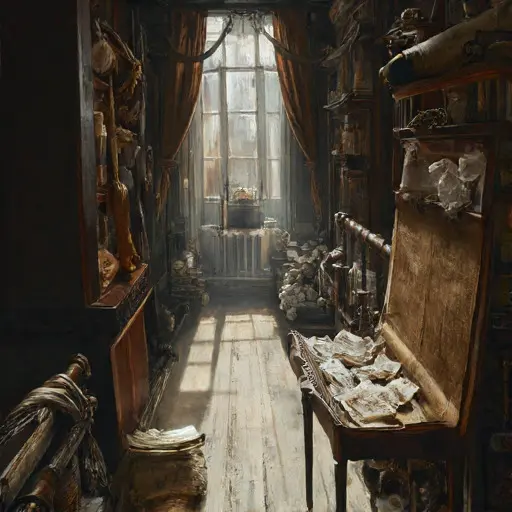
Behind the drafting chest, tucked between stacked vellum rolls, lies his final attempt: an elevation study where one cornice line falters, dipping just enough to betray a lost confidence. No note accompanies it—just the fading tension of a craftsman who shaped buildings from paper until the line itself resisted him.
The house answers nothing, and it remains abandoned still.
