The Lost Quintana Press Table and the Silence Behind Its Iron

A metallic hush lingers in the Press Room, where unfinished tins stand in quiet formation upon the iron table. A half-cut cylinder rests near the clamp, its seam rising like an unanswered question. The air tastes faintly of flux and old solder.
On the floor, a single strip of tin curls at one end, capturing the moment a craftsman’s gesture slipped from certainty into pause. Nothing is toppled, nothing in haste—but a deliberate stillness folds around the interrupted work, waiting for explanation that never comes.
The Workbound Days of Tomás Alejandro Quintana, Tinsmith
Evidence around these interiors recalls Tomás Alejandro Quintana, born 1872 in Córdoba, whose trade traveled with him in crates marked by worn Spanish script. In the Pattern Alcove, his cutouts for lantern panels remain sharply angled, suggesting disciplined morning routines. Tin snips lie sorted by jaw length, and a roll of embossed sheet—imported from Buenos Aires—rests beneath a padded mallet he used for rounding canisters. His temper seemed steady, shaped by repetitive craft: afternoons trimming edges flush, evenings burnishing seams until they shone.
In the Side Work Nook, a lidded container holds iron-red flux powder, its spoon angled neatly as if set down between tasks. A kettle he repaired sits on a small stove, bearing an immaculate seam. These rooms echo the quiet patience with which he measured, cut, and fitted each piece, confident in small accuracies that carried his modest livelihood.
Glimpses of Strain That Edged Into His Work
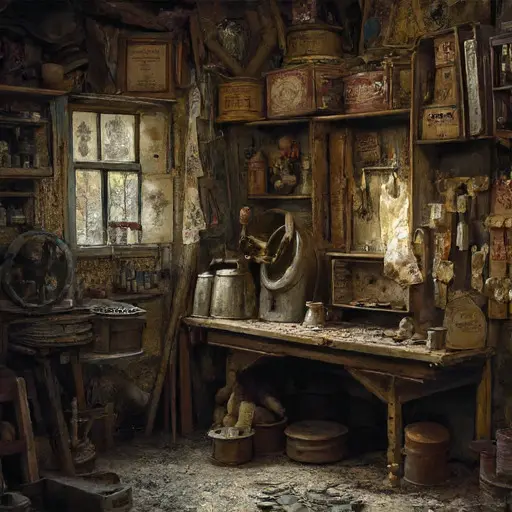
Subtle fractures mar the space. In the Upper Storage Drawer, a ruined batch of tin circles—warped from uneven heating—lies beside an unpaid invoice from a London importer. A folding rule is snapped cleanly at one joint, contradicting his methodical habits. The Guest Chamber reveals a travel coat draped across a chair, pockets weighed with solder sticks and marking chalk, but no other belongings prepared. A lantern frame on the bedside table sits edged but unsoldered, its panels misaligned as though his focus dipped unexpectedly.
The quiet downturn hints at encroaching difficulty: rising material costs, perhaps, or a commission denied after criticism of a faulty seam. His tools whisper of long evenings spent trying to correct mistakes he scarcely made before.
The Rivet That Marked His Final Hesitation
Back in the Press Room, everything circles the scattered rivet bowl. A few rivets roll near the table’s lip, glinting as if unsettled by a wavering hand. The half-shaped canister nearby bears a seam that bows inward—an error too slight for most to see but devastating for a tinsmith’s pride. Tin shavings cluster at the foot of the press table in an unfamiliar pattern, as though he shifted his stance repeatedly, uncertain of the next strike.
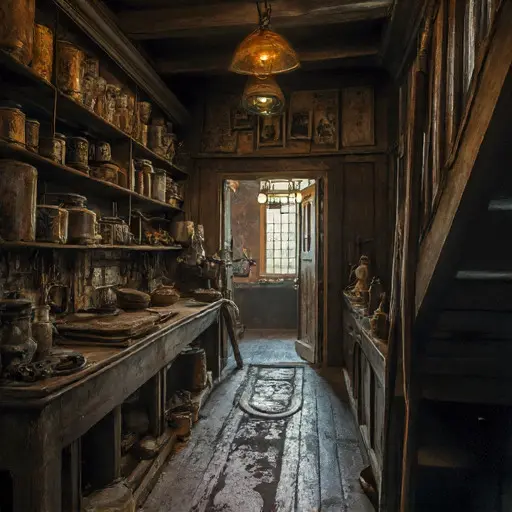
Beneath the press table, tucked beside a slanted support, lies his final attempt: a lantern panel whose embossed pattern begins confidently but ends in a faint, uneven line. The metal bears light scratches where certainty faltered. No note explains the pause—only the unspoken weight of a task abandoned at the threshold of completion.
The house withholds its reasons, and it remains abandoned still.
