The Lost Petrov Scullery Where the Measure Went Wrong

The first quiet in the scullery feels shaped by a broken measure—something once counted, then lost. The air folds around a scent of warm metal and lye, each corner hushed, held as if waiting for the craftsman’s next strike that never sounded. Nothing is overturned, yet every angle suggests hesitation suspended instead of resolved.
A Craftsman’s Rhythm Etched in Everyday Tools
Mikhail Ivanovich Petrov, born 1871 in Nizhny Novgorod, fashioned metal utensils for travelers and boarding houses. A patchworked towel from his sister Dariya hangs from a rack, frayed but cherished. Mikhail worked in strict sequences: evening annealing, dawn shaping, midday polishing near the sinks. His modest background glimmers in battered molds reused well past their prime, and in the careful alignment of tin ingots beneath the narrow table.
Domestic Corners Turned Toward Aspiration
Stacks of Russian-language order slips sit beneath a colander, noting commissions from local kitchens. A half-raised copper ladle, its curve impeccable, rests beside chalk marks tracking thickness. An imported brass ingot—rare, expensive—lies wrapped in linen, suggesting hopes of finer wares and larger buyers. Yet a second ladle beside it shows uneven strokes, a lapse uncharacteristic for Mikhail’s steady hand.

Pressures Rising at the Edges of Craft
Behind the largest sink lies a returned commission slip alleging “improper gauge.” A tin spoon bearing a ripple along its bowl rests atop folded burlap, as though Mikhail tried to disguise its flaw. The apron hooks stand subtly skewed, hinting at pacing—slow, deliberate, resigned. A brass mallet on the table still bears a smear of soot, wiped only halfway.
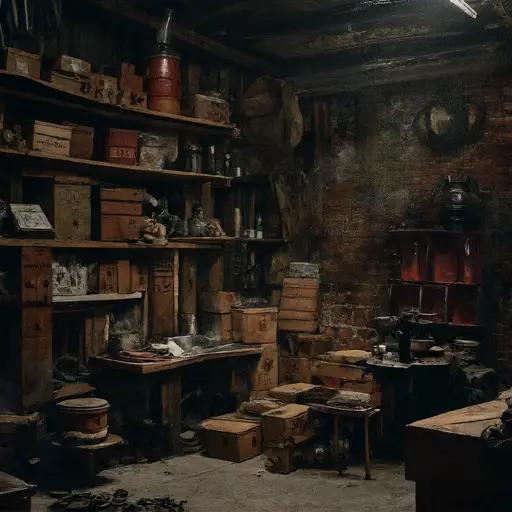
Returning to the scullery, the final clue remains: Mikhail’s measuring caliper resting open beside the perfect ladle and its flawed twin—one exact, one doubtful—marking the instant his resolve faltered and left the room waiting.
The house remains abandoned.
